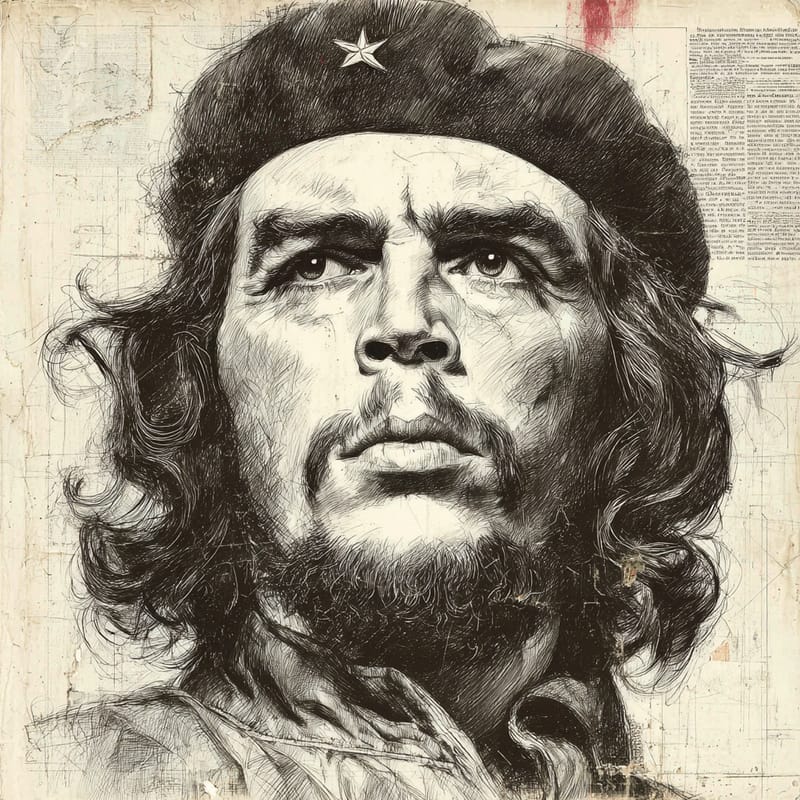
Che Guevara
The guerrilla internationalist
World revolution and the 'new man'.
Reformist Leninist-MarxistOne of 729 ideologies · enter the Leninist-Marxist hall →- Role
- Revolutionary
- Era
- 1928–1967
- Region
- Argentina / Cuba
- Social band
- Reformist
- Placement
- −98 · +70 · +45
§ Where Che Guevara stands
3 axesGuevara wanted capitalism abolished outright. As minister of industries from 1961 he championed a centralised budgetary finance system in which state enterprises were funded and directed from the centre, and in the Great Debate of 1963–64 he argued for moral rather than material incentives, rejecting the limited market mechanisms used in the Soviet bloc as a road back to capitalism.
Guevara believed a small armed vanguard could create the conditions for revolution, the foco theory set out in Guerrilla Warfare (1960), and he sought to export it across the Third World. In power he presided over the La Cabaña tribunals in 1959 and set up the Guanahacabibes labour camp for officials guilty of offences against revolutionary morality.
Guevara's vision was a radical remaking of human beings rather than a defence of custom. His 1965 essay Socialism and Man in Cuba called for a new man freed from bourgeois individualism, and his 1967 message to the Tricontinental, urging many Vietnams, scorned national borders. His progressivism was revolutionary rather than liberal, leaving little room for personal or cultural dissent.
How close are you to Che Guevara?
Three statements, one per axis. Answer them and we’ll drop you on the compass next to them.
§ The story
HistoricalErnesto 'Che' Guevara (1928–1967) was an Argentine-born Marxist revolutionary. Trained as a doctor in Buenos Aires, he travelled across Latin America, and in Guatemala in 1954 witnessed the CIA-backed overthrow of President Jacobo Árbenz, which convinced him that change required armed struggle. In Mexico he joined Fidel Castro's exiles, landed with them in Cuba in 1956 and rose to the rank of comandante, winning the decisive Battle of Santa Clara in December 1958.
After the revolution Guevara oversaw revolutionary tribunals and executions at La Cabaña fortress, then ran the National Bank and the Ministry of Industries, pursuing rapid industrialisation and moral incentives that faltered. He left Cuba in 1965 to spread revolution abroad, failed in the Congo, and was captured and executed by the Bolivian army in October 1967, with the CIA assisting the hunt. Alberto Korda's photograph made him a global icon of rebellion; to his critics and many Cuban exiles he remains a symbol of revolutionary violence.
Notable for
- 01Cuban Revolution commander
- 02'Guerrilla Warfare'
- 03Global revolutionary icon
Key works & moments
- 1954Witnesses the CIA-backed coup against Guatemala's elected president Jacobo Árbenz.
- 1956Lands in Cuba aboard the Granma with Fidel Castro's rebel force.
- 1958Captures Santa Clara in December; Batista flees Cuba within days.
- 1960Publishes Guerrilla Warfare, setting out the foco theory of armed revolution.
- 1965Publishes Socialism and Man in Cuba, then leaves Cuba to fight in the Congo.
- 1967Captured by the Bolivian army and executed at La Higuera on 9 October.
In their own words
“At the risk of seeming ridiculous, let me say that the true revolutionary is guided by great feelings of love.”
§ Minds closest to Che Guevara
All minds →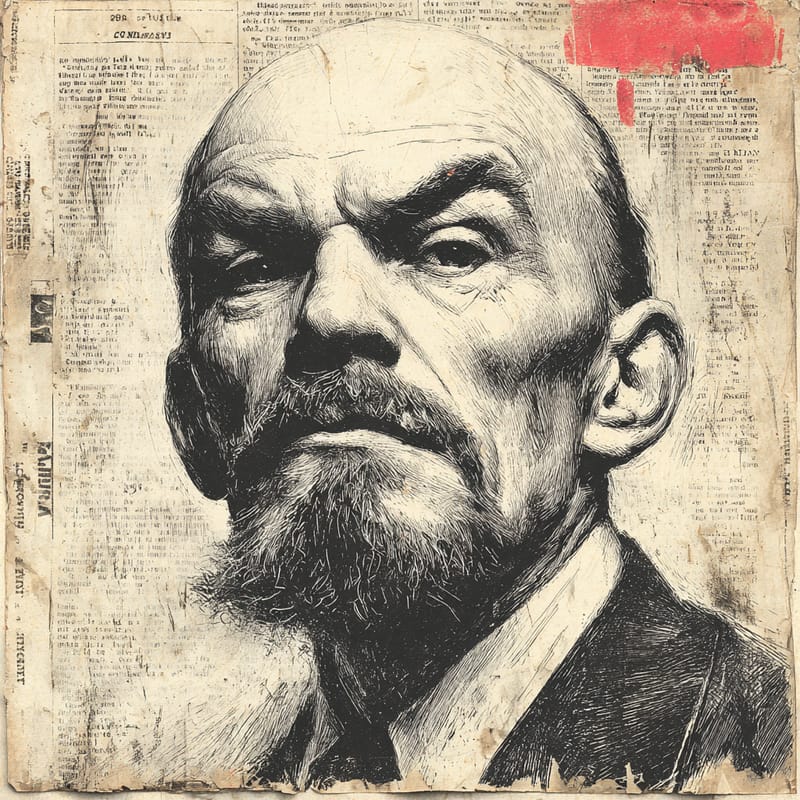

§ Also in the Leninist-Marxist hall
Enter the hall →§ Common questions
4 answersWhat was Che Guevara's political ideology?
Che Guevara was a Marxist-Leninist revolutionary and a theorist of guerrilla warfare: on the 99ideologies three-axis compass, a Reformist Leninist-Marxist. Economically he stood at the far left (−98), seeking to abolish private capital and run the economy through central planning and moral incentives. On governance he was strongly authoritarian (+70), backing armed vanguards and revolutionary tribunals. Socially he was progressive (+45), dreaming of a new socialist man free of bourgeois values.
Was Che Guevara left-wing or right-wing?
Left-wing, on the revolutionary far left. Guevara was a committed communist who helped turn Cuba into a one-party socialist state and tried to spark similar revolutions in Africa and Latin America. He even criticised the Soviet bloc, most openly in his 1965 Algiers speech, for trading with poor countries on capitalist terms. His authoritarian methods and use of executions set him apart from democratic socialists, who share his economic aims but not his means.
Why is Che Guevara controversial?
Because he is remembered both as an icon and as an executioner. Admirers see an idealist who gave up comfort and power to fight imperialism and died for his beliefs, and Alberto Korda's 1960 photograph made his face a worldwide emblem of rebellion. Critics point out that in 1959 he oversaw revolutionary tribunals and executions at La Cabaña prison, defended firing squads before the United Nations in 1964, and championed armed revolution that brought violence to several countries.
Which minds are closest to Che Guevara?
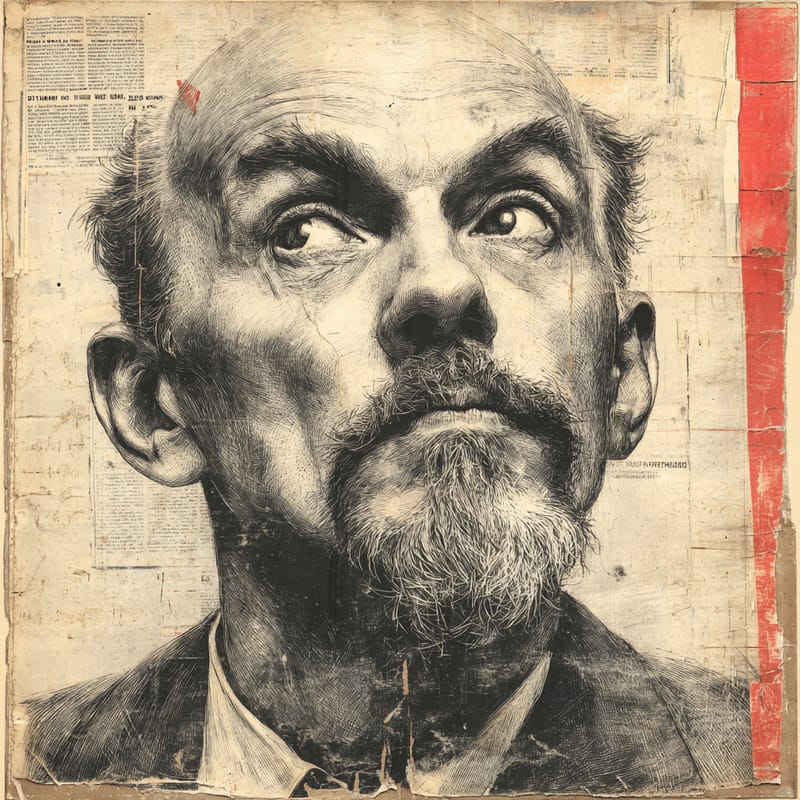
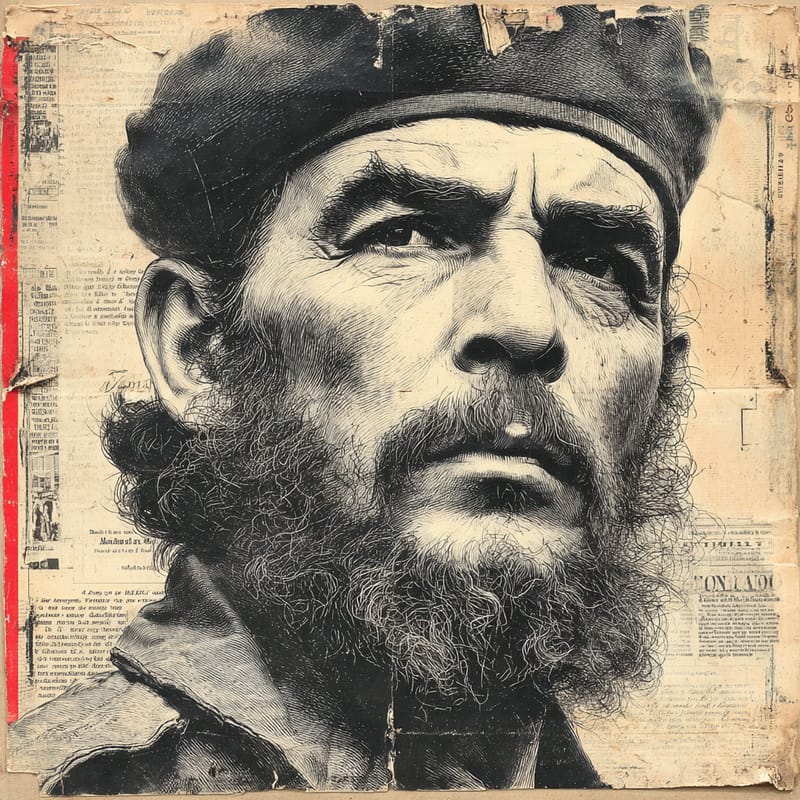
On the 99ideologies three-axis compass, the minds closest to Che Guevara are Vladimir Lenin (96% alike), Nikolai Bukharin (95% alike) and Fidel Castro (94% alike). The furthest is Hans-Hermann Hoppe (0% alike).