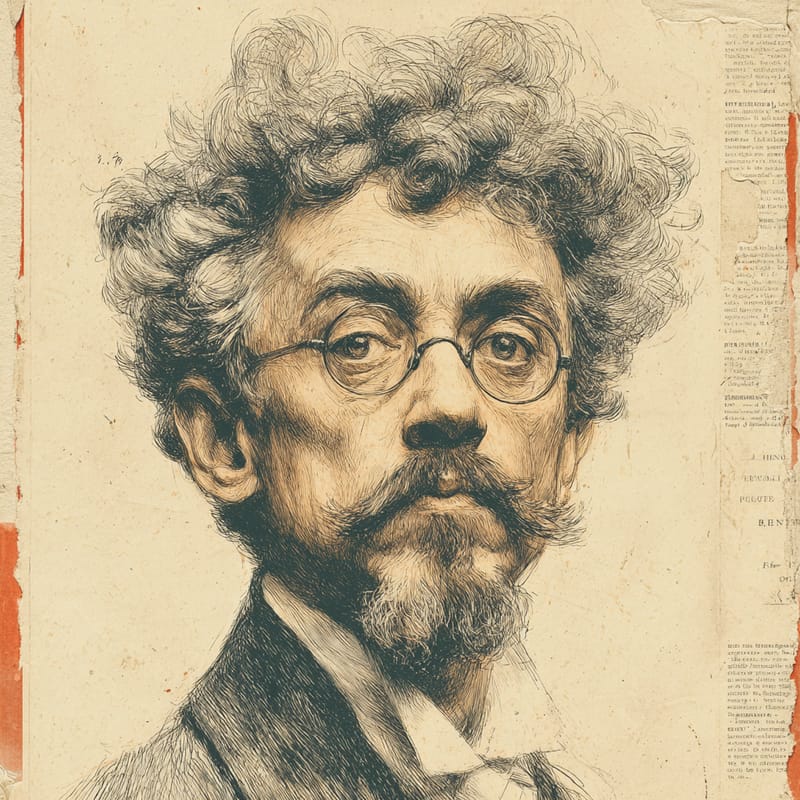
Karl Radek
The Schlageter line
Communism courting nationalism.
National BolshevikOne of 729 ideologies · enter the National Bolshevik hall →- Role
- Bolshevik
- Era
- 1885–1939
- Region
- Russia / Germany
- Social band
- Centre (no modifier)
- Placement
- −80 · +86 · −10
§ Where Karl Radek stands
3 axesRadek held orthodox Bolshevik economics throughout his career: the abolition of private ownership of industry and land, and planning under a workers' state. In the Left Opposition from 1923 he backed faster industrialisation, and after recanting in 1929 he became a public champion of Stalin's First Five-Year Plan.
Radek served the one-party state as propagandist and strategist. He helped lead the Comintern's 1920 Congress of the Peoples of the East at Baku, and in the 1930s wrote fulsome tributes to Stalin as a leading journalist at Izvestia. His approach to German nationalists in 1923 was a tactic for spreading Soviet-style revolution, not a step toward pluralism.
Personally Radek was a cosmopolitan internationalist, a Polish-Jewish journalist at home in several languages and famous for his political jokes. The nationalist note in his record comes from the Schlageter speech of June 1923, which honoured a nationalist saboteur executed by the French and appealed to German patriotism against the Versailles order, a tactical concession to national sentiment that the Comintern soon abandoned.
How close are you to Karl Radek?
Three statements, one per axis. Answer them and we’ll drop you on the compass next to them.
§ The story
HistoricalKarl Radek (1885–1939), born Karol Sobelsohn in Lemberg in Austrian Galicia, was a Marxist journalist and Bolshevik who became a leading figure of the Communist International. Active in the Polish and German socialist movements before 1914, he joined Lenin's circle during the war, crossed Germany with him in the sealed train of 1917, and attended the founding congress of the German Communist Party as the Bolsheviks' envoy. Jailed in Berlin in 1919, he returned to Moscow to become the Comintern's chief expert on Germany.
Radek's name is tied to the Schlageter line of 1923, when he urged German communists to win over nationalists angered by the French occupation of the Ruhr, a tactic later cited as an early example of red-brown convergence. After the failed German uprising that autumn he sided with Trotsky's Left Opposition, was expelled from the party in 1927 and exiled to Siberia, then recanted and became a prominent Stalinist journalist. Arrested in 1936, he confessed at the second Moscow show trial in January 1937, received ten years and was killed in prison in 1939.
Notable for
- 01The 1923 'Schlageter line'
- 02Comintern propagandist
- 03Perished in Stalin's purges
Key works & moments
- 1917Crosses Germany with Lenin in the sealed train, then works for the Bolsheviks in Stockholm.
- 1920Joins the leadership of the Communist International and speaks at the Baku Congress of the Peoples of the East.
- 1923Delivers his Schlageter speech to the Comintern executive on 20 June, courting German nationalists.
- 1927Expelled from the party as a Trotskyist and exiled to Siberia.
- 1937Confesses at the second Moscow show trial and is sentenced to ten years.
- 1939Killed in a Soviet prison, reportedly on the orders of the NKVD.
§ Minds closest to Karl Radek
All minds →

§ Also in the National Bolshevik hall
Enter the hall →§ Common questions
4 answersWhat was Karl Radek's political ideology?
Karl Radek was a Bolshevik Marxist and Comintern strategist, remembered above all for briefly courting German nationalists: on the 99ideologies three-axis compass, a National Bolshevik. Economically he was firmly collectivist (−80), committed to abolishing private ownership. On governance he was strongly authoritarian (+86), a lifelong servant of the one-party state. Socially he sits slightly toward tradition (−10), reflecting the nationalist appeals of his 1923 Schlageter speech rather than any personal conservatism.
Was Karl Radek left-wing or right-wing?
Left-wing. Radek was a revolutionary Marxist from his youth, a close associate of Lenin and Trotsky, and a leader of the Communist International. His 1923 overture to German nationalists was a tactical attempt to draw them toward communism and away from the Versailles powers, not an embrace of right-wing ideas, and it ended within months. His death in Stalin's terror was a fate shared with much of the Bolshevik old guard.
What was the Schlageter line?
It was a short-lived Comintern tactic of appealing to German nationalists in 1923. On 20 June that year Radek told the Comintern executive that Albert Leo Schlageter, a Freikorps veteran executed by the French for sabotage during the occupation of the Ruhr, deserved respect as a brave soldier of the counter-revolution, and urged nationalists to join the workers against Entente capitalism. Communists and nationalists debated publicly that summer, but the line collapsed after the failed German uprising of October 1923.
Which minds are closest to Karl Radek?
On the 99ideologies three-axis compass, the minds closest to Karl Radek are The Red-Brown Front (archetype) (95% alike), Leonid Brezhnev (95% alike) and O'Brien (94% alike). The furthest is Hans-Hermann Hoppe (0% alike).