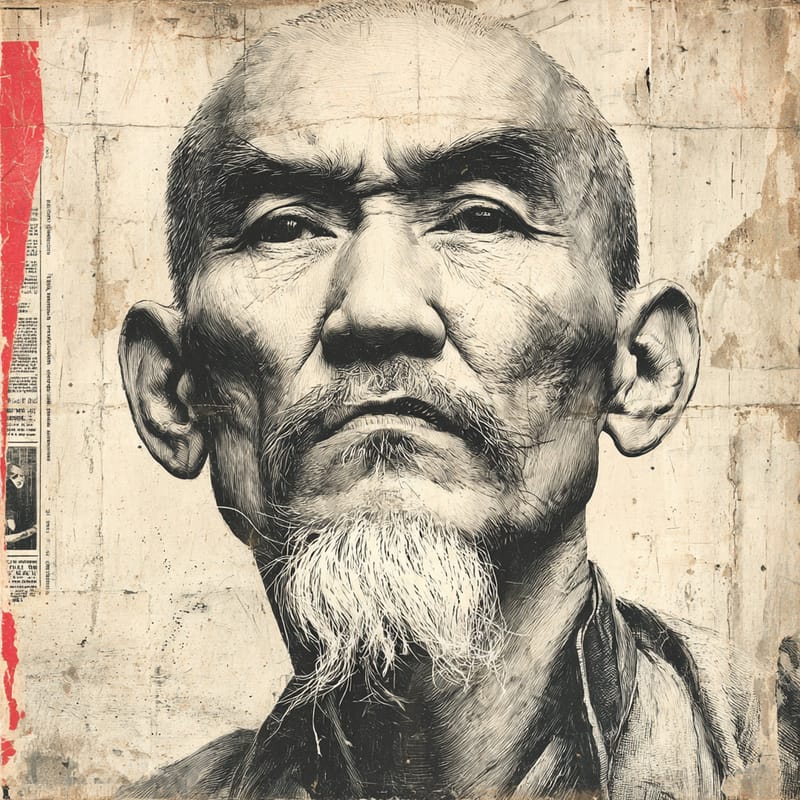
Ho Chi Minh
Independence and communism
National liberation fused with Marxism-Leninism.
Heterodox Leninist-MarxistOne of 729 ideologies · enter the Leninist-Marxist hall →- Role
- Revolutionary & head of state
- Era
- 1890–1969
- Region
- Vietnam
- Social band
- Heterodox
- Placement
- −92 · +72 · +20
§ Where Ho Chi Minh stands
3 axesHo's state followed the Soviet and Chinese model. The land reform campaign of 1953–56 confiscated landlords' holdings and redistributed them through denunciation tribunals, and a three-year plan for socialist transformation launched in 1958 collectivised North Vietnamese agriculture into cooperatives and brought industry and commerce under state control, ending private enterprise of any size.
Ho built a one-party state through decades of revolutionary war. The Viet Minh eliminated rival nationalists and Trotskyists after 1945, the Workers' Party monopolised power in the North, and the Nhan Van–Giai Pham affair of 1956–58 ended with writers who had demanded artistic freedom silenced, sent to labour camps or imprisoned. His personal style was modest, but the system he founded tolerated no opposition.
Ho fused communist modernism with appeals to Vietnamese tradition and patriotism. His government launched a mass literacy campaign in September 1945 using the romanised quoc ngu script, and the 1946 constitution declared women equal to men. Yet he cultivated the austere, paternal image of Uncle Ho and framed the revolution as national liberation rather than a break with Vietnamese identity.
How close are you to Ho Chi Minh?
Three statements, one per axis. Answer them and we’ll drop you on the compass next to them.
§ The story
HistoricalHo Chi Minh (1890–1969), born Nguyen Sinh Cung in central Vietnam, founded the communist movement that won Vietnam's independence. He left French Indochina in 1911 as a ship's kitchen hand, worked his way around the world, and in Paris, as Nguyen Ai Quoc, petitioned the 1919 Versailles conference for Vietnamese rights. A founding member of the French Communist Party in 1920 and later a Comintern agent, he founded the Vietnamese communist party in 1930 and the Viet Minh front in 1941.
On 2 September 1945 Ho proclaimed the Democratic Republic of Vietnam in Hanoi, quoting the American Declaration of Independence. He then led the eight-year war that ended French rule at Dien Bien Phu in 1954 and, as president of North Vietnam, the struggle to reunify the country against the US-backed South. His rule also brought a brutal land reform in 1953–56, in which thousands were executed, and a crackdown on dissident intellectuals. Revered as Uncle Ho, he died in 1969; Saigon was renamed Ho Chi Minh City in 1976.
Notable for
- 01Founded the Democratic Republic of Vietnam
- 02Led anti-colonial liberation
- 03Declared Vietnamese independence, 1945
Key works & moments
- 1919As Nguyen Ai Quoc, petitions the Versailles peace conference for Vietnamese rights.
- 1920Joins the founders of the French Communist Party at the Congress of Tours.
- 1930Unites rival groups into a Vietnamese communist party in Hong Kong, soon renamed the Indochinese Communist Party.
- 1941Returns to Vietnam after three decades abroad and founds the Viet Minh independence front.
- 1945Proclaims the Democratic Republic of Vietnam in Hanoi's Ba Dinh Square on 2 September.
- 1954Viet Minh victory at Dien Bien Phu ends French rule; the Geneva Accords divide Vietnam.
In their own words
“Nothing is more precious than independence and freedom.”
§ Minds closest to Ho Chi Minh
All minds →

§ Also in the Leninist-Marxist hall
Enter the hall →§ Common questions
4 answersWhat was Ho Chi Minh's political ideology?
Ho Chi Minh was a Marxist-Leninist and a Vietnamese nationalist: on the 99ideologies three-axis compass, a Heterodox Leninist-Marxist. Economically he stood far to the left (−92), redistributing land and collectivising farms and industry under party control. On governance he was strongly authoritarian (+72), founding a one-party state forged in revolutionary war. Socially he leaned mildly progressive (+20), pairing literacy drives and legal equality for women with appeals to tradition and nation.
Was Ho Chi Minh left-wing or right-wing?
Left-wing. Ho was a lifelong communist, trained by the Comintern in Moscow, who built a socialist state in North Vietnam allied with the Soviet Union and China. His appeal rested heavily on anti-colonial nationalism, which led some Western observers to see him as a nationalist first, but his economic programme of land reform, collectivisation and nationalisation, and his single-party rule, place him firmly in the Marxist-Leninist camp.
Was Ho Chi Minh a nationalist or a communist?
Both, and he saw no contradiction. Ho came to communism through anti-colonialism: in his 1960 essay The Path Which Led Me to Leninism he recalled that reading Lenin's theses on the national and colonial questions in 1920 won him over, because they promised support to colonised peoples. He spent decades as a Comintern agent and built a Marxist-Leninist state, yet he framed his struggle as national liberation, opening his 1945 declaration with words from the American Declaration of Independence.
Which minds are closest to Ho Chi Minh?
On the 99ideologies three-axis compass, the minds closest to Ho Chi Minh are Josip Broz Tito (96% alike), Fidel Castro (96% alike) and Nikolai Bukharin (94% alike). The furthest is Hans-Hermann Hoppe (0% alike).