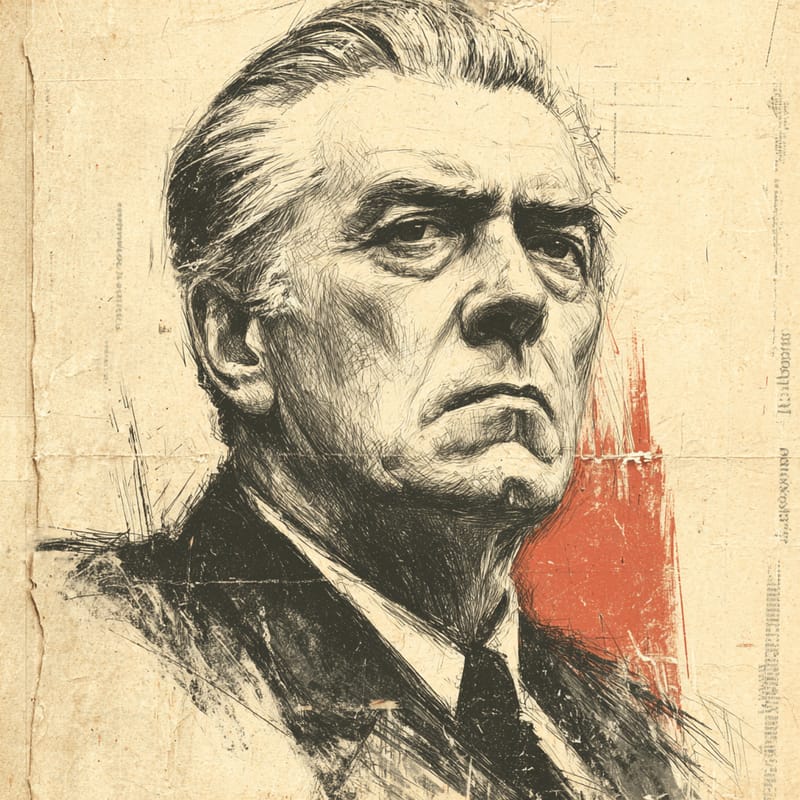
Enver Hoxha
The hermit dictator
Total isolation and ideological purity.
Leninist-MarxistOne of 729 ideologies · enter the Leninist-Marxist hall →- Role
- Head of state
- Era
- 1908–1985
- Region
- Albania
- Social band
- Centre (no modifier)
- Placement
- −96 · +85 · −5
§ Where Enver Hoxha stands
3 axesHoxha imposed total state ownership. Industry and land were nationalised in the 1940s and agriculture was fully collectivised by the late 1960s. The 1976 constitution went further than any in the Soviet bloc by barring the state from taking foreign loans or credits, sealing Albania inside one of the most closed command economies in the world.
Hoxha's rule was among the harshest in the communist world. Rivals such as Koçi Xoxe, executed in 1949, were purged, and his long-serving prime minister Mehmet Shehu died in 1981 in what was officially called suicide. The Sigurimi watched the population, political prisoners were sent to camps such as Spaç, and attempting to flee the country was treated as treason.
Hoxha's social record pulls in opposite directions. In 1967 he declared Albania the world's first atheist state, closing every mosque and church and campaigning against clan custom and the subordination of women. Yet the regime was also culturally puritanical and nationalist, purging liberal artists after the 1972 song festival and banning Western music, fashions and long hair.
How close are you to Enver Hoxha?
Three statements, one per axis. Answer them and we’ll drop you on the compass next to them.
§ The story
HistoricalEnver Hoxha (1908–1985) ruled communist Albania for four decades. Born in Gjirokastër in the south, he studied in France on a state scholarship that he later lost, worked briefly at the Albanian consulate in Brussels and taught French in Korçë before the Italian invasion of 1939. In November 1941 he became leader of the newly founded Albanian Communist Party, led its partisans against Italian and German occupation, and in 1944 took power as head of government and party chief.
Hoxha built one of the most isolated and repressive states in Europe. He broke in turn with Yugoslavia in 1948, the Soviet Union in 1961 and China in 1978, each time accusing his former patrons of revisionism, until Albania had virtually no allies. The Sigurimi secret police filled prisons and labour camps, religion was banned outright in 1967, and more than 170,000 concrete bunkers were built against invasions that never came. His regime collapsed in 1991–92, a few years after his death.
Notable for
- 01Four decades of isolated rule
- 02Declared an atheist state
- 03Broke with the USSR and China
Key works & moments
- 1941Becomes leader of the newly founded Albanian Communist Party in occupied Tirana.
- 1944Takes power as the partisans drive out the last German forces in November.
- 1961Breaks with Khrushchev's Soviet Union and aligns Albania with Mao's China.
- 1967Proclaims Albania the world's first atheist state, closing every mosque and church.
- 1978China cuts off aid; Hoxha attacks Mao's Three Worlds theory in Imperialism and the Revolution.
- 1985Dies in April; Ramiz Alia succeeds him as party leader.
§ Minds closest to Enver Hoxha
All minds →

§ Also in the Leninist-Marxist hall
Enter the hall →§ Common questions
4 answersWhat was Enver Hoxha's political ideology?
Enver Hoxha was a hardline Stalinist, the founder of what admirers call Hoxhaism or anti-revisionist Marxism-Leninism: on the 99ideologies three-axis compass, a Leninist-Marxist. Economically he sat at the far left (−96), with total state ownership and a sealed command economy. On governance he was extremely authoritarian (+85), ruling through purges and secret police. Socially he sat just on the traditional side of the centre (−5), combining militant state atheism with puritanical nationalism.
Was Enver Hoxha left-wing or right-wing?
Left-wing, in its most orthodox form. Hoxha regarded both the Soviet Union after Stalin and China after Mao as betrayers of Marxism-Leninism, and he defended Stalin's legacy to the end of his life, publishing the memoir With Stalin in 1979. His fierce nationalism, isolation and cultural puritanism have led some observers to compare his regime with right-wing dictatorships, but its economic system and ideology were unmistakably communist.
Why did Enver Hoxha ban religion?
Because he saw religion as a rival loyalty and an obstacle to building a unified socialist nation. Albania was divided between Sunni Muslims, Bektashis, Orthodox Christians and Catholics, and Hoxha embraced the old nationalist idea that the true faith of Albanians is Albanianism. Inspired partly by China's Cultural Revolution, a campaign launched in 1967 closed or converted all of the country's places of worship, clergy were imprisoned or killed, and the 1976 constitution formally banned religious activity.
Which minds are closest to Enver Hoxha?
On the 99ideologies three-axis compass, the minds closest to Enver Hoxha are O'Brien (97% alike), Leonid Brezhnev (97% alike) and Nicolae Ceaușescu (95% alike). The furthest is Hans-Hermann Hoppe (0% alike).