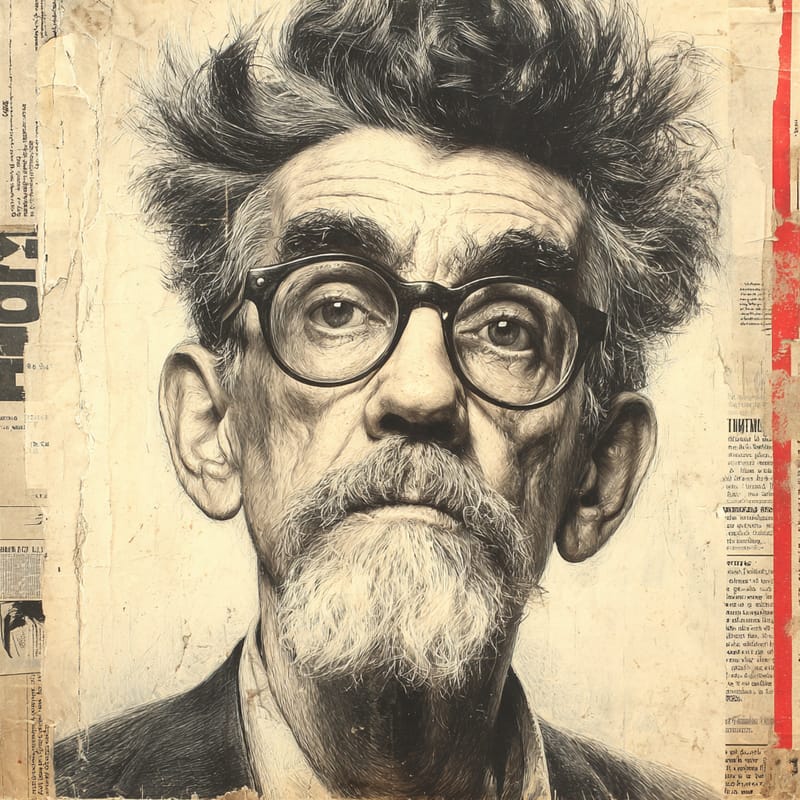
Antonio Gramsci
Cultural hegemony
Revolution in the realm of ideas.
Reformist Leninist-MarxistOne of 729 ideologies · enter the Leninist-Marxist hall →- Role
- Theorist & politician
- Era
- 1891–1937
- Region
- Italy
- Social band
- Reformist
- Placement
- −88 · +65 · +60
§ Where Antonio Gramsci stands
3 axesGramsci was a revolutionary communist who wanted the means of production taken out of private hands; the factory councils he championed in L'Ordine Nuovo in 1919–20 were meant to become the cells of a workers' state that would run industry. His originality lay elsewhere: he insisted that economics alone would not bring revolution and rejected the determinism that expected capitalism simply to collapse.
Gramsci accepted Lenin's model of a disciplined revolutionary party and the dictatorship of the proletariat, and as party leader he steered the 1926 Lyon Congress toward the Comintern line against Amadeo Bordiga's left. Yet his prison writings cast the party as a modern Prince that must win consent before taking power, a war of position fought in civil society rather than only a frontal assault on the state.
On cultural questions Gramsci was a progressive moderniser. His unfinished 1926 essay on the Southern Question called for an alliance between northern workers and the southern peasantry, and the Prison Notebooks demanded an intellectual and moral reform that would free ordinary people from the deference and religious common sense he saw as props of the existing order.
How close are you to Antonio Gramsci?
Three statements, one per axis. Answer them and we’ll drop you on the compass next to them.
§ The story
HistoricalAntonio Gramsci (1891–1937) was an Italian Marxist theorist and politician. Born into a poor family in Sardinia, he won a scholarship to the University of Turin in 1911, joined the Socialist Party and became a journalist. In 1919 he co-founded the weekly L'Ordine Nuovo, which championed the Turin factory councils, and in 1921 he helped launch the Communist Party of Italy. Elected to parliament in 1924, he became the party's leader, but in 1926 Mussolini's regime arrested him despite his parliamentary immunity.
Sentenced to more than twenty years, Gramsci filled some thirty notebooks in prison despite failing health, and died in a Rome clinic in April 1937, days after regaining his formal freedom. Smuggled out and published after 1945, the Prison Notebooks argued that ruling classes govern less by force than by hegemony, the consent manufactured through schools, churches, newspapers and common sense. His ideas shaped the post-war Italian Communist Party, Eurocommunism, cultural studies and postcolonial theory, were borrowed by the French New Right, and later made him a stock villain of conspiracy theories about cultural Marxism.
Notable for
- 01'Prison Notebooks'
- 02Theory of cultural hegemony
- 03Co-founded the Italian Communist Party
Key works & moments
- 1917Hails the Bolshevik seizure of power in his article The Revolution Against Capital.
- 1919Co-founds L'Ordine Nuovo in Turin, backing the factory councils of the Biennio Rosso.
- 1921Helps found the Communist Party of Italy after the split from the Socialists at Livorno.
- 1924Elected to parliament and becomes party leader; launches the newspaper L'Unità.
- 1926Arrested on 8 November under Mussolini's emergency laws, despite his parliamentary immunity.
- 1929–35Writes the Prison Notebooks, developing his theories of hegemony, intellectuals and the war of position.
In their own words
“The crisis consists precisely in the fact that the old is dying and the new cannot be born; in this interregnum a great variety of morbid symptoms appear.”
§ Minds closest to Antonio Gramsci
All minds →

§ Also in the Leninist-Marxist hall
Enter the hall →§ Common questions
4 answersWhat was Antonio Gramsci's political ideology?
Antonio Gramsci was a Marxist and a Leninist communist: on the 99ideologies three-axis compass, a Reformist Leninist-Marxist. Economically he stood on the far left (−88), seeking the abolition of capitalist ownership through workers' councils and a socialist state. On governance he leaned clearly authoritarian (+65), loyal to the vanguard party and the Comintern, though he stressed winning consent over coercion. Socially he was progressive (+60), a moderniser who saw education and culture as the ground on which power is won.
Was Antonio Gramsci left-wing or right-wing?
Left-wing, firmly. Gramsci co-founded the Communist Party of Italy, led it against Mussolini and spent his last decade in Fascist custody. Where he differed from many communists was in method rather than goal: he argued that in Western societies the left had to win a long war of position for cultural leadership before it could take state power. That emphasis made him a hero to the democratic and academic left, and some right-wing movements later borrowed his strategy.
What did Gramsci mean by cultural hegemony?
Hegemony is Gramsci's term for how a ruling class keeps power through consent as well as force. In the Prison Notebooks he argued that capitalism survived in the West because its values were spread through schools, churches, newspapers and everyday common sense until they seemed natural. The answer, he wrote, was for the working class to build its own counter-hegemony, led by organic intellectuals rooted in their class, before attempting to take the state.
Which minds are closest to Antonio Gramsci?
On the 99ideologies three-axis compass, the minds closest to Antonio Gramsci are Michel Pablo (95% alike), Leon Trotsky (94% alike) and Tony Cliff (94% alike). The furthest is Hans-Hermann Hoppe (0% alike).