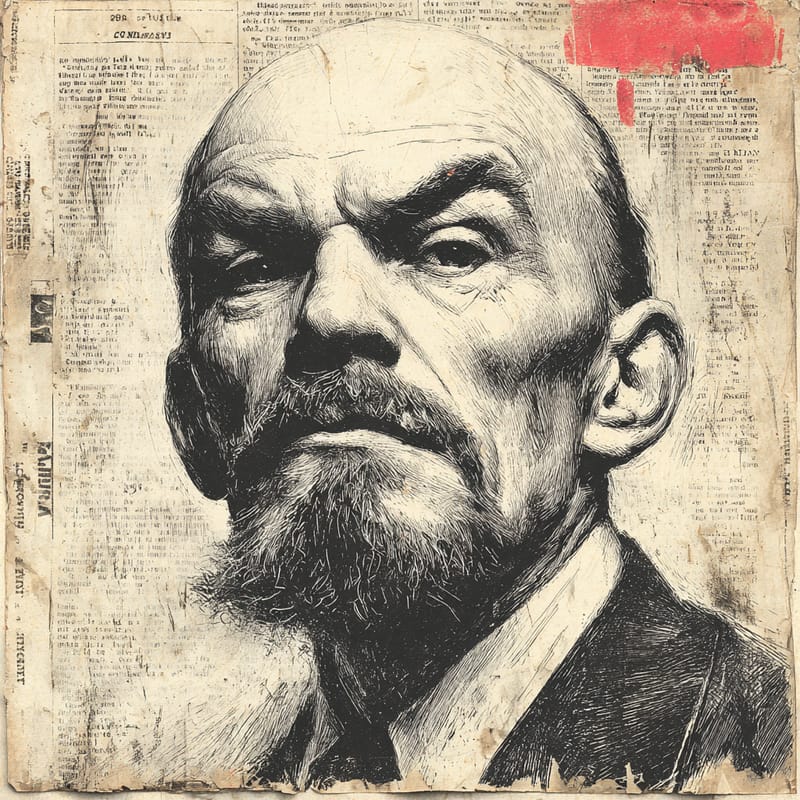
Vladimir Lenin
The vanguard party
Revolution led by a disciplined revolutionary elite.
Reformist Leninist-MarxistOne of 729 ideologies · enter the Leninist-Marxist hall →- Role
- Revolutionary & head of state
- Era
- 1870–1924
- Region
- Russia
- Social band
- Reformist
- Placement
- −95 · +78 · +50
§ Where Vladimir Lenin stands
3 axesLenin set out to abolish capitalism: the 1917 Decree on Land abolished private landownership, the banks were nationalised that December and large industry in June 1918, and War Communism requisitioned grain from the peasants. When that provoked revolt and famine he retreated to the New Economic Policy of 1921, permitting small private trade and farming while the state kept the commanding heights.
Lenin built the twentieth century's first one-party state. In What Is to Be Done? (1902) he argued for a vanguard of professional revolutionaries, and in power he created the Cheka in December 1917, dispersed the Constituent Assembly in January 1918 after his party lost the vote, declared the Red Terror that September and banned factions within the party in 1921.
Socially the early Soviet state was militantly modernising. A January 1918 decree separated church from state and opened a campaign against the Orthodox Church, divorce was made simple, Soviet Russia legalised abortion in 1920, and a mass literacy drive began. Lenin's aim was revolutionary transformation rather than personal freedom, but the break with tradition was radical.
How close are you to Vladimir Lenin?
Three statements, one per axis. Answer them and we’ll drop you on the compass next to them.
§ The story
HistoricalVladimir Ilyich Lenin, born Ulyanov (1870–1924), was the Russian revolutionary who founded the Bolshevik party and the Soviet state. Radicalised after his elder brother Alexander was hanged in 1887 for plotting against Tsar Alexander III, he trained as a lawyer, was exiled to Siberia in 1897 and spent most of 1900–1917 abroad. After the tsar fell he returned to Petrograd in April 1917, led the October seizure of power and chaired the Council of People's Commissars until his death.
Lenin's legacy is the model of a disciplined vanguard party ruling in the name of the working class, copied from China to Cuba. His government took Russia out of the First World War, won the civil war of 1918–21 and created the Soviet Union in 1922, but it also dissolved the elected Constituent Assembly, founded the Cheka secret police and unleashed the Red Terror. Admirers credit him with the first socialist state; critics argue that the one-party dictatorship he built made Stalinism possible. His embalmed body lies in a mausoleum on Red Square.
Notable for
- 01Led the October Revolution, 1917
- 02Founded the Soviet state
- 03'What Is to Be Done?' and vanguard theory
Key works & moments
- 1902Publishes What Is to Be Done?, arguing for a vanguard party of professional revolutionaries.
- 1903The Russian Social Democrats split at their Second Congress; Lenin leads the Bolshevik faction.
- 1917Returns to Petrograd in April with his April Theses; the Bolsheviks seize power in October.
- 1918Disperses the Constituent Assembly and accepts the Treaty of Brest-Litovsk, ending Russia's war with Germany.
- 1921Replaces War Communism with the New Economic Policy after the Kronstadt rebellion.
- 1922–23Weakened by strokes, dictates a Testament urging the party to remove Stalin as general secretary.
In their own words
“Without revolutionary theory there can be no revolutionary movement.”
“Communism is Soviet power plus the electrification of the whole country.”
§ Minds closest to Vladimir Lenin
All minds →
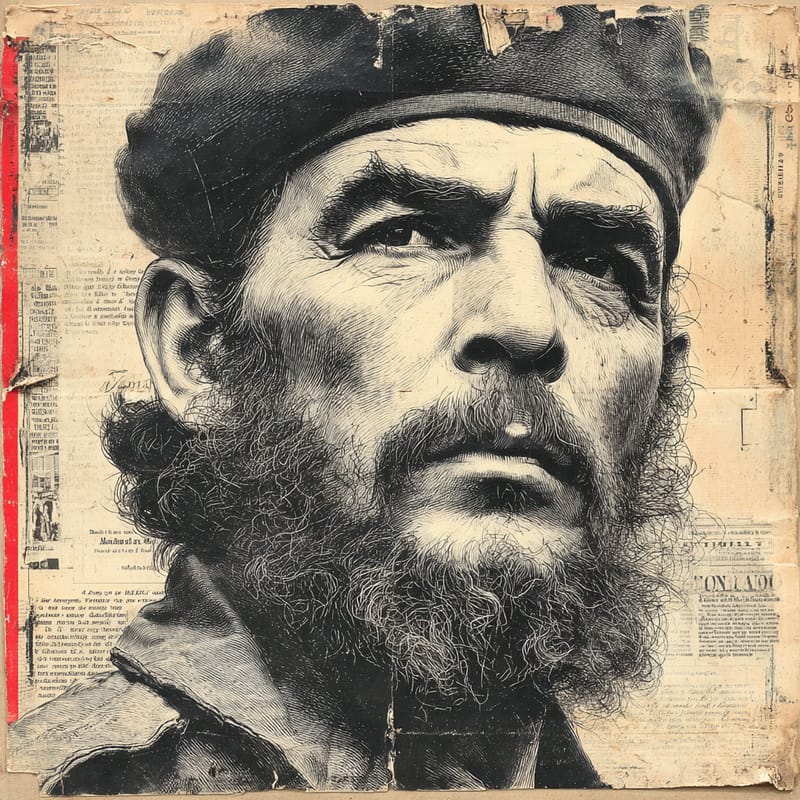
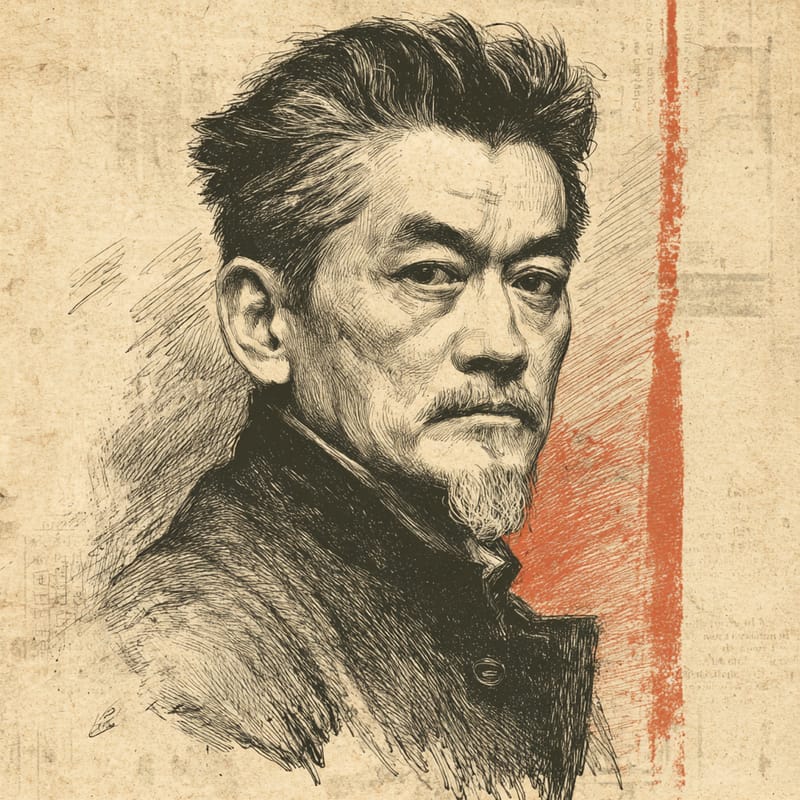


§ Also in the Leninist-Marxist hall
Enter the hall →§ Common questions
4 answersWhat was Vladimir Lenin's political ideology?
Lenin was a Marxist revolutionary who gave his name to Marxism-Leninism: on the 99ideologies three-axis compass, a Reformist Leninist-Marxist. Economically he sat at the far left (−95), abolishing private ownership of land, banks and industry, though he allowed limited private trade under the New Economic Policy. On governance he was strongly authoritarian (+78), founding a one-party state ruled by a vanguard. Socially he was progressive (+50), attacking the church and legalising divorce and abortion.
Was Lenin left-wing or right-wing?
Left-wing, at the far end of the spectrum. Lenin led the first successful communist revolution, expropriated landowners and capitalists, and founded the Communist International in 1919 to spread revolution worldwide. The nuance lies in governance: his party ruled through dictatorship, secret police and terror, which is why democratic socialists and anarchists have long rejected Leninism even while sharing its hostility to capitalism.
Did Lenin want Stalin to succeed him?
No. In notes dictated in December 1922 and January 1923, known as his Testament, the ailing Lenin called Stalin too rude and urged the party to find a way to remove him as general secretary. He also criticised Trotsky and other leaders and named no successor. After Lenin's death in January 1924 the document was read to senior delegates but kept from the public, and Stalin went on to defeat his rivals; it was published in the Soviet Union only in 1956.
Which minds are closest to Vladimir Lenin?
On the 99ideologies three-axis compass, the minds closest to Vladimir Lenin are Che Guevara (96% alike), Nikolai Bukharin (93% alike) and Antonio Gramsci (93% alike). The furthest is Hans-Hermann Hoppe (0% alike).