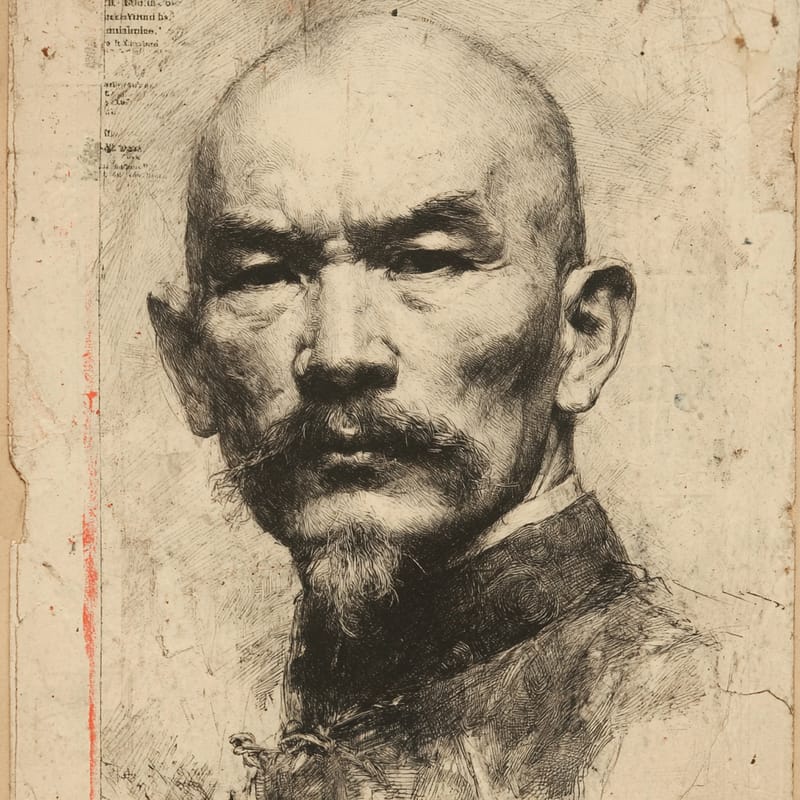
Chiang Kai-shek
Nationalist capitalism
Market order under one party.
Traditional National CapitalistOne of 729 ideologies · enter the National Capitalist hall →- Role
- Generalissimo
- Era
- 1887–1975
- Region
- China / Taiwan
- Social band
- Traditional
- Placement
- +90 · +54 · −56
§ Where Chiang Kai-shek stands
3 axesChiang was no laissez-faire theorist: he invoked Sun Yat-sen's Principle of People's Livelihood, and state enterprises loomed large in both Nanjing and Taipei. But he allied with bankers and industrialists against communism, and on Taiwan the 1953 Land-to-the-Tiller Act paid landlords partly in shares of state firms being privatised, while the 1960 Statute for the Encouragement of Investment opened the island to private and foreign capital.
Chiang ruled through a one-party state. Under the Kuomintang's doctrine of political tutelage, proclaimed in 1928, the party governed in the people's name until they were deemed ready for democracy. On Taiwan the Temporary Provisions, adopted in 1948 and extended in 1960, let him be re-elected president without limit, while martial law, imposed in 1949, barred new opposition parties.
Chiang fused Confucian ethics, nationalism and his adopted Methodist faith into a programme of moral renewal. His New Life Movement, launched in 1934, preached the old virtues of propriety, righteousness, integrity and shame alongside hygiene and discipline, his book China's Destiny (1943) blamed the unequal treaties and imported ideologies for China's ills, and in 1966 he answered Mao's Cultural Revolution with a Chinese Cultural Renaissance Movement.
How close are you to Chiang Kai-shek?
Three statements, one per axis. Answer them and we’ll drop you on the compass next to them.
§ The story
HistoricalChiang Kai-shek (1887–1975) led China's Nationalist Party, the Kuomintang, from the late 1920s until his death, ruling the Republic of China first on the mainland and, after 1949, on Taiwan. Born in Zhejiang and trained as a soldier in Japan, he joined Sun Yat-sen's revolutionary movement, headed the Whampoa Military Academy from 1924 and, after Sun's death, launched the 1926 Northern Expedition that brought much of China under a Nationalist government in Nanjing.
Chiang's purge of his Communist allies in Shanghai in April 1927 began a civil war that, interrupted by the war against Japan from 1937, ended in his defeat and retreat to Taiwan in 1949. He led China among the Allies, attending the 1943 Cairo Conference, but corruption, inflation and military failure eroded his rule. On Taiwan he governed under martial law, imposed in 1949 and lifted only in 1987, during the White Terror; in 1947 troops he sent had crushed the island's February 28 uprising, killing an estimated 18,000–28,000 people.
Notable for
- 01Led the Kuomintang
- 02Ruled wartime China, then Taiwan
- 03Anti-communist Nationalist
Key works & moments
- 1924Becomes commandant of the Whampoa Military Academy, founded with Soviet help.
- 1927Turns on the Communists in the Shanghai massacre, beginning the Chinese Civil War.
- 1934Launches the New Life Movement to revive Confucian virtues and discipline.
- 1936Kidnapped in the Xi'an Incident and pressed into a united front with the Communists against Japan.
- 1949Retreats to Taiwan after defeat in the civil war; martial law begins.
- 1971The UN General Assembly transfers China's seat to the People's Republic.
§ Minds closest to Chiang Kai-shek
All minds →


§ Also in the National Capitalist hall
Enter the hall →§ Common questions
4 answersWhat was Chiang Kai-shek's political ideology?
Chiang Kai-shek was an anti-communist Chinese nationalist who claimed Sun Yat-sen's Three Principles of the People: on the 99ideologies three-axis compass, a Traditional National Capitalist. Economically he sat near the market pole (+90), backing property, business and, on Taiwan, export-led private enterprise despite a large state sector. On governance he leaned clearly authoritarian (+54), ruling through a one-party state and decades of martial law. Socially he was traditionalist (−56), promoting Confucian virtue through the New Life Movement.
Was Chiang Kai-shek left-wing or right-wing?
Right-wing in practice, though his party had revolutionary roots. The Kuomintang was reorganised with Soviet help in the 1920s and allied with the Communists until Chiang purged them in 1927; thereafter he defined his rule against communism, relied on landlords, bankers and the army, and promoted Confucian morality. His land reform on Taiwan was redistributive, but it compensated landlords and was designed to pre-empt communist appeal. He belongs to the nationalist, authoritarian right.
Was Chiang Kai-shek a fascist?
Not in the full sense, though he borrowed from fascism. In the 1930s he admired German and Italian discipline, employed German military advisers, and officers loyal to him founded the Blue Shirts Society in 1932, partly on European fascist models; the New Life Movement's drilled uniformity drew similar comparisons. But his ideology rested on Sun Yat-sen's Three Principles and Confucianism, his party was organised on Leninist lines, and he fought alongside the Allies against Japan. Most historians call his regime authoritarian nationalist rather than fascist.
Which minds are closest to Chiang Kai-shek?
On the 99ideologies three-axis compass, the minds closest to Chiang Kai-shek are Porfirio Díaz (98% alike), Juan Vicente Gómez (98% alike) and Syngman Rhee (98% alike). The furthest is Emma Goldman (0% alike).