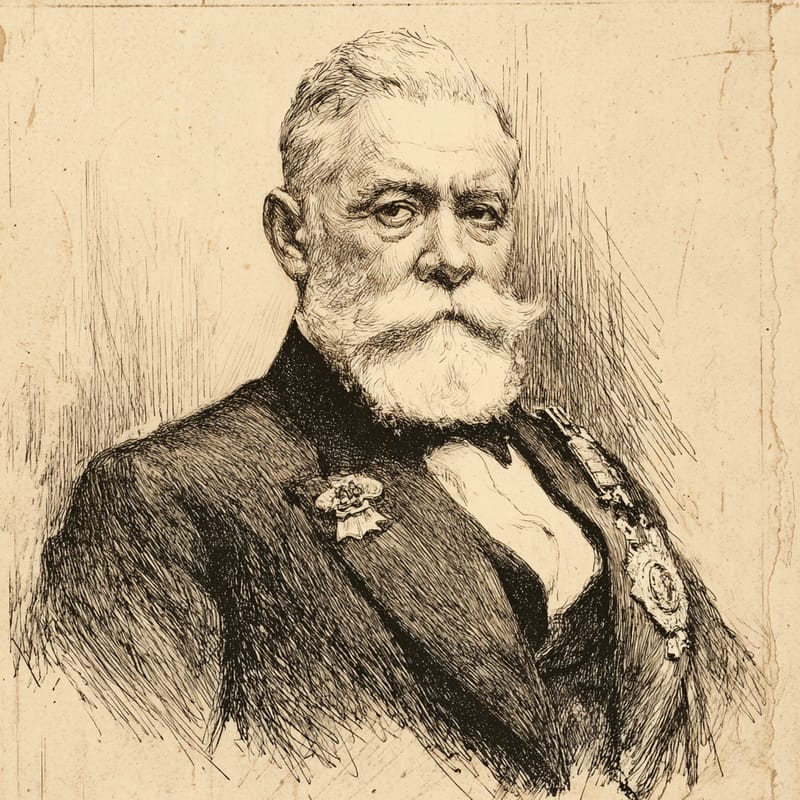
Porfirio Díaz
Order and progress
Foreign capital, iron rule.
Traditional National CapitalistOne of 729 ideologies · enter the National Capitalist hall →- Role
- President (dictator)
- Era
- 1830–1915
- Region
- Mexico
- Social band
- Traditional
- Placement
- +92 · +56 · −52
§ Where Porfirio Díaz stands
3 axesDíaz threw Mexico open to foreign capital: under his rule British and American investors built railways, developed mines and the first oil fields, and survey laws, including the 1883 colonisation law, let companies acquire vast tracts of supposedly vacant land. Finance minister Limantour balanced the budget from the mid-1890s, restoring Mexico's credit abroad.
Díaz ruled through a centralised personal dictatorship behind a constitutional facade. Congress and state governorships were filled with loyalists, elections were managed, the rurales mounted police kept order in the countryside, and security forces crushed the Cananea mine strike in 1906 and the Río Blanco textile strike in 1907. His 1876 slogan of no re-election gave way to constitutional amendments that let him serve indefinitely.
The Porfirian order was hierarchical, Europhile and socially conservative. His científico advisers, steeped in positivism and social Darwinism, saw Indigenous communities as obstacles to progress; the regime fought the Yaqui and deported thousands to the plantations of Yucatán in the 1900s, while Díaz quietly relaxed enforcement of the anticlerical Reform Laws to make peace with the Catholic Church.
How close are you to Porfirio Díaz?
Three statements, one per axis. Answer them and we’ll drop you on the compass next to them.
§ The story
HistoricalJosé de la Cruz Porfirio Díaz (1830–1915) was a Mexican general who dominated Mexico for more than three decades, as president in 1876–1880 and from 1884 to 1911. Born in Oaxaca, he studied at a seminary and then law before joining the Liberals, and he became a national hero in the wars against the Conservatives and the French intervention, fighting at Puebla on 5 May 1862 and retaking the city in 1867. After failed presidential bids and a revolt against Benito Juárez, he seized power in 1876 through the Plan of Tuxtepec, which promised no re-election.
The Porfiriato brought railways, mines, oil wells and export agriculture financed largely by foreign capital, a balanced budget under finance minister José Yves Limantour and the positivist motto order and progress. Its costs were concentrated land ownership, the dispossession of Indigenous and village communities, managed elections, a muzzled press and the violent suppression of strikes and rural revolts. After telling the journalist James Creelman in 1908 that Mexico was ready for democracy, Díaz ran again in 1910; Francisco Madero's revolt forced him into exile in 1911, and he died in Paris.
Notable for
- 01The Porfiriato (1876–1911)
- 02Railway-and-mining boom
- 03Overthrown by the Mexican Revolution
Key works & moments
- 1862Fights in the Mexican victory over French forces at Puebla on 5 May.
- 1876Seizes power through the Plan of Tuxtepec, under the banner of no re-election.
- 1884Returns to the presidency and holds it without a break until 1911.
- 1906–07Security forces crush strikes at the Cananea copper mine and the Río Blanco textile mills.
- 1908Tells US journalist James Creelman that Mexico is ready for democracy.
- 1911Resigns after Madero's revolution and sails into exile in France.
§ Minds closest to Porfirio Díaz
All minds →

§ Also in the National Capitalist hall
Enter the hall →§ Common questions
4 answersWhat was Porfirio Díaz's political ideology?
Porfirio Díaz was a Liberal general turned positivist dictator: on the 99ideologies three-axis compass, a Traditional National Capitalist. Economically he sat near the market pole (+92), opening Mexico to foreign investment in railways, mines and oil. On governance he was clearly authoritarian (+56), ruling for over three decades through managed elections and the suppression of opponents. Socially he was traditionalist (−52), presiding over a hierarchical, Europhile order that dispossessed Indigenous communities and made peace with the Church.
Was Porfirio Díaz left-wing or right-wing?
Right-wing in practice, though he began on the liberal side of nineteenth-century Mexican politics. Díaz rose as a hero of the Liberal cause against the Conservatives and the French-backed empire, but in power he favoured large landowners, foreign investors and a technocratic elite, crushed strikes and rural revolts, and reconciled with the Church. The revolution that overthrew him became the founding myth of the party-state that governed Mexico for most of the twentieth century.
Why was Porfirio Díaz overthrown?
Because his regime closed every peaceful route to power while its prosperity bypassed most Mexicans. Land was concentrated in a few hands, villages lost communal fields, strikes were crushed and Díaz kept re-electing himself despite his own slogan of no re-election. In 1908 he told James Creelman he would welcome an opposition party, but in 1910 his challenger Francisco Madero was jailed and Díaz claimed victory. Madero's Plan of San Luis Potosí sparked revolts, rebels took Ciudad Juárez in May 1911, and Díaz resigned.
Which minds are closest to Porfirio Díaz?
On the 99ideologies three-axis compass, the minds closest to Porfirio Díaz are Juan Vicente Gómez (99% alike), Syngman Rhee (99% alike) and Chiang Kai-shek (98% alike). The furthest is Emma Goldman (0% alike).