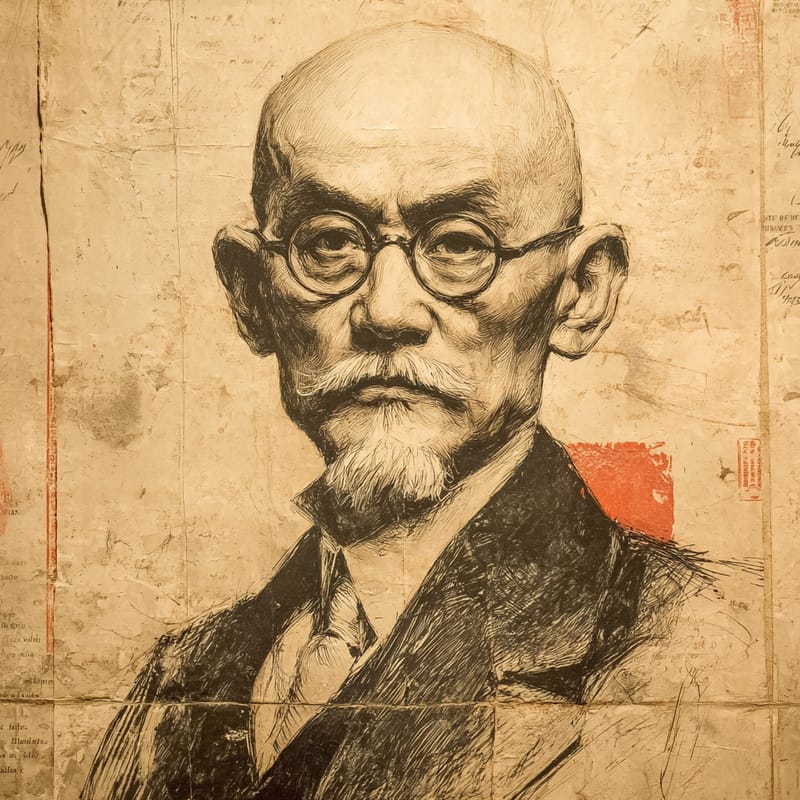
Syngman Rhee
The autocratic founder
Capitalist, anti-communist, strongman.
Traditional National CapitalistOne of 729 ideologies · enter the National Capitalist hall →- Role
- President
- Era
- 1875–1965
- Region
- South Korea
- Social band
- Traditional
- Placement
- +90 · +55 · −50
§ Where Syngman Rhee stands
3 axesRhee's republic was built on private property and American aid against the communist North. The 1949 Farmland Reform Act bought out large landlords and sold their land to tenant farmers, creating a nation of small owners, while former Japanese factories and firms were sold cheaply to well-connected businessmen, seeding several future chaebol. The economy depended heavily on US aid and imports.
Rhee was elected but ruled ever more autocratically. The 1948 National Security Act criminalised communist activity and was turned on critics, martial law in 1952 helped him force through direct presidential elections, and a dubious 'rounding off' vote in 1954 lifted his term limit. In 1959 his former rival Cho Bong-am was executed after a trial since overturned.
Rhee was a fervent nationalist and Christian conservative who framed anti-communism as a moral crusade. In the late 1940s he promoted Ilminism, the One-People Principle, a doctrine of ethnic unity and obedience to the state, and the 1958 Civil Code enacted under his government kept the patriarchal household-head system at the centre of family law.
How close are you to Syngman Rhee?
Three statements, one per axis. Answer them and we’ll drop you on the compass next to them.
§ The story
HistoricalSyngman Rhee (1875–1965) was the first president of the Republic of Korea, serving from 1948 to 1960. Born in Hwanghae Province under the Joseon dynasty, he joined the reformist Independence Club, was jailed from 1899 to 1904 and became a Methodist in prison. He then studied in the United States, earning a Princeton doctorate in 1910, and spent most of the Japanese colonial period abroad lobbying for independence, including as first president of the Korean Provisional Government from 1919 until its assembly removed him in 1925.
Returning in 1945, Rhee built a right-wing, anti-communist following in the American-occupied South and was elected president by the National Assembly when the republic was founded in August 1948. He led the South through the Korean War, opposed the 1953 armistice and won a mutual defence treaty with Washington. His rule saw mass killings of suspected leftists, from the suppression of the Jeju uprising to the Bodo League executions of 1950, and repeated constitutional manipulation. A rigged election in March 1960 provoked the April Revolution, and he resigned and went into exile in Hawaii.
Notable for
- 01First president of South Korea
- 02Anti-communist nation-building
- 03Toppled by the April Revolution
Key works & moments
- 1899–1904Imprisoned for reformist activism; converts to Christianity in jail.
- 1919Elected first president of the Korean Provisional Government in exile.
- 1948Becomes the first president of the newly proclaimed Republic of Korea.
- 1953Frees some 25,000 anti-communist prisoners of war to disrupt armistice talks, then wins a US defence treaty.
- 1954Forces through the 'rounding off' amendment exempting him from the presidential term limit.
- 1960Resigns after the April Revolution against a rigged election, then leaves for exile in Hawaii.
§ Minds closest to Syngman Rhee
All minds →


§ Also in the National Capitalist hall
Enter the hall →§ Common questions
4 answersWhat was Syngman Rhee's political ideology?
Syngman Rhee was an anti-communist nationalist who led South Korea as a Cold War strongman: on the 99ideologies three-axis compass, a Traditional National Capitalist. Economically he sat near the market pole (+90), building a private-property republic on land reform, US aid and favoured businessmen. On governance he leaned clearly authoritarian (+55), bending the constitution and jailing or killing opponents while keeping elections. Socially he was traditionalist (−50), a Christian nationalist who preached ethnic unity and kept patriarchal family law.
Was Syngman Rhee left-wing or right-wing?
Right-wing. Rhee defined his politics against communism, which he fought at home with the National Security Act and abroad in the Korean War, and he aligned South Korea firmly with the United States. His economy rested on private property, and his social outlook was nationalist and Christian conservative. The one policy that looks left of centre, the 1949–50 land reform, is widely seen as a way to pre-empt communist appeal by turning tenants into small owners.
Was Syngman Rhee a dictator?
In his later years, by most historians' judgement, yes, though he came to power legally. Rhee was chosen by the National Assembly in 1948 and won popular elections in 1952 and 1956, but he used martial law to change the constitution, scrapped his own term limit in 1954, saw his chief opponent Cho Bong-am executed in 1959 and presided over a blatantly rigged vote in March 1960. Student-led protests in the April Revolution forced him to resign, and he died in exile in Hawaii.
Which minds are closest to Syngman Rhee?
On the 99ideologies three-axis compass, the minds closest to Syngman Rhee are Porfirio Díaz (99% alike), Juan Vicente Gómez (98% alike) and Chiang Kai-shek (98% alike). The furthest is Emma Goldman (0% alike).