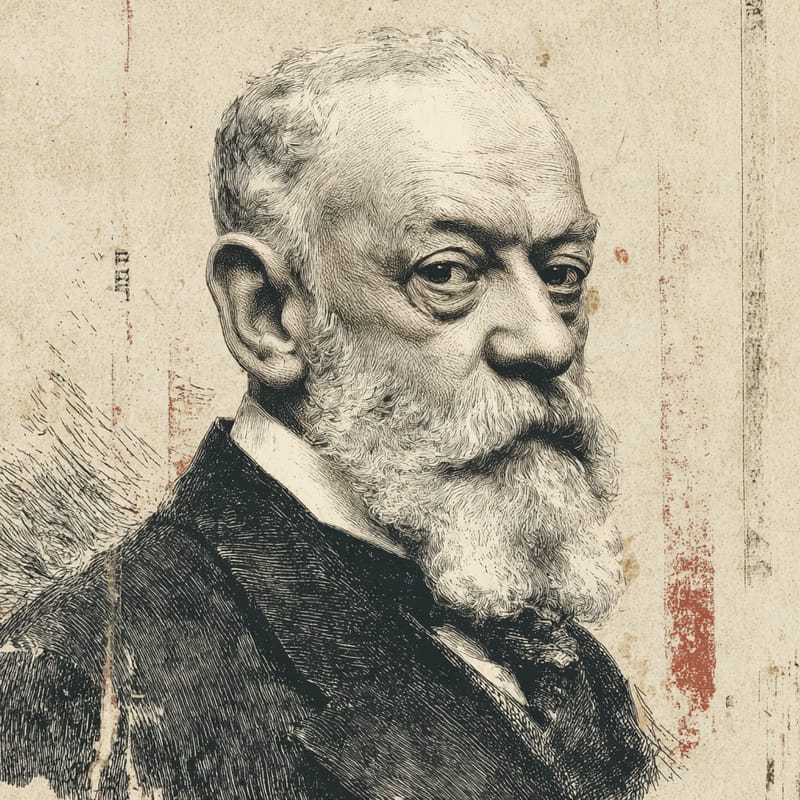
Alfred Krupp
The cannon king
Industry wedded to the nation-state.
Traditional National CapitalistOne of 729 ideologies · enter the National Capitalist hall →- Role
- Industrialist
- Era
- 1812–1887
- Region
- Germany
- Social band
- Traditional
- Placement
- +91 · +46 · −48
§ Where Alfred Krupp stands
3 axesKrupp built a vast family-owned empire and kept it in private hands, resisting any dilution of his personal control. Yet his fortune rested on governments as customers: steel cannon sold to Prussia and to foreign states, advertised by the 50-tonne gun he showed at the 1867 Paris Exposition. His welfare schemes were the employer's gifts, conditional on loyalty, rather than workers' rights.
Krupp tied his fortune to the Prussian monarchy and its army, cultivating King, later Kaiser, Wilhelm I as patron and customer and supplying the guns that helped unify Germany in 1870–71. Inside his works he ruled as a sovereign, laying down rules of conduct for every employee in the 1872 General Regulations, though he never sought public office.
Krupp was a paternalist who governed his workers' lives beyond the factory gate. Company housing, schools, hospitals and shops came with expectations of obedience, and his 1877 address A Word to My Employees urged them to devote their leisure to home and family, avoid socialist agitation and leave high politics to those with the time and insight for it.
How close are you to Alfred Krupp?
Three statements, one per axis. Answer them and we’ll drop you on the compass next to them.
§ The story
HistoricalAlfred Krupp (1812–1887) was a German industrialist who turned his family's struggling cast-steel works in Essen into one of Europe's largest industrial enterprises. He took charge at fourteen after his father Friedrich died in 1826, spent years perfecting crucible steel, won international attention with a flawless steel ingot at London's Great Exhibition of 1851 and prospered on seamless railway tyres before turning to artillery. His breech-loading steel guns armed Prussia and many foreign states.
Krupp's artillery helped Prussia defeat France in 1870–71, and his readiness to sell guns to governments across Europe and beyond earned him the nickname the Cannon King. He combined autocratic control with company welfare, building housing, health and pension funds, schools and shops for workers who were expected in return to shun socialism and unions. The firm he left became synonymous with German armament through two world wars, and his great-grandson Alfried Krupp was convicted at Nuremberg in 1948 for the use of slave labour.
Notable for
- 01Krupp steel-and-arms empire
- 02Armed Imperial Germany
- 03Pioneered worker paternalism
Key works & moments
- 1826Takes over the family's failing cast-steel works in Essen at fourteen after his father's death.
- 1851Exhibits a giant, flawless cast-steel ingot at London's Great Exhibition.
- 1867Shows a 50-tonne steel cannon at the Paris Exposition Universelle.
- 1870–71Krupp breech-loading artillery helps Prussia and its allies defeat France.
- 1872Issues the General Regulations, codifying his paternalist rule over the workforce.
- 1877Issues A Word to My Employees, warning them against socialism.
§ Minds closest to Alfred Krupp
All minds →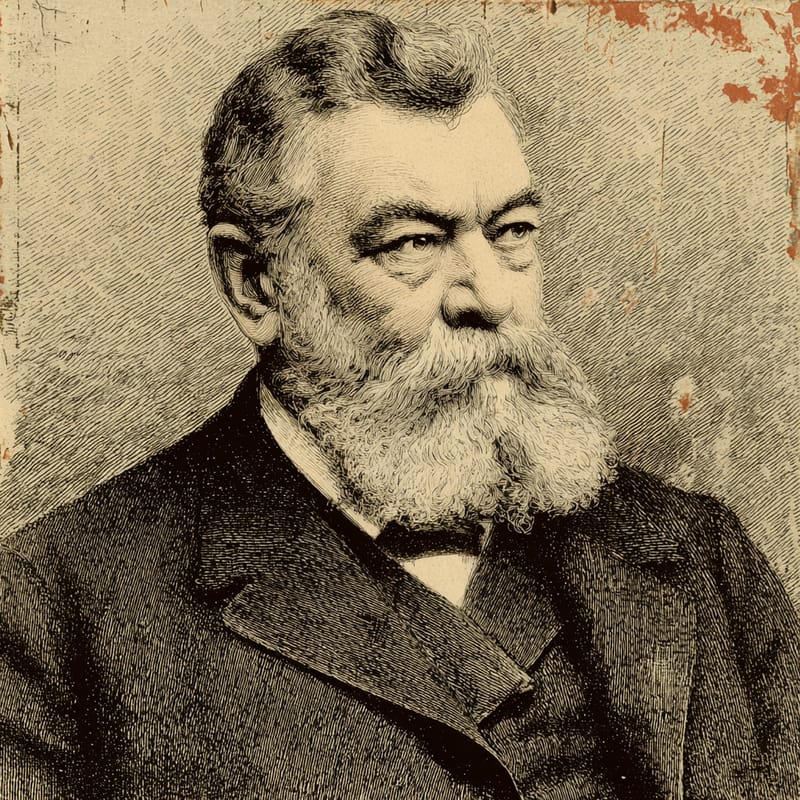

§ Also in the National Capitalist hall
Enter the hall →§ Common questions
4 answersWhat was Alfred Krupp's political ideology?
Alfred Krupp was a monarchist industrial paternalist: on the 99ideologies three-axis compass, a Traditional National Capitalist. Economically he sat near the market pole (+91), running a private family empire whose fortunes rested on state arms orders. On governance he leaned authoritarian (+46), allied to the Prussian crown and army and ruling his works by decree. Socially he was traditionalist (−48), offering housing and welfare to workers in exchange for loyalty, family life and distance from socialism.
Was Alfred Krupp left-wing or right-wing?
Right-wing. Krupp was a conservative monarchist and a fierce opponent of socialism and trade unions. His company welfare system can look progressive, and it is often cited as a forerunner of Bismarck's social insurance laws of the 1880s, but it was designed to bind workers to the firm and keep them away from the Social Democrats, not to share power with them. He belongs to the authoritarian, nationalist business right of Imperial Germany.
Why was Alfred Krupp called the Cannon King?
Because his firm became the world's best-known maker of steel artillery. From the 1850s Krupp pressed cast-steel breech-loading guns on sceptical Prussian generals who preferred bronze, won Prussian orders and saw his artillery outclass France's guns in the Franco-Prussian War of 1870–71. He also sold cannon to Russia, the Ottoman Empire and many other states, and showcased monster guns at international exhibitions. The nickname captured both his commercial reach and his close bond with the Prussian military.
Which minds are closest to Alfred Krupp?
On the 99ideologies three-axis compass, the minds closest to Alfred Krupp are Leland Stanford (98% alike), The National Champion (archetype) (98% alike) and Syngman Rhee (96% alike). The furthest is Emma Goldman (0% alike).