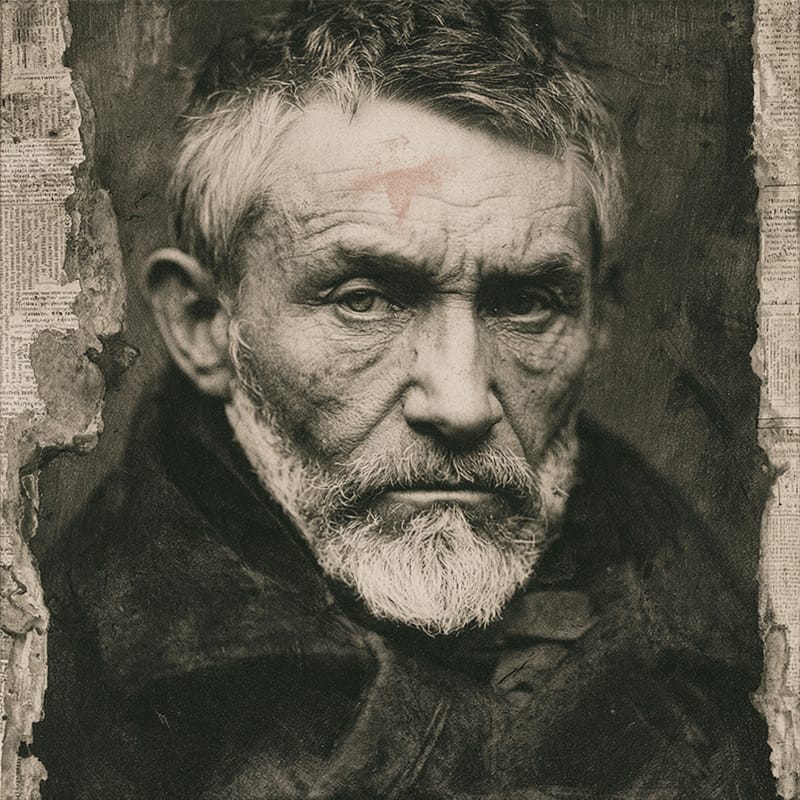
Louis Auguste Blanqui
Classical MarxistOne of 729 ideologies · enter the Classical Marxist hall →- Role
- —
- Era
- —
- Region
- —
- Social band
- Centre (no modifier)
- Placement
- −100 · −50 · 0
§ Where Louis Auguste Blanqui stands
3 axesBlanqui was a communist who believed that private property and capital rested on the plunder of labour and must give way to collective ownership. His essays, gathered posthumously as Critique sociale (1885), attacked capital and usury and treated communism as the future of society, though he insisted it could only grow from an educated people rather than be decreed overnight.
Blanqui waged a lifelong war on the state as it existed, from the Bourbon monarchy to Napoleon III's empire and Thiers's government, and in 1880 founded a newspaper titled Ni Dieu ni maître (Neither God nor Master), a motto anarchists adopted. His hostility to authority stopped at the revolution itself: he pressed in March 1848 for elections to be postponed and envisaged a temporary dictatorship of revolutionary Paris.
Blanqui was a militant atheist and anticlerical who saw the Church as the chief prop of reaction and ignorance, a conviction captured in the motto Neither God nor Master. He regarded mass education freed from clerical control as the precondition for communism, and his 1872 prison meditation L'Éternité par les astres offered a strictly materialist vision of an infinite universe.
How close are you to Louis Auguste Blanqui?
Three statements, one per axis. Answer them and we’ll drop you on the compass next to them.
§ The story
HistoricalLouis Auguste Blanqui (1805–1881) was a French revolutionary socialist, born in Puget-Théniers, the son of a Girondin deputy to the National Convention and younger brother of the liberal economist Adolphe Blanqui. Drawn into the secret Carbonari network as a student in Paris, he fought on the barricades of July 1830 and spent the next half-century organising conspiracies against monarchy and empire. Successive French regimes imprisoned him for more than thirty years in all, earning him the nickname l'Enfermé, the Locked-Up One.
Blanqui gave his name to Blanquism: the belief that a small, disciplined secret society should seize power by insurrection and hold it in a temporary revolutionary dictatorship until the people were educated for self-rule. His 1839 rising with Armand Barbès failed, as did later attempts in 1848 and 1870. Arrested the day before the Paris Commune began in March 1871, he was elected to its council in absentia; Adolphe Thiers refused the Communards' offer to exchange him for hostages including the Archbishop of Paris, who was later shot. Blanquists such as Édouard Vaillant later helped found the unified socialist party, the SFIO.
Key works & moments
- 1830Fights on the Paris barricades in the July Revolution that topples Charles X.
- 1839Leads the failed Société des Saisons uprising with Armand Barbès; his death sentence is commuted.
- 1848Freed by the February Revolution, leads a radical club, then is jailed after the 15 May demonstration.
- 1871Arrested on 17 March, he is elected to the Paris Commune's council while held in prison.
- 1879Elected deputy for Bordeaux while imprisoned; the election is annulled, but he is freed.
- 1880–81Launches the newspaper Ni Dieu ni maître; dies in Paris on 1 January 1881.
§ Minds closest to Louis Auguste Blanqui
All minds →


§ Also in the Classical Marxist hall
Enter the hall →§ Common questions
4 answersWhat was Louis Auguste Blanqui's political ideology?
Blanqui was a revolutionary communist whose doctrine became known as Blanquism: on the 99ideologies three-axis compass, a Classical Marxist. He sits at the far left economically (−100), wanting capital and private property replaced by collective ownership, and on the anti-authoritarian side of governance (−50), a lifelong enemy of monarchy, empire and church. His social stance, militantly atheist and anticlerical, is left unrated (0). His faith in a conspiratorial vanguard and a temporary revolutionary dictatorship set him apart from both anarchists and Marx.
Was Louis Auguste Blanqui left-wing or right-wing?
Far left. Blanqui spent his life trying to overthrow every French regime from the Restoration monarchy to the early Third Republic in the name of the working class and communism, and his followers fought in the Paris Commune. What distinguished him on the left was method rather than goal: he trusted a small armed elite to seize power and govern temporarily on the people's behalf, an approach Engels criticised and that Russian Mensheviks later hurled at Lenin as an insult.
Was Louis Auguste Blanqui a Marxist?
No, not in a strict sense. Blanqui's ideas grew from French revolutionary republicanism and the egalitarian tradition of Babeuf and Buonarroti, and he developed them independently of Marx, who was thirteen years younger. Marx respected him as a revolutionary, but Engels criticised Blanquism in 1874 for believing a small minority could make a revolution by surprise. The 99ideologies placement groups him with classical Marxism because he shared its goals of communism and working-class revolution and is inseparable from the Paris Commune that Marx celebrated.
Which minds are closest to Louis Auguste Blanqui?
On the 99ideologies three-axis compass, the minds closest to Louis Auguste Blanqui are Georgi Plekhanov (81% alike), Paul Mattick (81% alike) and Wilhelm Liebknecht (81% alike). The furthest is Adam Sutler (0% alike).