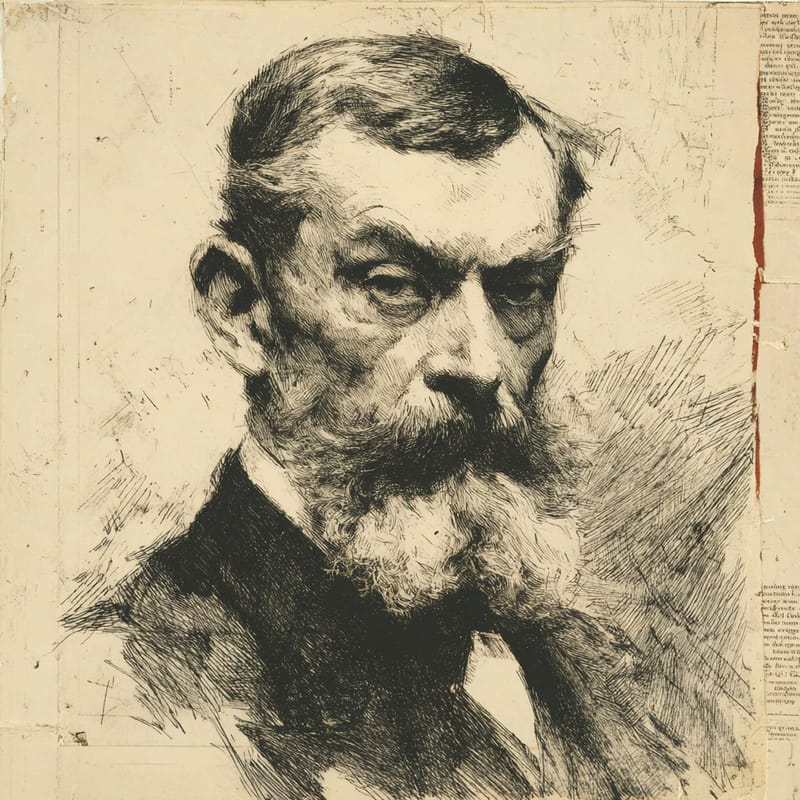
Georgi Plekhanov
Father of Russian Marxism
Theory before the vanguard.
Reformist Classical MarxistOne of 729 ideologies · enter the Classical Marxist hall →- Role
- Theorist
- Era
- 1856–1918
- Region
- Russia
- Social band
- Reformist
- Placement
- −90 · −40 · +45
§ Where Georgi Plekhanov stands
3 axesPlekhanov held that socialism would grow out of capitalism's own development, with social ownership replacing private ownership once industry and the working class had matured. Our Differences (1885) attacked the Narodnik hope that the peasant commune could leap straight to socialism, and the Emancipation of Labour programme of 1884 committed Russian Marxists to collective ownership of the means of production.
Plekhanov insisted that Russia first needed a bourgeois-democratic revolution with full political freedoms, and he opposed both Narodnik terrorism and the Bolsheviks' minority seizure of power in October 1917. His democratic commitment had limits, though: at the 1903 party congress he declared the success of the revolution the supreme law, adding that even universal suffrage could be restricted if it required.
A convinced Westerniser and materialist, Plekhanov rejected the idea that Russia's village traditions offered a special path, arguing in The Development of the Monist View of History (1895) that Russia would follow Europe through capitalism. He wrote on art and religion from a materialist standpoint and popularised the term dialectical materialism, though his patriotic defencism in 1914 estranged him from the internationalist left.
How close are you to Georgi Plekhanov?
Three statements, one per axis. Answer them and we’ll drop you on the compass next to them.
§ The story
HistoricalGeorgi Valentinovich Plekhanov (1856–1918) was born into a minor gentry family in Tambov province and became a Narodnik revolutionary, addressing Russia's first political street demonstration outside St Petersburg's Kazan Cathedral in 1876. Opposing the movement's turn to terrorism, he led the Black Repartition faction before emigrating to Switzerland in 1880, where he converted to Marxism. In 1883 he founded the Emancipation of Labour group in Geneva with Pavel Axelrod and Vera Zasulich, the first Russian Marxist organisation.
Plekhanov's books trained the first generation of Russian Marxists, Lenin among them, and in 1900 he joined Lenin and Martov on the editorial board of the new newspaper Iskra. After the 1903 split he drifted to the Mensheviks, supported Russia's war against Germany in 1914 and returned home in 1917 to oppose the Bolsheviks. In an open letter to Petrograd's workers after the October seizure he warned that Russia lacked the conditions for socialism. He died of tuberculosis in a Finnish sanatorium in 1918, later honoured in Soviet Marxism as a philosopher while his politics were condemned.
Notable for
- 01Introduced Marxism to Russia
- 02'The Development of the Monist View of History'
- 03Opposed the October coup
Key works & moments
- 1876Speaks at the Kazan Cathedral demonstration in St Petersburg, Russia's first political street protest.
- 1883Founds the Emancipation of Labour group in Geneva and publishes Socialism and the Political Struggle.
- 1895The Development of the Monist View of History appears legally in Russia under the pseudonym N. Beltov.
- 1900Joins Lenin and Martov on the editorial board of the Marxist newspaper Iskra.
- 1903Sides with Lenin at the party's Second Congress, then moves towards the Mensheviks.
- 1917Returns to Russia after 37 years in exile and denounces the October seizure of power.
§ Minds closest to Georgi Plekhanov
All minds →

§ Also in the Classical Marxist hall
Enter the hall →§ Common questions
4 answersWhat was Georgi Plekhanov's political ideology?
Georgi Plekhanov was an orthodox Marxist, later a Menshevik: on the 99ideologies three-axis compass, a Reformist Classical Marxist. Economically he sat at the far left (−90), expecting capitalism to mature into collective ownership. On governance he leaned libertarian (−40), insisting on a democratic stage and opposing the Bolsheviks' seizure of power, though in 1903 he allowed that revolutionary necessity could override suffrage. Socially he was progressive (+45), a Westernising materialist who rejected Russian exceptionalism.
Was Georgi Plekhanov left-wing or right-wing?
Left-wing. Plekhanov founded Russian Marxism and spent decades in exile working for a socialist revolution. In 1917 he found himself on the right of the socialist movement, but because of strategy rather than goals: he believed Russia was too backward for socialism, wanted it to pass through capitalism and parliamentary democracy first, and backed the war against Germany. His break with Lenin was over timing and methods, not over the final aim of common ownership.
Why did Plekhanov oppose the October Revolution?
Because he believed it violated Marxism itself. Plekhanov argued that socialism required a developed capitalist economy and a large, organised working class, and Russia, still overwhelmingly peasant, had neither. In his open letter to the workers of Petrograd in late 1917 he warned that a premature seizure of power by one class would bring civil war and could cost workers the gains of the February Revolution. He also distrusted the Bolsheviks' centralised, minority-led party, a danger he had come to see in Lenin after 1903.
Which minds are closest to Georgi Plekhanov?
On the 99ideologies three-axis compass, the minds closest to Georgi Plekhanov are Wilhelm Liebknecht (99% alike), Antonio Labriola (98% alike) and Karl Kautsky (98% alike). The furthest is Adam Sutler (0% alike).