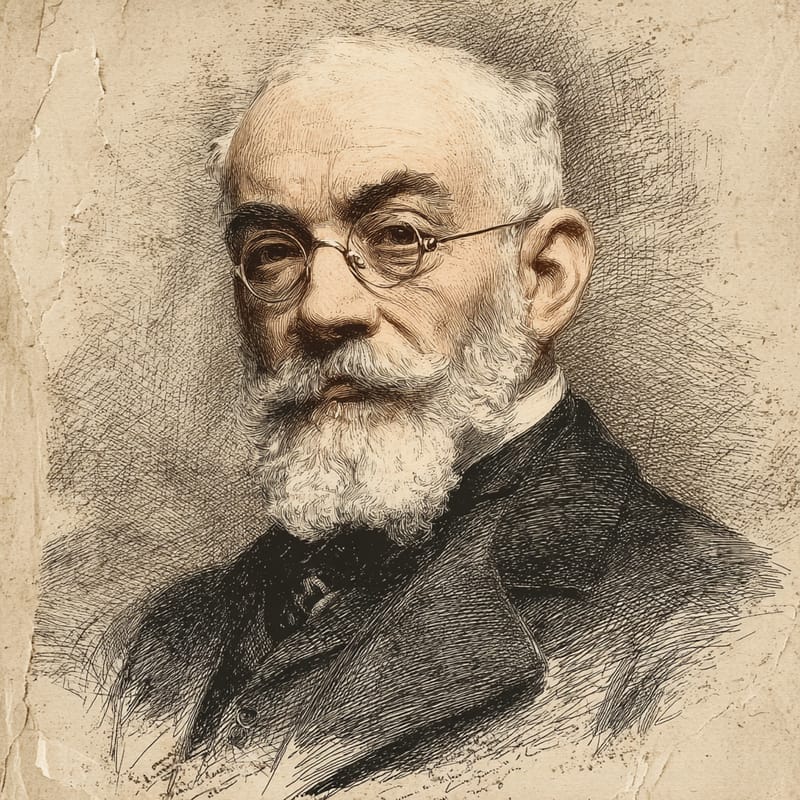
Antonio Labriola
Marxism as philosophy of praxis
Italy's first Marxist theorist.
Reformist Classical MarxistOne of 729 ideologies · enter the Classical Marxist hall →- Role
- Philosopher
- Era
- 1843–1904
- Region
- Italy
- Social band
- Reformist
- Placement
- −88 · −44 · +48
§ Where Antonio Labriola stands
3 axesLabriola accepted Marx's case that the economic structure of society conditions its law, politics and ideas, and that capitalism must give way to collective ownership. His essay In Memory of the Communist Manifesto (1895) presented the Manifesto's account of class struggle as the starting point of socialist politics, while insisting that economics explains history only in the last instance.
He welcomed the founding of an Italian workers' party at Genoa in 1892, which separated socialists from anarchists, and wanted socialism advanced by an organised, educated working class through democratic struggle. Labriola distrusted insurrectionary adventures and parliamentary opportunism alike, and his letters published as Discorrendo di socialismo e di filosofia (1898) defended open, critical inquiry against any official doctrine.
Labriola's humanism was secular and modern: he treated morals, religion and law as historical products rather than eternal truths, and taught that people make their own history through social practice. His progressivism had limits, however, as his 1902 endorsement of Italian expansion into Tripoli showed, putting national interest ahead of anti-colonial principle.
How close are you to Antonio Labriola?
Three statements, one per axis. Answer them and we’ll drop you on the compass next to them.
§ The story
HistoricalAntonio Labriola (1843–1904) was an Italian philosopher born in Cassino who trained in the Hegelian circle of Bertrando Spaventa in Naples and taught moral philosophy and pedagogy at the University of Rome from 1874. Moving from liberalism through radical democracy, he declared himself a socialist around 1890 and began a long correspondence with Friedrich Engels. A celebrated lecturer, he counted the young Benedetto Croce among those he steered toward the study of Marx.
Labriola was the first Italian to treat Marxism as a full philosophy rather than a set of economic slogans. His essays of 1895–1898 rejected both mechanical determinism and the eclectic positivist socialism fashionable in Italy, describing historical materialism as a 'philosophy of praxis' in which people make history through their social activity. Antonio Gramsci adopted the phrase in his prison notebooks, carrying Labriola's influence into twentieth-century humanist Marxism. His record is clouded by a 1902 newspaper interview in which he backed Italian expansion into Tripoli, to the dismay of fellow socialists.
Notable for
- 01Introduced Marxism to Italy
- 02'Essays on the Materialist Conception of History'
- 03Philosophy of praxis
Key works & moments
- 1874Begins teaching moral philosophy and pedagogy at the University of Rome.
- 1890Starts corresponding with Friedrich Engels, an exchange that lasts until Engels's death in 1895.
- 1895Publishes In Memory of the Communist Manifesto, the first of his essays on historical materialism.
- 1896Publishes Historical Materialism: A Preliminary Elucidation.
- 1898His letters to Georges Sorel appear as Discorrendo di socialismo e di filosofia, calling Marxism a philosophy of praxis.
- 1904Dies in Rome; his essays later shape Gramsci's prison notebooks.
§ Minds closest to Antonio Labriola
All minds →

§ Also in the Classical Marxist hall
Enter the hall →§ Common questions
4 answersWhat was Antonio Labriola's political ideology?
Antonio Labriola was a humanist Marxist: on the 99ideologies three-axis compass, a Reformist Classical Marxist. Economically he sat at the far left (−88), accepting Marx's case for collective ownership and his materialist account of history. On governance he leaned libertarian (−44), favouring a democratic, educated workers' movement and open debate over dogma or insurrection. Socially he was progressive (+48), a secular modernist, though his 1902 support for Italian expansion into Tripoli marked the limits of his internationalism.
Was Antonio Labriola left-wing or right-wing?
Left-wing. Labriola was a convinced Marxist who wanted capitalism replaced by socialism and spent his last fifteen years building the theoretical foundations of the Italian workers' movement. He was not, however, a party organiser or revolutionary agitator; his contribution was philosophical, arguing that Marxism was a theory of human practice rather than a mechanical law of economics. That non-dogmatic emphasis, later taken up by Gramsci, places him in the democratic, humanist current of classical Marxism.
What did Antonio Labriola mean by the 'philosophy of praxis'?
He meant that Marxism is above all a philosophy of human activity. In letters to Georges Sorel published in 1898, Labriola argued that historical materialism unites thought and action: people come to know the world by transforming it through labour and social practice, so ideas cannot be separated from the conditions that produce them. The phrase rejected both idealist philosophy and crude economic determinism. Antonio Gramsci later used 'philosophy of praxis' throughout his prison notebooks, partly to evade the censors, making it a watchword of Western Marxism.
Which minds are closest to Antonio Labriola?
On the 99ideologies three-axis compass, the minds closest to Antonio Labriola are Karl Kautsky (99% alike), Wilhelm Liebknecht (99% alike) and Georgi Plekhanov (98% alike). The furthest is Adam Sutler (0% alike).