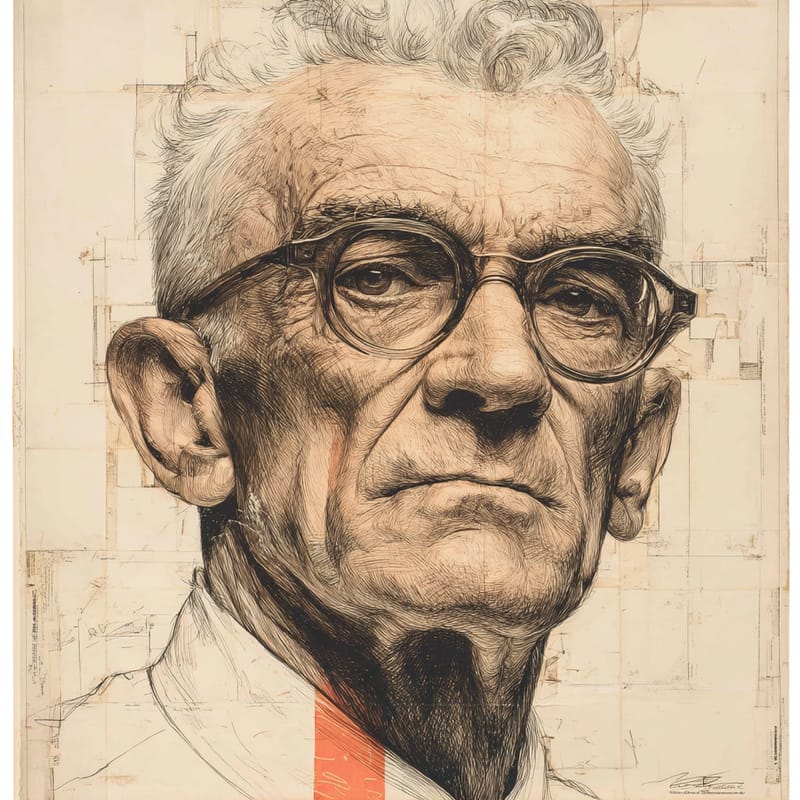
Paul Mattick
Marx against Keynes
Crisis theory for the councils.
Reformist Council CommunistOne of 729 ideologies · enter the Council Communist hall →- Role
- Theorist
- Era
- 1904–1981
- Region
- Germany / US
- Social band
- Reformist
- Placement
- −92 · −70 · +42
§ Where Paul Mattick stands
3 axesMattick was an orthodox Marxist economist of a council communist stamp. Marx and Keynes: The Limits of the Mixed Economy (1969) argued that Keynesian deficit spending could prop up demand but not restore profitability, so the mixed economy would eventually face renewed crisis. His alternative was not state planning but common ownership administered by the producers through workers' councils.
Mattick rejected the Bolshevik model as state capitalism ruled by a party bureaucracy, a case collected in Anti-Bolshevik Communism (1978). Like Pannekoek, whose essays he published in his journals, he held that socialism required workers to govern production directly through councils rather than through parliaments, trade unions or a vanguard party.
Mattick's progressivism was that of a working-class internationalist and secular rationalist. He opposed fascism and Stalinism alike, refused to rally to either side's patriotism in the Second World War, and through Living Marxism (1938–41) gave an English-language platform to émigré radicals such as Karl Korsch. His concerns centred on class emancipation rather than cultural politics.
How close are you to Paul Mattick?
Three statements, one per axis. Answer them and we’ll drop you on the compass next to them.
§ The story
HistoricalPaul Mattick (1904–1981) was a German-American Marxist writer and economist. Born in Pomerania and raised in Berlin, he trained as a toolmaker at Siemens, joined the revolutionary youth movement during the upheavals of 1918–19 and became active in the Communist Workers' Party (KAPD). He emigrated to the United States in 1926, worked in Chicago factories, and took part in the Industrial Workers of the World and in organising the unemployed during the Depression.
Mattick edited International Council Correspondence, later renamed Living Marxism and then New Essays, which kept the anti-Leninist council communist tradition alive in English from 1934 to 1943. Largely self-taught, he developed Marxist crisis theory along lines drawn from Henryk Grossmann, and his Marx and Keynes (1969) found a new audience in the New Left by arguing that government spending could only postpone capitalism's contradictions. He died in Cambridge, Massachusetts, in 1981.
Notable for
- 01'Marx and Keynes'
- 02Council-communist economics
- 03Crisis theory
Key works & moments
- 1926Emigrates from Germany to the United States, settling in Chicago.
- 1934Launches International Council Correspondence, the voice of American council communism.
- 1938Relaunches his journal as Living Marxism, publishing Pannekoek and Karl Korsch.
- 1969Publishes Marx and Keynes: The Limits of the Mixed Economy.
- 1978Publishes Anti-Bolshevik Communism, collecting his critiques of Leninism.
§ Minds closest to Paul Mattick
All minds →

§ Also in the Council Communist hall
Enter the hall →The closest minds above are this hall’s whole roster.
§ Common questions
4 answersWhat was Paul Mattick's political ideology?
Paul Mattick was a council communist and Marxist crisis theorist: on the 99ideologies three-axis compass, a Reformist Council Communist. Economically he sat at the socialist pole (−92), arguing that capitalism's crises could be ended only by common ownership under workers' control. On governance he was strongly libertarian (−70), rejecting the Bolshevik party-state as well as parliamentary reformism. Socially he was progressive (+42), a secular, internationalist working-class intellectual.
Was Paul Mattick left-wing or right-wing?
Left-wing, in the anti-Leninist revolutionary tradition. Mattick wanted capitalism abolished and saw Keynesian welfare states as stopgaps, which puts him far to the left of social democracy. But he was equally hostile to the Soviet Union, which he described as state capitalism ruled by a party bureaucracy. His politics belong to the small council communist current that rejected both Western capitalism and Eastern communism in favour of workers' self-rule.
What did Paul Mattick argue in Marx and Keynes?
In Marx and Keynes: The Limits of the Mixed Economy (1969), Mattick argued that Keynesian policy could not overcome the crisis tendencies Marx had identified. Government spending and deficit finance might sustain employment for a time, he said, but because state-funded production does not generate new profits for private capital, it would eventually strain the system it was meant to rescue. Written at the height of the post-war boom, it became one of the best-known Marxist critiques of Keynesian economics.
Which minds are closest to Paul Mattick?
On the 99ideologies three-axis compass, the minds closest to Paul Mattick are Herman Gorter (99% alike), Anton Pannekoek (97% alike) and Otto Rühle (97% alike). The furthest is Adam Sutler (0% alike).