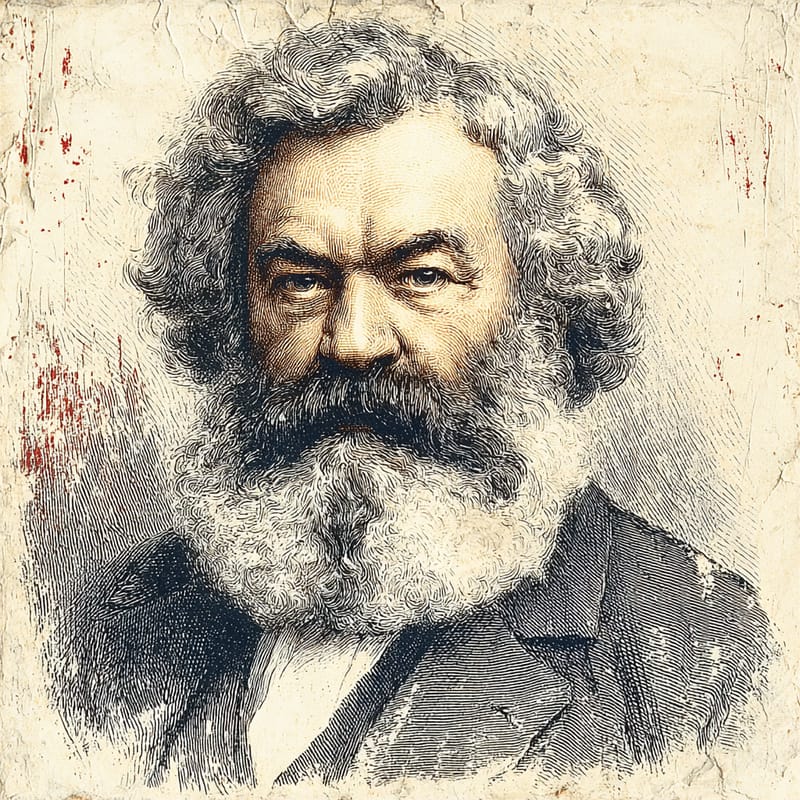
Karl Marx
Workers of the world, unite
The critique of capital itself.
Reformist Classical MarxistOne of 729 ideologies · enter the Classical Marxist hall →- Role
- Philosopher & economist
- Era
- 1818–1883
- Region
- Germany
- Social band
- Reformist
- Placement
- −98 · −48 · +60
§ Where Karl Marx stands
3 axesMarx called for abolishing private ownership of the means of production and ending wage labour. Capital (1867) argued that profit arises from surplus value extracted from workers' unpaid labour and that competition drives capitalism toward concentration and crisis, and the Critique of the Gotha Programme (1875) sketched a communist society distributing from each according to ability, to each according to need.
Marx envisioned the eventual disappearance of the state into a free association of producers, and in The Civil War in France (1871) he praised the Paris Commune's elected, recallable officials paid workers' wages. He also called for a transitional dictatorship of the proletariat in 1875, though in an 1872 speech in Amsterdam he allowed that workers in countries such as America and Britain might win power by peaceful means.
Marx was a radical modernist who called religion the opium of the people in his 1844 introduction to a critique of Hegel's philosophy of right, and who expected inherited hierarchies and national divisions to dissolve. The Communist Manifesto (1848) welcomed capitalism's destruction of feudal and patriarchal ties as a step toward human emancipation and demanded free public education and an end to children's factory labour.
How close are you to Karl Marx?
Three statements, one per axis. Answer them and we’ll drop you on the compass next to them.
§ The story
HistoricalKarl Marx (1818–1883) was a German philosopher, economist, historian and revolutionary. Born in Trier to a family of Jewish descent whose father had converted to Protestantism, he studied law and philosophy in Bonn and Berlin and took a doctorate at Jena in 1841. Shut out of an academic career by his radicalism, he edited the Rheinische Zeitung until Prussian censors closed it in 1843, then moved to Paris and Brussels, where he began his lifelong partnership with Friedrich Engels.
With Engels he wrote The Communist Manifesto (1848), and after the defeat of the 1848 revolutions he settled in London, living in poverty, supported by Engels and journalism, while writing Capital, whose first volume appeared in 1867. His theory that history is driven by class struggle and that capitalism would give way to communism became one of the most influential bodies of thought in modern history. Twentieth-century states ruling in his name, from the Soviet Union to China, built one-party dictatorships whose repression and famines killed tens of millions; how far his ideas bear responsibility remains debated.
Notable for
- 01'Das Kapital'
- 02'The Communist Manifesto'
- 03Founded historical materialism
Key works & moments
- 1843Prussian censors close the Rheinische Zeitung, which Marx had edited.
- 1845Expelled from Paris; writes the Theses on Feuerbach in Brussels.
- 1848Publishes The Communist Manifesto with Friedrich Engels.
- 1849Expelled from Prussia after the revolutions and settles permanently in London.
- 1864Writes the Inaugural Address of the International Workingmen's Association.
- 1867Publishes the first volume of Capital.
In their own words
“The philosophers have only interpreted the world, in various ways; the point is to change it.”
“The history of all hitherto existing society is the history of class struggles.”
§ Minds closest to Karl Marx
All minds →

§ Also in the Classical Marxist hall
Enter the hall →§ Common questions
4 answersWhat was Karl Marx's political ideology?
Karl Marx was a communist and the founder of Marxism, the theory that class struggle drives history and that capitalism will give way to a classless society: on the 99ideologies three-axis compass, a Reformist Classical Marxist. Economically he sat at the far left (−98), calling for common ownership and the end of wage labour. On governance he leaned clearly libertarian (−48), expecting the state to wither away after a transitional workers' rule, and socially he was progressive (+60), a radical modernist critical of religion and inherited hierarchy.
Was Karl Marx left-wing or right-wing?
Left-wing: Marx is the central figure of the socialist and communist left. He called for the abolition of private ownership of the means of production, the end of class society and, ultimately, of the state itself. Within the left he differed from anarchists by accepting a transitional dictatorship of the proletariat and from reformers by expecting revolution in most countries, while his remark that workers might win power peacefully in some democracies gave democratic socialists a claim to him too.
Was Karl Marx responsible for communist dictatorships?
Historians disagree. Marx died in 1883, decades before the Russian Revolution, and wrote little about how a socialist society should be governed; his praise of the Paris Commune stressed elected, recallable officials. Critics argue that his call for a dictatorship of the proletariat, his dismissal of individual rights as bourgeois and his certainty about history's direction made one-party rule likely. Defenders reply that Lenin, Stalin and Mao added the vanguard party and mass terror themselves, so responsibility lies chiefly with them.
Which minds are closest to Karl Marx?
On the 99ideologies three-axis compass, the minds closest to Karl Marx are Friedrich Engels (99% alike), The Spectre of Communism (archetype) (98% alike) and Paul Lafargue (97% alike). The furthest is Adam Sutler (0% alike).