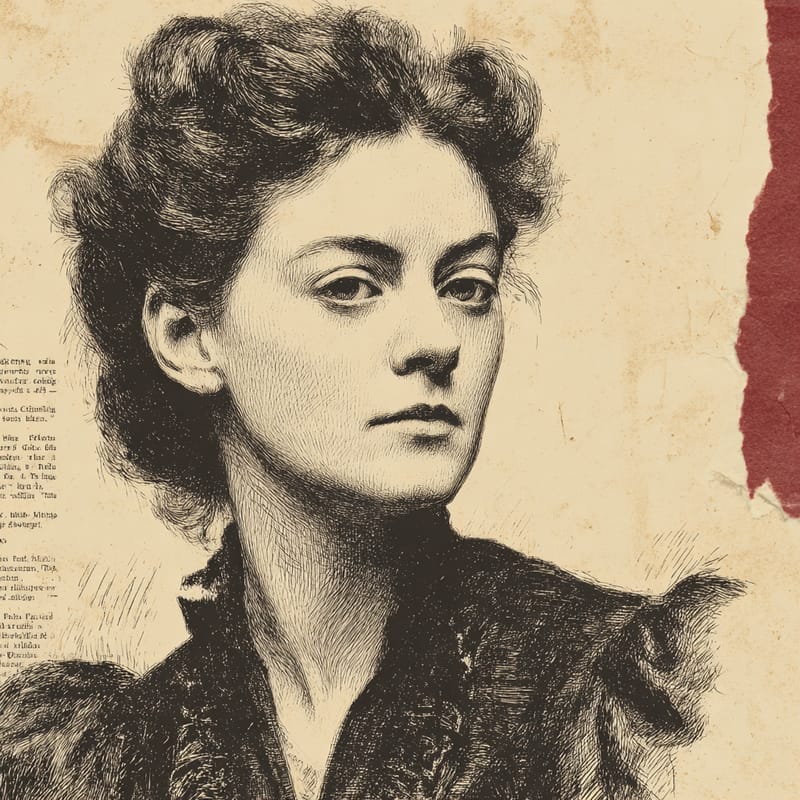
Eleanor Marx
Socialism and women's freedom
Organiser of the new unionism.
Progressive Classical MarxistOne of 729 ideologies · enter the Classical Marxist hall →- Role
- Activist & translator
- Era
- 1855–1898
- Region
- United Kingdom
- Social band
- Progressive
- Placement
- −92 · −44 · +70
§ Where Eleanor Marx stands
3 axesEleanor Marx shared her father's goal of common ownership of the means of production, and she pursued it by organising unskilled workers whom the old craft unions had ignored. She helped found the National Union of Gasworkers and General Labourers in 1889, served on its executive and campaigned for a legal eight-hour day, helping to stage London's great May Day demonstration of 1890.
She favoured democratic organisation from below rather than conspiracy or state command: the Socialist League she co-founded in 1884 broke with the Social Democratic Federation's autocratic leadership, and she worked through unions, mass meetings and the Second International, attending its founding congress in Paris in 1889. She also opposed the anarchists who later took control of the League.
Eleanor Marx was a pioneering socialist feminist who argued in The Woman Question (1886), written with Edward Aveling, that women's subordination was rooted in economic dependence and would end only with socialism. She organised women workers, promoted Ibsen's dramas of female emancipation in Britain and, speaking to Jewish workers in London's East End, proudly identified with her Jewish heritage.
How close are you to Eleanor Marx?
Three statements, one per axis. Answer them and we’ll drop you on the compass next to them.
§ The story
HistoricalJenny Julia Eleanor Marx (1855–1898), known in her family as Tussy, was a British socialist organiser, writer and translator, the youngest daughter of Karl Marx. Born in London, she grew up in a household of German émigrés, worked as her father's secretary and assistant, and after his death in 1883 helped Friedrich Engels with her father's papers. A skilled translator, she published an English translation of Flaubert's Madame Bovary in 1886 and championed the plays of Henrik Ibsen in Britain.
Eleanor Marx left the Social Democratic Federation with William Morris in 1884 to found the Socialist League, and she became one of the most effective organisers of the new unionism of unskilled workers, helping Will Thorne build the Gasworkers' union in 1889 and supporting that year's London Dock Strike. She co-wrote The Woman Question (1886) with her partner Edward Aveling, linking women's emancipation to socialism. She died by suicide in 1898 after learning that Aveling had secretly married another woman, and later biographers, notably Yvonne Kapp, rescued her career from neglect.
Notable for
- 01New-unionism organiser
- 02Socialist-feminist pioneer
- 03Translated key socialist texts
Key works & moments
- 1884Leaves the Social Democratic Federation with William Morris to found the Socialist League.
- 1886Co-writes The Woman Question with Edward Aveling and publishes her translation of Madame Bovary.
- 1889Helps Will Thorne build the Gasworkers' union and supports the London Dock Strike.
- 1889Attends the founding congress of the Second International in Paris.
- 1890Helps organise London's first great May Day rally for the eight-hour day.
- 1898Dies by suicide in Sydenham after discovering Aveling's secret marriage.
§ Minds closest to Eleanor Marx
All minds →

§ Also in the Classical Marxist hall
Enter the hall →§ Common questions
4 answersWhat was Eleanor Marx's political ideology?
Eleanor Marx was a Marxist socialist and pioneering socialist feminist: on the 99ideologies three-axis compass, a Progressive Classical Marxist. Economically she sat at the far left (−92), working for common ownership and the organisation of unskilled labour. On governance she leaned libertarian (−44), favouring democratic organisation from below through unions and mass movements rather than conspiracy or state command, and socially she was strongly progressive (+70), insisting that women's emancipation was central to socialism.
Was Eleanor Marx left-wing or right-wing?
Left-wing without qualification. Eleanor Marx devoted her life to socialism, helped found the Socialist League, organised the new unions of unskilled workers and took part in the founding of the Second International. Within the left she stood for democratic, mass-based Marxism rather than insurrectionary conspiracy or anarchism, and she pressed the labour movement to take up women's emancipation and internationalism, which places her on the far left economically and on the progressive, anti-authoritarian side of the socialist tradition.
What did Eleanor Marx do for the labour movement?
She helped turn Marxist ideas into practical organisation among Britain's unskilled workers. In 1889 Eleanor Marx helped Will Thorne build the National Union of Gasworkers and General Labourers, which won an eight-hour day at London gasworks, and she supported the London Dock Strike that year. She organised women workers, helped stage the 1890 May Day demonstration in Hyde Park, translated and interpreted at international socialist congresses, and lectured widely, making her a leading figure of the new unionism.
Which minds are closest to Eleanor Marx?
On the 99ideologies three-axis compass, the minds closest to Eleanor Marx are Friedrich Engels (96% alike), Paul Lafargue (96% alike) and The Spectre of Communism (archetype) (96% alike). The furthest is Adam Sutler (0% alike).