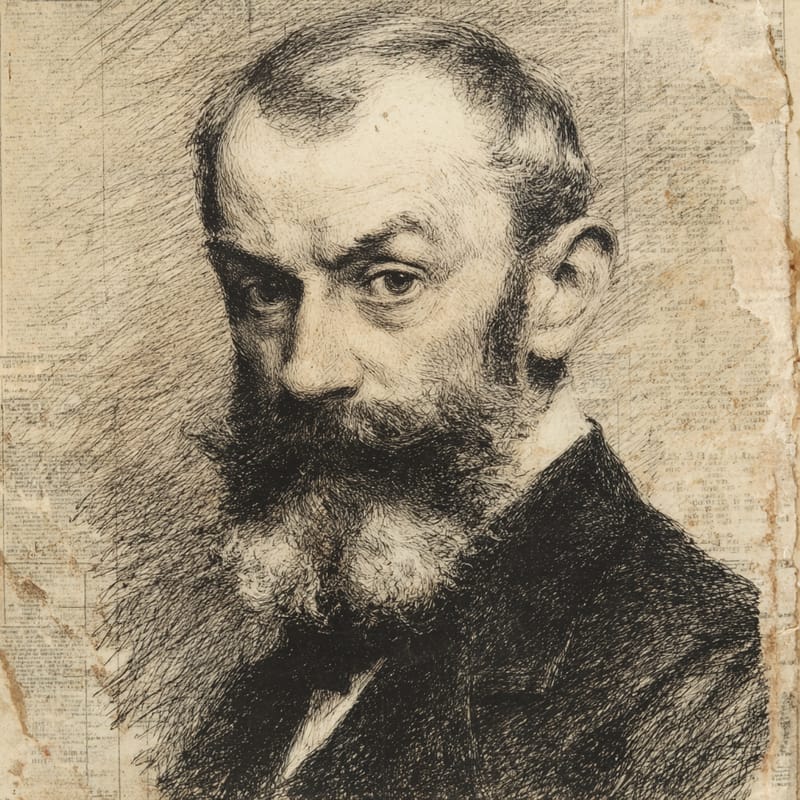
Paul Lafargue
The right to be lazy
Marxism with wit and leisure.
Reformist Classical MarxistOne of 729 ideologies · enter the Classical Marxist hall →- Role
- Writer & socialist
- Era
- 1842–1911
- Region
- France / Cuba
- Social band
- Reformist
- Placement
- −90 · −46 · +60
§ Where Paul Lafargue stands
3 axesLafargue wanted the means of production held in common and helped shape the Parti Ouvrier programme whose preamble Marx dictated to Guesde in London in 1880. His twist was to judge socialism by the free time it would give: The Right to Be Lazy argues that capitalist overwork breeds gluts and misery, and that machines under common ownership should shorten the working day to three hours.
He worked through a legal mass party, elections and trade-union agitation rather than conspiracy, and sat in the Chamber of Deputies for Lille from 1891 to 1893. Yet he remained a revolutionary who expected class struggle to end capitalism, opposed socialists joining bourgeois cabinets during the 1899 Millerand affair, and entered the unified SFIO in 1905.
Lafargue was a provocative modernist who attacked the work ethic preached by Christian and bourgeois moralists alike, ridiculing the worship of labour as a disastrous dogma. He wrote satires against religion such as The Religion of Capital (1887) and defended a materialist, secular reading of history, morals and custom.
How close are you to Paul Lafargue?
Three statements, one per axis. Answer them and we’ll drop you on the compass next to them.
§ The story
HistoricalPaul Lafargue (1842–1911) was a French socialist writer, physician and organiser, born in Santiago de Cuba to a family of mixed French and Caribbean descent and raised in Bordeaux. Expelled from the Paris medical faculty for revolutionary agitation after an international students' congress at Liège in 1865, he met Karl Marx in London, joined the First International and in 1868 married Marx's daughter Laura. With Jules Guesde he founded the Marxist workers' party that became the Parti Ouvrier Français.
Lafargue's lasting fame rests on The Right to Be Lazy, first serialised in 1880, which mocked the 1848 demand for a 'right to work' and argued that machinery should cut the working day to three hours. A tireless propagandist for Marxism in France and Spain, he was jailed for his speeches and won a parliamentary seat for Lille in 1891 while in prison. Marx, irritated by French Marxist dogmatism, is reported by Engels to have told him that he himself was no Marxist. In 1911 Lafargue and Laura ended their lives together at Draveil, and Lenin spoke at their funeral.
Notable for
- 01'The Right to Be Lazy'
- 02Founded French Marxism with Guesde
- 03Anti-work polemic
Key works & moments
- 1865Attends the Liège international students' congress and is expelled from the Paris medical faculty.
- 1868Marries Laura, daughter of Karl Marx, in London.
- 1880Helps launch the Parti Ouvrier programme with Guesde and Marx; serialises The Right to Be Lazy.
- 1883Publishes The Right to Be Lazy as a pamphlet, prefaced from Sainte-Pélagie prison.
- 1891Elected deputy for Lille while jailed over speeches after the Fourmies May Day shooting.
- 1911Dies with Laura in a suicide pact at Draveil; Lenin speaks at their funeral.
In their own words
“A strange delusion possesses the working classes of the nations where capitalist civilization holds its sway.”
§ Minds closest to Paul Lafargue
All minds →

§ Also in the Classical Marxist hall
Enter the hall →§ Common questions
4 answersWhat was Paul Lafargue's political ideology?
Paul Lafargue was a Marxist socialist: on the 99ideologies three-axis compass, a Reformist Classical Marxist. Economically he sat at the far left (−90), seeking common ownership of the means of production and a drastically shorter working day. On governance he was moderately anti-authoritarian (−46), building a legal mass party and winning election in 1891 while refusing coalition with bourgeois governments. Socially he was clearly progressive (+60), a secular satirist of religion and of the work ethic.
Was Paul Lafargue left-wing or right-wing?
Firmly left-wing. Lafargue spent his life spreading Marxism in France and Spain, co-founded France's first Marxist party and wanted capitalism replaced by collective ownership. What set him apart within the left was his emphasis: rather than glorifying labour, as much of the socialist movement did, he argued that liberation meant less work and more leisure. He pursued that goal through elections, strikes and propaganda rather than insurrection, which is why he reads as a reformist within classical Marxism.
What did Paul Lafargue mean by 'the right to be lazy'?
He meant that workers should demand less work, not more. Written as a riposte to the 'right to work' raised in the 1848 revolution, the pamphlet argues that capitalist societies have made a religion of toil, driving workers to exhaustion while overproduction causes crises and unemployment. Lafargue proposed that, with modern machinery, no one should work more than three hours a day, leaving the rest for rest, pleasure and culture. Ironic in tone, it has become a founding text for later anti-work and post-work thinkers.
Which minds are closest to Paul Lafargue?
On the 99ideologies three-axis compass, the minds closest to Paul Lafargue are The Spectre of Communism (archetype) (98% alike), Friedrich Engels (97% alike) and Karl Marx (97% alike). The furthest is Adam Sutler (0% alike).