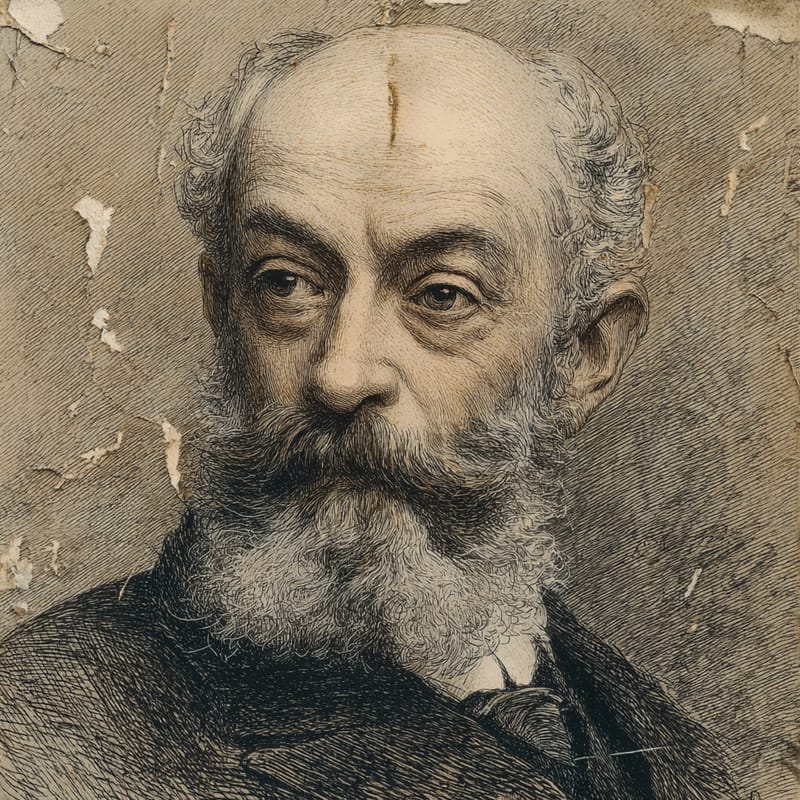
Wilhelm Liebknecht
Knowledge is power
Co-founder of German socialism.
Reformist Classical MarxistOne of 729 ideologies · enter the Classical Marxist hall →- Role
- Party founder
- Era
- 1826–1900
- Region
- Germany
- Social band
- Reformist
- Placement
- −88 · −42 · +45
§ Where Wilhelm Liebknecht stands
3 axesLiebknecht wanted capitalism replaced by collective ownership; the Eisenach programme of 1869 called for abolishing the wage system through cooperative labour. At Gotha in 1875 he accepted Lassallean demands such as state-aided producer cooperatives to unite the movement, but he treated them as steps toward socialism rather than ends in themselves.
A veteran of 1848, Liebknecht fought for universal suffrage, a free press and a democratic republic against Bismarck's authoritarian monarchy, and spent years in prison for it. After arguing in an 1869 speech that the Reichstag should serve only as a platform for agitation, he built a disciplined but legal mass party that came to treat parliament as its main stage.
Liebknecht saw education as the key to working-class emancipation, a theme of his 1872 lecture Knowledge Is Power – Power Is Knowledge to Dresden's workers' educational association. He was an internationalist who opposed the annexation of Alsace-Lorraine, and the party he helped lead demanded secular schools and equal rights for women in its 1891 Erfurt Programme.
How close are you to Wilhelm Liebknecht?
Three statements, one per axis. Answer them and we’ll drop you on the compass next to them.
§ The story
HistoricalWilhelm Liebknecht (1826–1900) was born in Giessen in Hesse and fought in the Baden revolution of 1848–49 before fleeing into exile. In London from 1850 to 1862 he became a close companion of Karl Marx and Friedrich Engels. Back in Germany he partnered with the young August Bebel in Leipzig, and in 1869 the two founded the Social Democratic Workers' Party at Eisenach, which merged with the Lassalleans in 1875 in the party later renamed the SPD.
Liebknecht and Bebel defied Bismarck's Germany from the Reichstag, refusing to back war credits in 1870 and condemning the annexation of Alsace-Lorraine, and in 1872 they were convicted of preparing high treason. He helped steer the movement through the Anti-Socialist Laws of 1878–1890 and edited the party daily Vorwärts from 1891 until his death. Marx attacked the compromise Gotha Programme he negotiated in 1875, but Liebknecht's mass, educated party became the model for European socialism. His son Karl was murdered in 1919 as a leader of the Spartacists.
Notable for
- 01Co-founded the SPD
- 02Workers'-education movement
- 03'Knowledge is power'
Key works & moments
- 1849Fights in the Baden uprising and escapes into exile in Switzerland.
- 1850–62Lives in London exile in the circle of Marx and Engels.
- 1869Co-founds the Social Democratic Workers' Party with August Bebel at Eisenach.
- 1872Lectures on Knowledge Is Power – Power Is Knowledge; convicted with Bebel of preparing high treason.
- 1875Negotiates the Gotha unity congress, merging his party with the Lassalleans.
- 1891Becomes editor-in-chief of the SPD's central newspaper Vorwärts.
§ Minds closest to Wilhelm Liebknecht
All minds →

§ Also in the Classical Marxist hall
Enter the hall →§ Common questions
4 answersWhat was Wilhelm Liebknecht's political ideology?
Wilhelm Liebknecht was a Marxist social democrat: on the 99ideologies three-axis compass, a Reformist Classical Marxist. Economically he sat at the far left (−88), seeking the abolition of the wage system and collective ownership. On governance he leaned libertarian (−42), a democrat and republican who opposed Bismarck's authoritarian state and built a legal mass party. Socially he was progressive (+45), stressing workers' education, internationalism and secular schooling.
Was Wilhelm Liebknecht left-wing or right-wing?
Left-wing. Liebknecht was a revolutionary of 1848, a friend of Marx and a founder of German Social Democracy, the largest socialist party of its day. His methods were those of the democratic left: elections, newspapers, education and parliamentary agitation, even under the Anti-Socialist Laws. Some on the far left saw his 1875 compromise with the Lassalleans as too moderate, and Marx attacked it, but his goal of a socialist society never changed.
Did Wilhelm Liebknecht found the SPD?
Yes, together with August Bebel. The two founded the Social Democratic Workers' Party at Eisenach in 1869, a Marxist-leaning rival to Ferdinand Lassalle's General German Workers' Association. In 1875 Liebknecht negotiated the merger of the two at Gotha into the Socialist Workers' Party of Germany, which took the name Social Democratic Party of Germany in 1890. He then edited its newspaper Vorwärts, making him one of the party's chief founders and its leading journalist until his death in 1900.
Which minds are closest to Wilhelm Liebknecht?
On the 99ideologies three-axis compass, the minds closest to Wilhelm Liebknecht are Georgi Plekhanov (99% alike), Antonio Labriola (99% alike) and Karl Kautsky (98% alike). The furthest is Adam Sutler (0% alike).