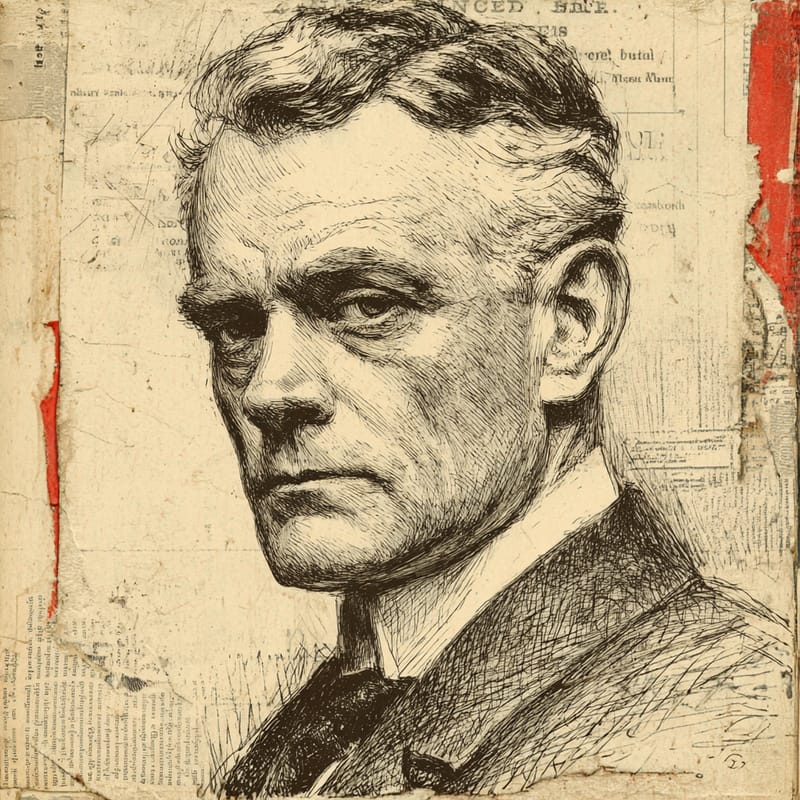
James P. Cannon
American Trotskyism
Built the US revolutionary left.
Reformist TrotskyistOne of 729 ideologies · enter the Trotskyist hall →- Role
- Party leader
- Era
- 1890–1974
- Region
- United States
- Social band
- Reformist
- Placement
- −92 · +50 · +55
§ Where James P. Cannon stands
3 axesCannon wanted American capitalism overthrown and industry run by a workers' government. He came to politics through the Industrial Workers of the World, and in the 1939–40 faction fight he defended Trotsky's view that the Soviet Union's nationalised economy should be defended against capitalist powers despite Stalin's crimes, a dispute that split the party when Max Shachtman's minority walked out.
A Leninist party-builder, Cannon prized a disciplined proletarian party, the case he made in The Struggle for a Proletarian Party (1943). Yet he worked through legal propaganda, elections and union organising, and at the 1941 Minneapolis Smith Act trial he defended the party's right to advocate socialism, testimony published as Socialism on Trial.
Cannon's social commitments came through labour struggle and civil-liberties defence. From 1925 he led International Labor Defense, campaigning for Sacco and Vanzetti and other jailed radicals, and his Socialist Workers Party campaigned against Jim Crow segregation, though class struggle rather than cultural change remained his focus.
How close are you to James P. Cannon?
Three statements, one per axis. Answer them and we’ll drop you on the compass next to them.
§ The story
HistoricalJames Patrick Cannon (1890–1974) was the founder of American Trotskyism. Born in Rosedale, Kansas, he joined the Socialist Party in 1908 and became an organiser for the Industrial Workers of the World. After 1919 he was a founding leader of the American Communist movement and headed its International Labor Defense, until in 1928, at the Comintern congress in Moscow, he read Trotsky's suppressed critique of the Comintern's draft programme, embraced it and was expelled on his return.
Cannon built the Communist League of America and then the Socialist Workers Party, founded in 1938, the most important Trotskyist party outside Europe. In 1941 he and 17 comrades were convicted in the first prosecution under the Smith Act, which made advocating the overthrow of the government a crime, and he went to prison at the end of 1943. In 1953 his Open Letter against Michel Pablo split the Fourth International. Admirers credit him with sustaining a revolutionary party through American anticommunism; his opponents in the 1939–40 faction fight accused him of bureaucratic conservatism.
Notable for
- 01Founded the Socialist Workers Party
- 02Defendant in the Smith Act trial
- 03'The History of American Trotskyism'
Key works & moments
- 1928Reads Trotsky's suppressed critique at the Comintern congress in Moscow; expelled from the US Communist Party.
- 1929Founds the Communist League of America, publishing The Militant.
- 1938Founds the Socialist Workers Party and becomes its national secretary.
- 1941Convicted with 17 comrades in the first Smith Act prosecution and sentenced to 16 months in prison.
- 1944Publishes The History of American Trotskyism, based on lectures given in 1942.
- 1953Issues the Open Letter against Michel Pablo that splits the Fourth International.
§ Minds closest to James P. Cannon
All minds →





§ Also in the Trotskyist hall
Enter the hall →§ Common questions
4 answersWhat was James P. Cannon's political ideology?
James P. Cannon was a Trotskyist communist: on the 99ideologies three-axis compass, a Reformist Trotskyist, the first word describing his social outlook rather than any preference for gradual change. Economically he sat at the far socialist end (−92), seeking workers' ownership through revolution; on governance he leaned authoritarian (+50) as a Leninist builder of a disciplined vanguard party; and socially he was clearly progressive (+55), a labour militant and defender of civil liberties and jailed radicals.
Was James P. Cannon left-wing or right-wing?
Far left. Cannon moved from the Industrial Workers of the World to the Communist Party and then to Trotskyism, always seeking the revolutionary overthrow of capitalism. His expulsion from the Communist Party in 1928 was for opposing Stalin from the left, and his Socialist Workers Party stood outside both the Democratic Party and the Moscow-aligned communists. Its leaders were jailed under the Smith Act for their revolutionary advocacy, which underlines how far from the mainstream he stood.
What was the Smith Act trial of 1941?
It was the first prosecution under the Alien Registration Act of 1940, known as the Smith Act, which made it a crime to advocate the violent overthrow of the US government. In 1941 federal prosecutors in Minneapolis charged leaders of the Socialist Workers Party and of Teamsters Local 544, and 18 defendants, including Cannon, were convicted of conspiring to advocate overthrow and sentenced to between 12 and 16 months. The Communist Party backed the prosecution, before its own leaders were indicted under the same law in 1948.
Which minds are closest to James P. Cannon?
On the 99ideologies three-axis compass, the minds closest to James P. Cannon are Michel Pablo (99% alike), Tony Cliff (98% alike) and Leon Trotsky (98% alike). The furthest is Hans-Hermann Hoppe (0% alike).