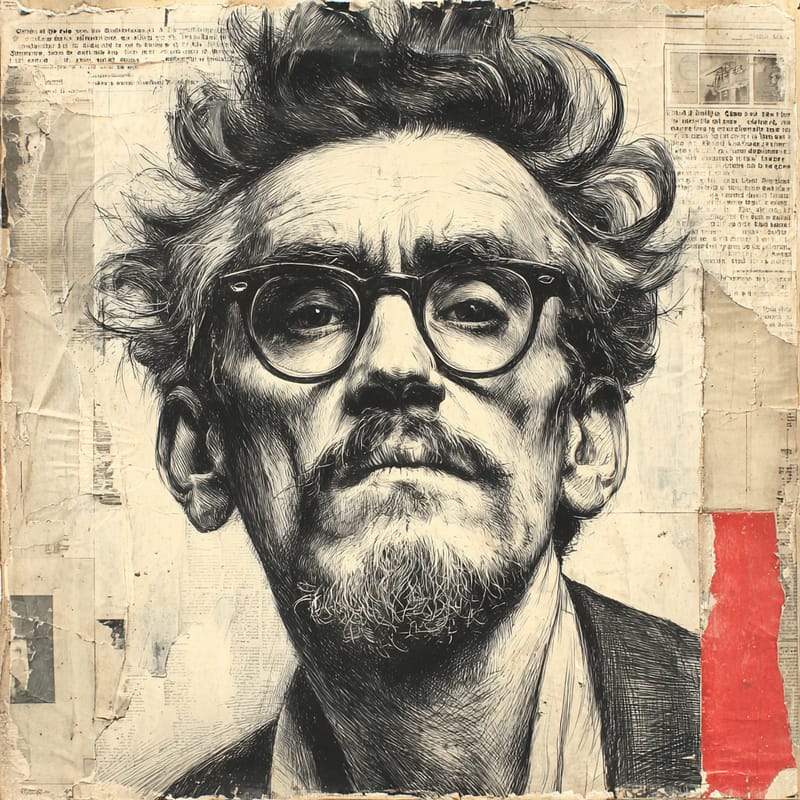
Leon Trotsky
Permanent revolution
World revolution against the bureaucratic state.
Reformist TrotskyistOne of 729 ideologies · enter the Trotskyist hall →- Role
- Revolutionary & theorist
- Era
- 1879–1940
- Region
- Russia
- Social band
- Reformist
- Placement
- −94 · +52 · +60
§ Where Leon Trotsky stands
3 axesTrotsky wanted the economy wholly socialised and centrally planned. In 1920 he argued for the militarisation of labour, and from 1923 his Left Opposition pressed for faster industrialisation and stronger planning than the party majority allowed under the New Economic Policy. In The Revolution Betrayed (1936) he still defended state ownership as the great conquest of 1917 while attacking the bureaucracy that ran it.
Trotsky was a revolutionary authoritarian in power and a critic of dictatorship in exile. As war commissar he defended the Red Terror in Terrorism and Communism (1920) and helped crush the Kronstadt sailors' revolt in 1921. Later he called the Soviet Union a degenerated workers' state and urged a political revolution against its bureaucracy, though he never embraced parliamentary democracy.
A cosmopolitan modernist, Trotsky wrote Literature and Revolution (1924) on art and culture, and Problems of Everyday Life (1923), which addressed the family, women's emancipation, religion and the drinking and swearing of the old order. In 1938 he co-wrote the Manifesto for an Independent Revolutionary Art with André Breton, defending artistic freedom against Stalinist conformity.
How close are you to Leon Trotsky?
Three statements, one per axis. Answer them and we’ll drop you on the compass next to them.
§ The story
HistoricalLeon Trotsky, born Lev Davidovich Bronstein (1879–1940) to a Jewish farming family in southern Ukraine, was a leader of the Russian Revolution and the founder of the Red Army. Twice exiled to Siberia and twice escaped, he chaired the St Petersburg Soviet in 1905, joined the Bolsheviks in 1917 and organised the October insurrection in Petrograd. He then served as commissar for foreign affairs, leading the Brest-Litovsk peace talks, and from 1918 to 1925 as commissar for war.
After Lenin's death Trotsky led the Left Opposition against Stalin, demanding faster industrialisation and party democracy, and lost: he was expelled from the party in 1927 and deported in 1929. From exile in Turkey, France, Norway and Mexico he denounced Stalinism, was condemned in absentia at the Moscow show trials and founded the Fourth International in 1938. In August 1940 the NKVD agent Ramón Mercader killed him with an ice axe in Coyoacán. Admirers see an incorruptible critic of Stalinism; critics recall his defence of the Red Terror and his role in crushing the Kronstadt rising of 1921.
Notable for
- 01Theory of permanent revolution
- 02Founded the Fourth International
- 03Assassinated in exile, 1940
Key works & moments
- 1905–06Chairs the St Petersburg Soviet; in prison writes Results and Prospects, outlining permanent revolution.
- 1917Leads the Petrograd Soviet's Military Revolutionary Committee in the October seizure of power.
- 1918–25As People's Commissar for War, builds the Red Army and leads it through the Civil War.
- 1929Deported from the Soviet Union after losing the power struggle with Stalin.
- 1938Founds the Fourth International at a conference near Paris.
- 1940Assassinated at his home in Coyoacán, Mexico, by the NKVD agent Ramón Mercader.
In their own words
“In a country where the sole employer is the State, opposition means death by slow starvation. The old principle: who does not work shall not eat, has been replaced by a new one: who does not obey shall not eat.”
“Life is beautiful. Let the future generations cleanse it of all evil, oppression and violence, and enjoy it to the full.”
§ Minds closest to Leon Trotsky
All minds →

§ Also in the Trotskyist hall
Enter the hall →§ Common questions
4 answersWhat was Leon Trotsky's political ideology?
Leon Trotsky was a revolutionary Marxist whose ideas define Trotskyism: on the 99ideologies three-axis compass, a Reformist Trotskyist, where the first word describes his social outlook, not gradualism, which he rejected. He sat at the far socialist end economically (−94), backing full state ownership and planning; he leaned authoritarian on governance (+52), defending revolutionary dictatorship while attacking Stalin's bureaucracy; and he was clearly progressive socially (+60), a cosmopolitan modernist hostile to religion and nationalism.
Was Leon Trotsky left-wing or right-wing?
Far left. Trotsky sought to abolish capitalism worldwide through proletarian revolution and founded the Red Army to defend the Bolshevik state. His break with Stalin was a dispute within communism, not a move towards the centre: he attacked Stalin for betraying the revolution, for the doctrine of socialism in one country and for bureaucratic privilege, while still defending the Soviet planned economy. His governance record is the nuance: authoritarian in power, a critic of dictatorship in exile.
What is the theory of permanent revolution?
It is Trotsky's argument, first set out in Results and Prospects (1906) and developed in The Permanent Revolution (1930), that in backward countries such as Russia the bourgeoisie was too weak to carry out its own democratic revolution, so the working class would have to lead it and would then move straight on to socialist measures. Because socialism could not be completed in one isolated country, the revolution would have to spread internationally. Stalin's doctrine of socialism in one country, advanced in 1924, was its direct opposite.
Which minds are closest to Leon Trotsky?
On the 99ideologies three-axis compass, the minds closest to Leon Trotsky are Tony Cliff (99% alike), Michel Pablo (99% alike) and James P. Cannon (98% alike). The furthest is Hans-Hermann Hoppe (0% alike).