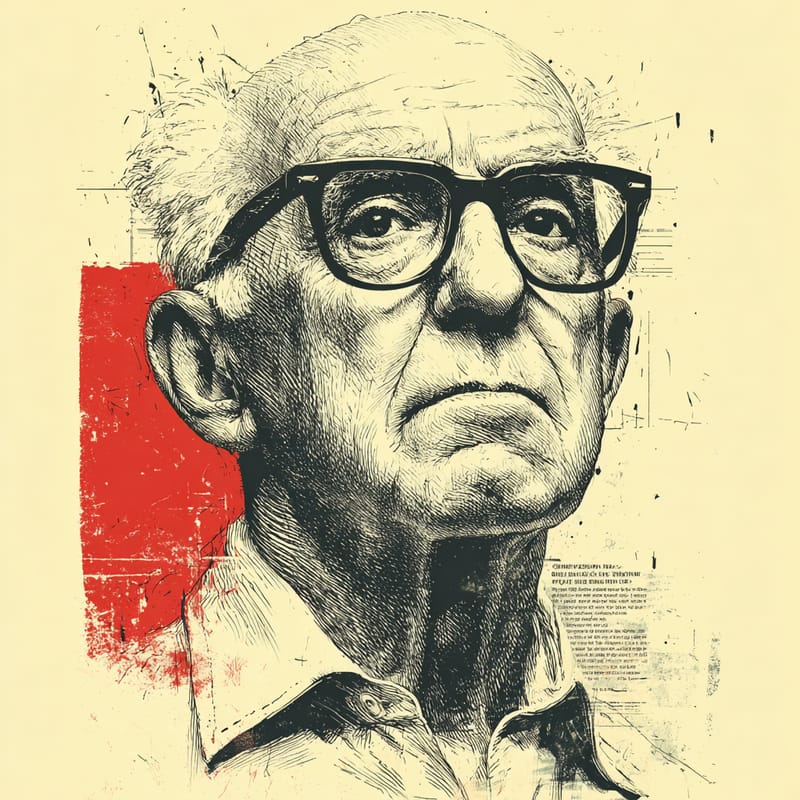
Tony Cliff
State capitalism
The USSR was never socialist.
Reformist TrotskyistOne of 729 ideologies · enter the Trotskyist hall →- Role
- Party leader & theorist
- Era
- 1917–2000
- Region
- Palestine / UK
- Social band
- Reformist
- Placement
- −92 · +50 · +60
§ Where Tony Cliff stands
3 axesCliff wanted capitalism replaced by an economy owned and run by workers themselves. In The Nature of Stalinist Russia (1948), later republished as State Capitalism in Russia, he argued that nationalised property alone did not make socialism: because the Soviet bureaucracy extracted the surplus and competed militarily with the West, it behaved as a collective capitalist, so its planned economy was no model.
Cliff was a Leninist who believed only a disciplined revolutionary party could lead the working class to power, and his four-volume Lenin (1975–79) celebrated democratic centralism. Yet his tradition prized socialism from below: rank-and-file self-activity and workers' councils rather than seizure of the state by a minority, and he saw the Stalinist police states as counter-revolutionary.
Cliff's politics were anti-racist, anti-Zionist and internationalist. His party helped launch the Anti-Nazi League in 1977 to confront the National Front, and in Class Struggle and Women's Liberation (1984) he backed women's emancipation while arguing that it depended on working-class struggle rather than on separatist feminism.
How close are you to Tony Cliff?
Three statements, one per axis. Answer them and we’ll drop you on the compass next to them.
§ The story
HistoricalTony Cliff (1917–2000) was born Yigael Gluckstein to a Zionist family in Zichron Yaakov, in Ottoman-ruled Palestine. He became a Trotskyist as a teenager and argued for unity between Arab and Jewish workers against both Zionism and British rule, which brought him a spell in British detention. He moved to Britain after the Second World War, spent several years in Dublin when the authorities refused him residence, and settled in London in 1952, where he built the group that became the Socialist Workers Party.
Cliff's defining idea was that the Soviet Union was not a workers' state, degenerated or otherwise, but bureaucratic state capitalism, with the bureaucracy acting as a ruling class. Summed up in the slogan Neither Washington nor Moscow, that thesis set his current apart from orthodox Trotskyism and gave the International Socialists and the SWP their identity. He wrote biographies of Rosa Luxemburg, Lenin and Trotsky and led his party into campaigns such as the Anti-Nazi League. Critics, including groups expelled from it, accused the party of top-down control; admirers credit it with sustaining revolutionary Marxism in British unions and universities.
Notable for
- 01State-capitalism theory
- 02Founded the Socialist Workers Party (UK)
- 03'Socialism from below'
Key works & moments
- 1930sAs a young Trotskyist in Palestine, campaigns for Arab–Jewish workers' unity against Zionism and British rule.
- 1948Writes The Nature of Stalinist Russia, arguing that the USSR is bureaucratic state capitalism.
- 1950Founds the Socialist Review Group after refusing to back either side in the Korean War.
- 1963Publishes Deflected Permanent Revolution, explaining the Chinese and Cuban revolutions without working-class leadership.
- 1977His International Socialists relaunch as the Socialist Workers Party and help found the Anti-Nazi League.
§ Minds closest to Tony Cliff
All minds →

§ Also in the Trotskyist hall
Enter the hall →§ Common questions
4 answersWhat was Tony Cliff's political ideology?
Tony Cliff was a revolutionary socialist in the Trotskyist tradition who broke with its orthodox wing: on the 99ideologies three-axis compass, a Reformist Trotskyist, the first word describing his social outlook rather than gradualism, which he rejected. He sat at the far socialist end economically (−92), demanding workers' ownership and control; he leaned authoritarian on governance (+50) as a Leninist party-builder; and he was clearly progressive socially (+60), anti-racist and internationalist.
Was Tony Cliff left-wing or right-wing?
Far left. Cliff sought the revolutionary overthrow of capitalism and founded Britain's largest far-left party, the Socialist Workers Party. His state-capitalism theory was a critique of the Soviet Union from the left, not a concession to the West: under the slogan Neither Washington nor Moscow he opposed both Cold War blocs. The governance nuance is his Leninism, which demanded a disciplined vanguard party even as he championed socialism from below.
Why did Tony Cliff call the Soviet Union state capitalist?
Because he concluded that the Soviet bureaucracy had become a ruling class. In The Nature of Stalinist Russia (1948) Cliff argued that after Stalin's first Five-Year Plan began in 1928, the bureaucracy controlled production, exploited workers and accumulated capital to compete militarily with the West, just as capitalists compete in a market. State ownership therefore did not make the USSR a workers' state, as orthodox Trotskyists held, but a form of bureaucratic state capitalism that socialists should not defend.
Which minds are closest to Tony Cliff?
On the 99ideologies three-axis compass, the minds closest to Tony Cliff are Leon Trotsky (99% alike), Michel Pablo (99% alike) and Emmanuel Goldstein (98% alike). The furthest is Hans-Hermann Hoppe (0% alike).