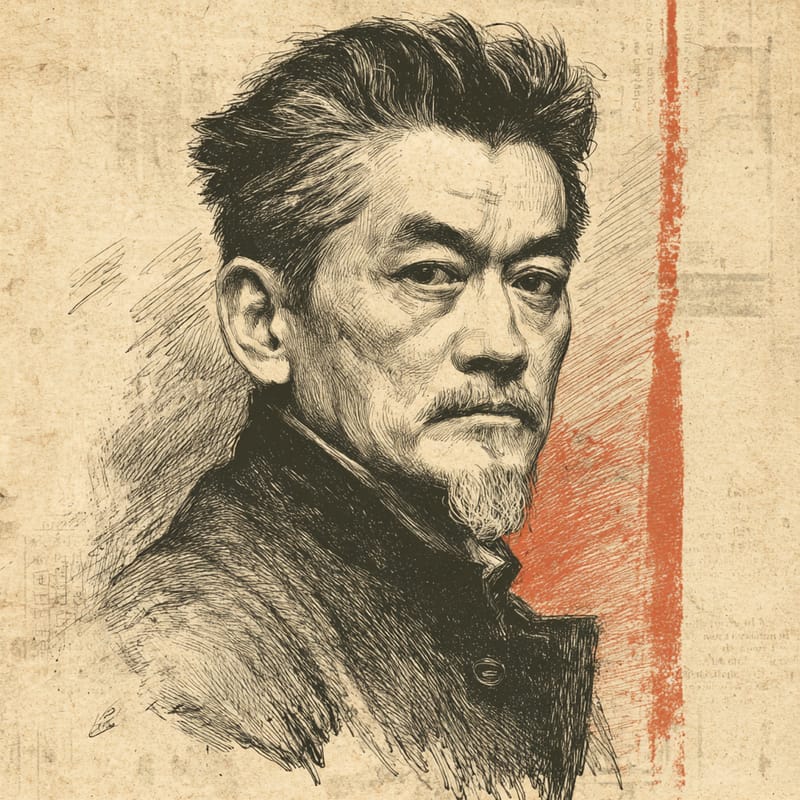
Mao Zedong
Continuous revolution
Peasant communism and permanent upheaval.
Reformist Stalinist-MarxistOne of 729 ideologies · enter the Stalinist-Marxist hall →- Role
- Chairman
- Era
- 1893–1976
- Region
- China
- Social band
- Reformist
- Placement
- −96 · +96 · +40
§ Where Mao Zedong stands
3 axesMao led China from land reform, which seized landlords' holdings from 1950, through the Soviet-style First Five-Year Plan of 1953–57 to full collectivisation. In 1958 the Great Leap Forward herded peasants into giant people's communes with communal kitchens and backyard steel furnaces, abolishing private plots, and even after the famine the economy stayed almost entirely state-owned and planned.
Mao built a one-party state that ruled through mass campaigns and fear. The Anti-Rightist Campaign of 1957 punished hundreds of thousands who had answered his call to criticise the party, the laogai labour camps held millions, and the Cultural Revolution's Red Guards humiliated, imprisoned and killed his rivals, all sustained by a personality cult built around the Little Red Book.
Mao attacked the inherited order head-on. The 1950 Marriage Law banned arranged marriage, concubinage and child betrothal, and in 1966 Red Guards were sent to destroy the 'Four Olds' of custom, culture, habits and ideas, smashing temples, books and antiques. That anti-traditional drive leans progressive on the compass, tempered by an enforced and puritanical ideological conformity.
How close are you to Mao Zedong?
Three statements, one per axis. Answer them and we’ll drop you on the compass next to them.
§ The story
HistoricalMao Zedong (1893–1976) was the founding leader of the People's Republic of China, which he ruled as chairman of the Chinese Communist Party until his death. The son of a prosperous peasant in Shaoshan, Hunan, he worked as an assistant in the Peking University library, attended the party's founding congress in 1921 and organised peasants in the 1920s. The Long March of 1934–35 carried him to the top of the party, and after victory in the civil war he proclaimed the People's Republic on 1 October 1949.
Mao adapted Marxism to an agrarian country, casting peasants rather than factory workers as the engine of revolution. In power he collectivised land and industry, and his Great Leap Forward of 1958–62 caused a famine that killed tens of millions, with estimates ranging from about 15 to 45 million. The Cultural Revolution he launched in 1966 turned the Red Guards against party rivals, intellectuals and China's cultural heritage. In 1981 the party formally condemned the Cultural Revolution while affirming that his achievements outweighed his errors, and his portrait still hangs over Tiananmen Gate.
Notable for
- 01Founded the People's Republic of China, 1949
- 02The Great Leap Forward
- 03The Cultural Revolution
Key works & moments
- 1921Attends the founding congress of the Chinese Communist Party in Shanghai as a delegate from Hunan.
- 1927Writes his Report on an Investigation of the Peasant Movement in Hunan, championing peasant revolution.
- 1934–35Survives the Long March; the Zunyi Conference of January 1935 lifts him into the top leadership.
- 1949Proclaims the People's Republic of China from Tiananmen Gate in Beijing on 1 October.
- 1958–62The Great Leap Forward forces peasants into communes; the ensuing famine kills tens of millions.
- 1966Launches the Cultural Revolution, mobilising Red Guards against party rivals and the 'Four Olds'.
In their own words
“A revolution is not a dinner party, or writing an essay, or painting a picture, or doing embroidery; it cannot be so refined, so leisurely and gentle, so temperate, kind, courteous, restrained and magnanimous.”
“Political power grows out of the barrel of a gun.”
§ Minds closest to Mao Zedong
All minds →


§ Also in the Stalinist-Marxist hall
Enter the hall →§ Common questions
4 answersWhat was Mao Zedong's political ideology?
Mao was a Marxist-Leninist who created his own variant, Maoism: on the 99ideologies three-axis compass, a Reformist Stalinist-Marxist. Economically he sat at the far left (−96), collectivising land and industry into a planned, state-owned economy. On governance he was near the authoritarian extreme (+96), ruling through a one-party state, mass campaigns and a personality cult, and socially he leaned progressive (+40), attacking Confucian tradition, arranged marriage and the 'Four Olds' while demanding strict ideological conformity.
Was Mao Zedong left-wing or right-wing?
Left-wing, and on the far left. Mao abolished private ownership of land and industry, organised the countryside into collective communes and justified his rule in the language of class struggle. His regime was extremely authoritarian, and he blended Marxism with Chinese nationalism, but his economic and social programme, from land reform to the assault on tradition, was a revolutionary communist one. Late in life he also opened relations with the United States, hosting Richard Nixon in Beijing in 1972.
How did Maoism differ from Soviet Marxism?
Mainly in its faith in the peasantry. Orthodox Marxism and Soviet practice cast the urban industrial working class as the revolutionary vanguard, but Mao, in writings such as his 1927 Hunan report, argued that China's peasants would lead the revolution, and he won power through a rural guerrilla war that encircled the cities. He also insisted that class struggle continued after the revolution, a doctrine of continuous revolution that justified the Cultural Revolution, and from the late 1950s China split bitterly with the Soviet Union.
Which minds are closest to Mao Zedong?
On the 99ideologies three-axis compass, the minds closest to Mao Zedong are Joseph Stalin (96% alike), Big Brother (96% alike) and Lazar Kaganovich (94% alike). The furthest is Hans-Hermann Hoppe (0% alike).