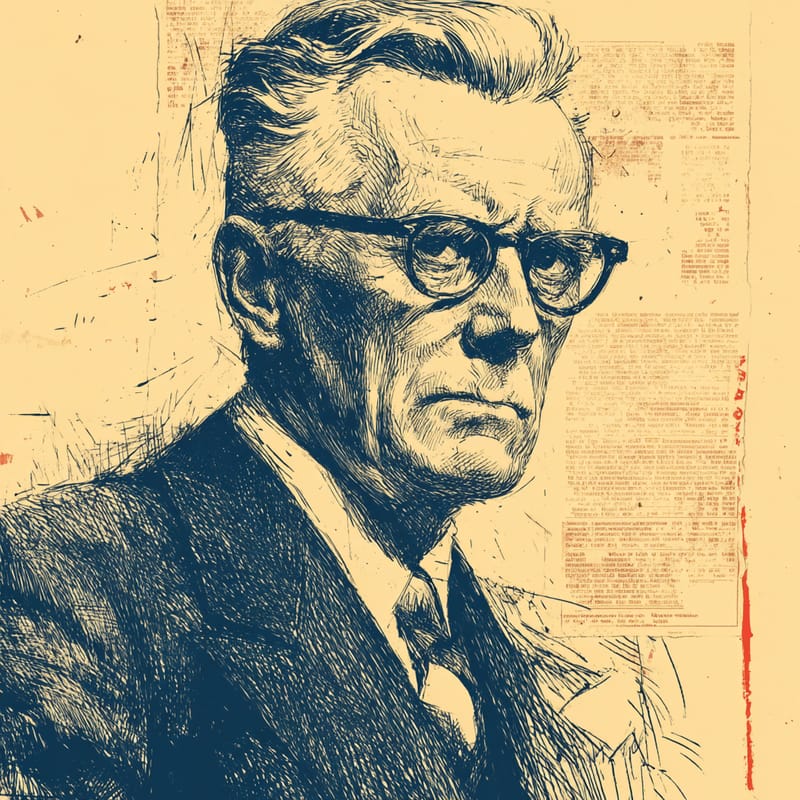
Gunnar Myrdal
The engineer of welfare
Social economics, Nobel-crowned.
Reformist Welfare CapitalistOne of 729 ideologies · enter the Welfare Capitalist hall →- Role
- Economist
- Era
- 1898–1987
- Region
- Sweden
- Social band
- Reformist
- Placement
- −10 · −22 · +38
§ Where Gunnar Myrdal stands
3 axesMyrdal argued that market economies left to themselves widen inequalities between people and regions, a process of cumulative causation he set out in Economic Theory and Under-developed Regions (1957). He wrote the economic appendix to the Social Democratic government's 1933 budget justifying deficit-financed public works, and in Beyond the Welfare State (1960) he defended democratic national planning within a market economy rather than public ownership.
Myrdal was a democratic reformer who trusted expert inquiry and open debate to change policy, from the Royal Population Commission of the mid-1930s to the UN Economic Commission for Europe, one of the few forums bridging East and West. His insistence in The Political Element in the Development of Economic Theory (1930) that values must be stated openly reflects that faith in transparent, democratic choice.
An American Dilemma (1944) argued that segregation and discrimination contradicted America's democratic creed, and it was cited by the Supreme Court in Brown v. Board of Education in 1954. With Alva Myrdal he championed family allowances, maternity care and better housing to support parenthood, though their Crisis in the Population Question (1934) also endorsed sterilising people deemed unfit, part of the era's technocratic eugenics.
How close are you to Gunnar Myrdal?
Three statements, one per axis. Answer them and we’ll drop you on the compass next to them.
§ The story
HistoricalKarl Gunnar Myrdal (1898–1987) was a Swedish economist, social scientist and Social Democratic politician. Born in Dalarna, he trained in law and then economics at Stockholm, became a leading figure of the Stockholm School and in 1933 a professor at Stockholm University. With his wife, Alva Myrdal, he wrote Crisis in the Population Question (1934), which shaped Swedish family policy, and he served as minister of commerce from 1945 to 1947 before leading the United Nations Economic Commission for Europe from 1947 to 1957.
Commissioned by the Carnegie Corporation in 1938, Myrdal directed the study of race in the United States published as An American Dilemma (1944), which argued that discrimination against Black Americans contradicted the nation's own democratic creed and was cited by the Supreme Court in Brown v. Board of Education. He later turned to development economics, publishing Asian Drama (1968), and shared the 1974 Nobel Memorial Prize in Economic Sciences with his ideological opposite, Friedrich Hayek. His wife, Alva, won the Nobel Peace Prize in 1982; critics fault the couple's technocratic social engineering, including their 1930s endorsement of sterilisation.
Notable for
- 01'An American Dilemma'
- 02Nobel Prize in Economics
- 03Architect of Swedish welfare policy
Key works & moments
- 1934Publishes Crisis in the Population Question with Alva Myrdal, shaping Swedish family policy.
- 1944An American Dilemma analyses racial discrimination in the United States.
- 1945Becomes Sweden's minister of commerce in the Social Democratic government.
- 1947Becomes executive secretary of the UN Economic Commission for Europe, serving until 1957.
- 1968Publishes Asian Drama, a three-volume study of poverty in South Asia.
- 1974Shares the Nobel Memorial Prize in Economic Sciences with Friedrich Hayek.
§ Minds closest to Gunnar Myrdal
All minds →


§ Also in the Welfare Capitalist hall
Enter the hall →§ Common questions
4 answersWhat was Gunnar Myrdal's political ideology?
Gunnar Myrdal was a Swedish social democrat and a leading economist of the welfare state: on the 99ideologies three-axis compass, a Reformist Welfare Capitalist. Economically he sits just left of centre (−10), favouring democratic planning and redistribution within a market economy. On governance he was a democratic reformer (−22) who trusted open inquiry and international cooperation, and socially he was progressive (+38), above all in his indictment of American racial discrimination.
Was Gunnar Myrdal left-wing or right-wing?
Left of centre. Myrdal was a Social Democratic politician and minister who helped design Sweden's welfare state and argued that unregulated markets deepen inequality between people, regions and nations. He was not a revolutionary socialist: he accepted private enterprise and markets but wanted them steered by democratic planning, public investment and redistribution. His 1974 Nobel, shared with the free-market economist Friedrich Hayek, was widely read as honouring two opposite poles of economic thought.
What was An American Dilemma about?
It was Myrdal's landmark 1944 study of race relations in the United States, commissioned by the Carnegie Corporation and written with a team of American scholars. Its dilemma was the conflict between the American Creed of liberty and equality and the treatment of Black Americans. Myrdal described a vicious circle in which white prejudice and Black disadvantage reinforced each other, and predicted that the creed would ultimately prevail. The Supreme Court cited the book in Brown v. Board of Education in 1954.
Which minds are closest to Gunnar Myrdal?
On the 99ideologies three-axis compass, the minds closest to Gunnar Myrdal are John Kenneth Galbraith (98% alike), Pierre Mendès France (97% alike) and Walter Reuther (97% alike). The furthest is Adam Sutler (20% alike).