
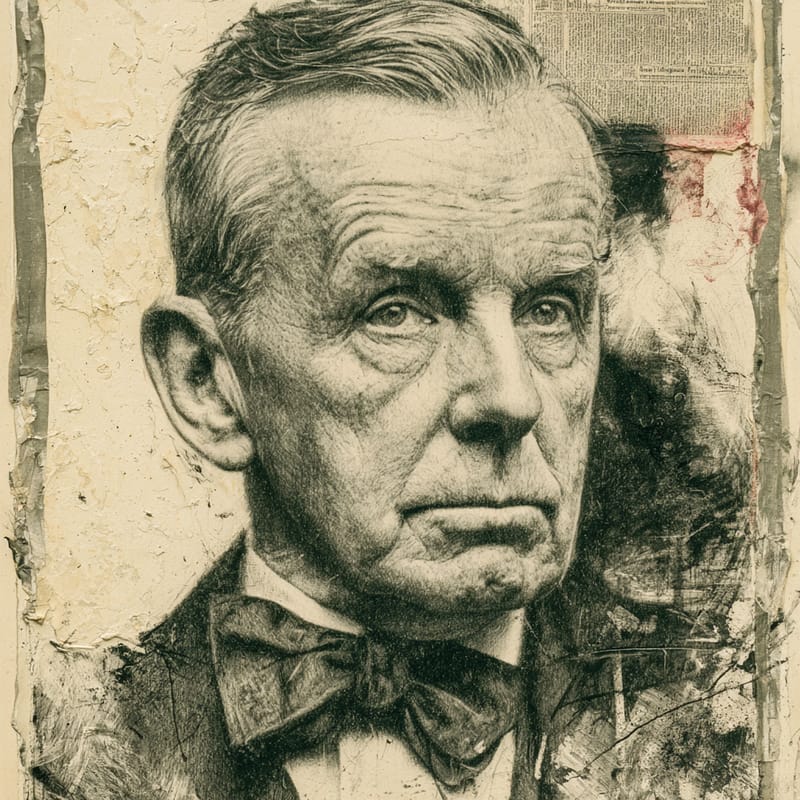
B. Seebohm Rowntree
Measured poverty
The Quaker who made want a fact.
Heterodox Welfare CapitalistOne of 729 ideologies · enter the Welfare Capitalist hall →- Role
- Reformer & industrialist
- Era
- 1871–1954
- Region
- United Kingdom
- Social band
- Heterodox
- Placement
- +2 · −20 · +18
§ Where B. Seebohm Rowntree stands
3 axesRowntree was a capitalist employer who believed industry could and should pay a living wage. The Human Needs of Labour (1918) calculated the minimum income a family needed, and at the family firm he introduced a pension scheme in 1906 and a works council after the First World War. He wanted the state to set minimums, not to run industry, which places him at the centre.
Rowntree worked through voluntary philanthropy, social research and advice to government rather than state compulsion. He served on Lloyd George's Land Enquiry before the First World War and directed the welfare department of the Ministry of Munitions from 1915, persuading employers and officials with evidence, and he ran his own firm with elected works councils as an experiment in industrial democracy.
A Quaker reformer, Rowntree insisted that poverty was mainly caused by low wages, sickness, old age and large families rather than personal failing, a finding of Poverty: A Study of Town Life (1901) that undercut Victorian moralism. His outlook kept a moral edge, however: English Life and Leisure (1951), written with G. R. Lavers, worried about gambling, drinking and changing sexual behaviour.
How close are you to B. Seebohm Rowntree?
Three statements, one per axis. Answer them and we’ll drop you on the compass next to them.
§ The story
HistoricalBenjamin Seebohm Rowntree (1871–1954) was an English sociologist, social reformer and industrialist. The son of the Quaker cocoa manufacturer Joseph Rowntree, he studied chemistry at Owens College in Manchester, joined the family firm in York in 1889 and later served as its chairman from 1923 to 1941. In 1899 he organised a house-to-house survey of working-class York, published as Poverty: A Study of Town Life (1901), which found that more than a quarter of the city's population lived in poverty and introduced the idea of a measurable poverty line.
The study distinguished primary poverty, where income could not cover bare physical needs, from secondary poverty caused by other spending, and traced a life cycle of want through childhood, parenthood and old age. By showing that low wages, large families and old age, rather than idleness, caused most poverty, it fed the Liberal welfare reforms of 1906–14. Rowntree advised David Lloyd George, ran the welfare department of the Ministry of Munitions during the First World War and repeated his York surveys in 1936 and 1950; his subsistence standards later informed the benefit rates in the Beveridge Report.
Notable for
- 01'Poverty: A Study of Town Life'
- 02Defined the poverty line
- 03Model welfare employer
Key works & moments
- 1899Begins a house-to-house survey of working-class households in York.
- 1901Publishes Poverty: A Study of Town Life, defining primary and secondary poverty.
- 1915Becomes director of the welfare department of the Ministry of Munitions.
- 1918Publishes The Human Needs of Labour, setting out minimum family living standards.
- 1941Publishes Poverty and Progress, his second survey of York, based on 1936 data.
- 1951Publishes Poverty and the Welfare State, a third York survey, with G. R. Lavers.
In their own words
“Families whose total earnings are insufficient to obtain the minimum necessaries for the maintenance of merely physical efficiency.”
§ Minds closest to B. Seebohm Rowntree
All minds →




§ Also in the Welfare Capitalist hall
Enter the hall →§ Common questions
4 answersWhat was B. Seebohm Rowntree's political ideology?
Seebohm Rowntree was a Quaker Liberal reformer and enlightened employer: on the 99ideologies three-axis compass, a Heterodox Welfare Capitalist. Economically he sits at the centre (+2), defending private industry while demanding living wages and state minimums. On governance he leaned liberal (−20), relying on research, persuasion and voluntary action rather than compulsion, and socially he was moderately progressive (+18), recasting poverty as a structural problem while keeping a moralist's concern with drink and gambling.
Was B. Seebohm Rowntree left-wing or right-wing?
Centrist, with a reforming lean. Rowntree was a Liberal and a capitalist who ran one of Britain's largest confectionery businesses, and he never favoured socialism or nationalisation. But his evidence that poverty stemmed from low wages and life-cycle hardship rather than vice became ammunition for social reformers, from the Liberal governments of 1906–14 to Labour's welfare state after 1945. His politics joined free enterprise to social responsibility, the welfare-capitalist middle ground.
What was Seebohm Rowntree's poverty line?
It was the minimum weekly income a household needed for what Rowntree called merely physical efficiency: enough for a bare nutritional diet, rent, clothing, fuel and household sundries, with nothing for newspapers, travel or treats. Families below it were in primary poverty; those above it who still lived in visible want were in secondary poverty. In York in 1899 he found about 10 per cent of the population in primary and about 18 per cent in secondary poverty, nearly 28 per cent in all.
Which minds are closest to B. Seebohm Rowntree?
On the 99ideologies three-axis compass, the minds closest to B. Seebohm Rowntree are William Beveridge (98% alike), Léon Bourgeois (96% alike) and Pierre Mendès France (93% alike). The furthest is Adam Sutler (28% alike).