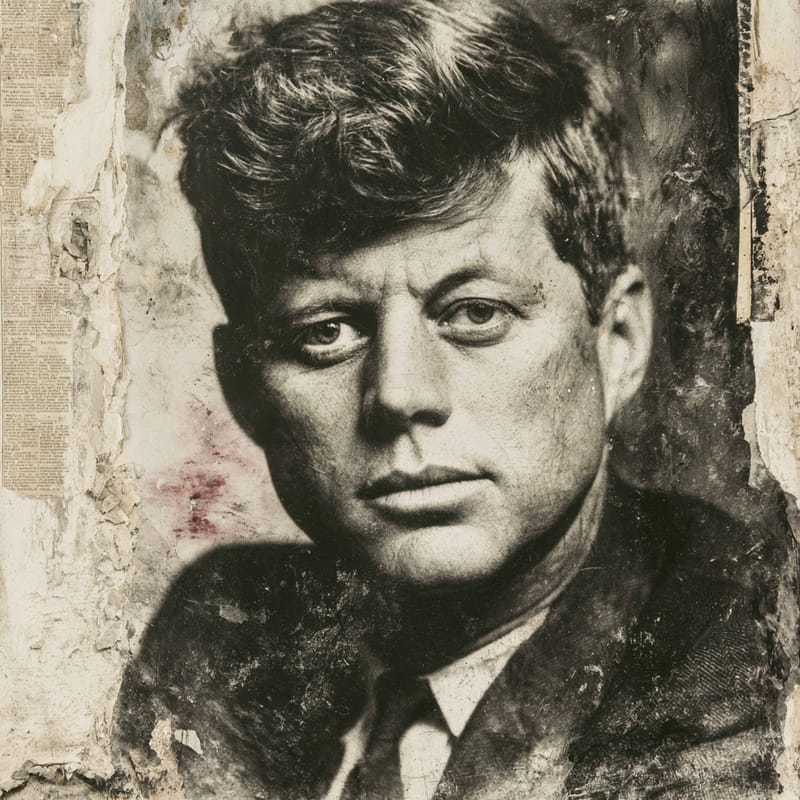
John F. Kennedy
CentristOne of 729 ideologies · enter the Centrist hall →- Role
- —
- Era
- —
- Region
- —
- Social band
- Centre (no modifier)
- Placement
- 0 · 0 · 0
§ Where John F. Kennedy stands
3 axesKennedy combined Keynesian growth policy with fiscal moderation. He raised the minimum wage in 1961, introduced an investment tax credit in 1962 and proposed the across-the-board income-tax cuts, lowering the top rate from 91 per cent, that Congress enacted in 1964. He also forced U.S. Steel to rescind a price rise in 1962, a mix of pro-business and interventionist measures that leaves him at the centre.
Kennedy worked through Congress and constitutional channels, using federal authority to enforce court-ordered desegregation by sending federal marshals and troops to the University of Mississippi in 1962 and federalising the Alabama National Guard in 1963. He also expanded covert action abroad, from the Bay of Pigs to Operation Mongoose, while firmly asserting civilian control over the military during the missile crisis.
Kennedy began cautiously on civil rights, delaying an executive order against discrimination in federal housing until 1962, but under pressure from the movement he gave a televised address in June 1963 calling civil rights a moral issue. He created the President's Commission on the Status of Women in 1961, signed the Equal Pay Act of 1963 and, as a Catholic candidate, defended the strict separation of church and state.
How close are you to John F. Kennedy?
Three statements, one per axis. Answer them and we’ll drop you on the compass next to them.
§ The story
HistoricalJohn Fitzgerald Kennedy (1917–1963) was the 35th president of the United States, serving from January 1961 until his assassination in November 1963. Born in Brookline, Massachusetts, into a wealthy Irish Catholic political family, he graduated from Harvard in 1940 and turned his senior thesis into the book Why England Slept. He commanded the torpedo boat PT-109 in the Pacific in 1943, then served in the House of Representatives from 1947 and the Senate from 1953. In 1960 he narrowly defeated Richard Nixon, becoming the youngest person and the first Catholic elected president.
Kennedy's presidency was dominated by the Cold War: the failed Bay of Pigs invasion in 1961, the Berlin crisis, the Cuban Missile Crisis of October 1962 and the Partial Test Ban Treaty of 1963. He founded the Peace Corps, committed the country to a Moon landing and, after the Birmingham protests, proposed the civil rights bill that became the Civil Rights Act of 1964. Critics point to the deepening US involvement in Vietnam and covert operations against Cuba. He was shot dead in Dallas on 22 November 1963; the Warren Commission concluded that Lee Harvey Oswald acted alone.
Key works & moments
- 1956Publishes Profiles in Courage, which wins the 1957 Pulitzer Prize for Biography.
- 1960Defeats Richard Nixon after the first televised presidential debates.
- 1961Founds the Peace Corps and approves the failed Bay of Pigs invasion of Cuba.
- 1962Faces down the Soviet Union in the thirteen-day Cuban Missile Crisis.
- 1963Proposes major civil rights legislation and concludes the Partial Nuclear Test Ban Treaty.
- 1963Assassinated in Dallas, Texas, on 22 November.
In their own words
“Ask not what your country can do for you – ask what you can do for your country.”
“I believe in an America where the separation of church and state is absolute.”
§ Minds closest to John F. Kennedy
All minds →


§ Also in the Centrist hall
Enter the hall →§ Common questions
4 answersWhat was John F. Kennedy's political ideology?
John F. Kennedy was a Cold War liberal Democrat: on the 99ideologies three-axis compass, a Centrist. Economically he sits at the centre (0), pairing a minimum-wage rise and Keynesian growth policy with business-friendly tax cuts. On governance he also sits at the centre (0), working through Congress and the courts while expanding covert action abroad. Socially he moved from caution to commitment on civil rights, proposing the bill that became the Civil Rights Act of 1964, and he defended the separation of church and state.
Was John F. Kennedy left-wing or right-wing?
Near the centre, leaning left on some issues. Kennedy was a liberal Democrat who supported a higher minimum wage, federal aid to education and medical care for the elderly, and who embraced civil rights legislation in 1963. But he was also a hawkish anti-communist who proposed deep cuts in income-tax rates, including the top rate, and moved slowly on domestic reform, so historians often describe him as a pragmatic Cold War liberal rather than a crusading progressive.
Was John F. Kennedy a conservative?
No, though conservatives sometimes claim him. Kennedy was a Democrat who called himself a liberal, notably in a 1960 speech accepting the nomination of New York's Liberal Party, and he pursued a higher minimum wage, civil rights legislation and health insurance for the elderly. Conservatives point to his tax-cut proposals, his hard line against communism and his rhetoric of national service and sacrifice. Most historians see a moderate liberal whose priorities reflected the Cold War consensus of the early 1960s.
Which minds are closest to John F. Kennedy?
On the 99ideologies three-axis compass, the minds closest to John F. Kennedy are Jim Hacker (97% alike), Kofi Annan (96% alike) and Jacques Delors (96% alike). The furthest is Adam Sutler (37% alike).