
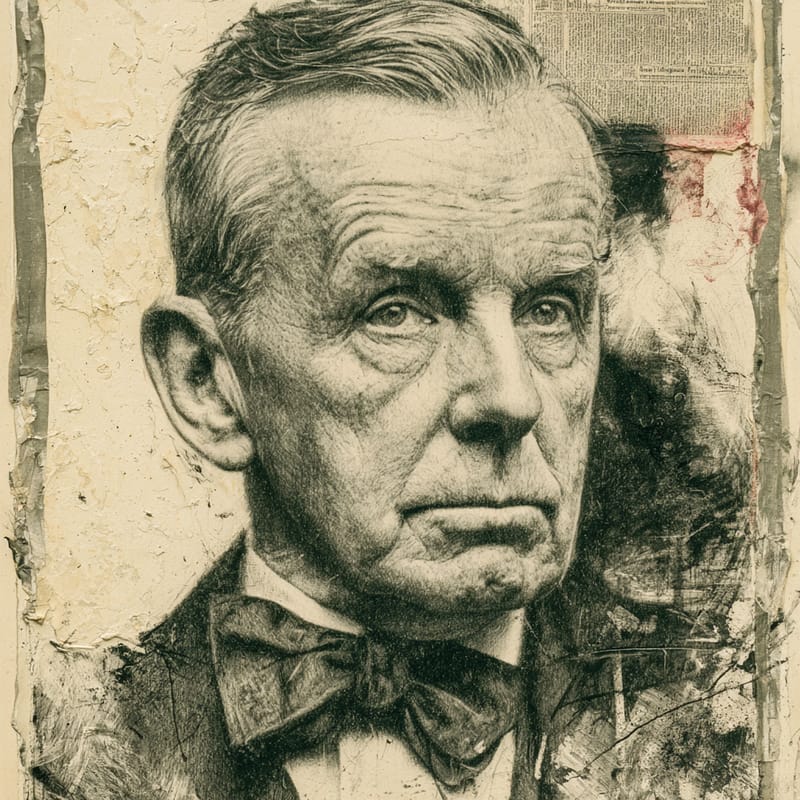
Léon Bourgeois
Solidarism
The social debt we owe each other.
Heterodox Welfare CapitalistOne of 729 ideologies · enter the Welfare Capitalist hall →- Role
- Prime Minister
- Era
- 1851–1925
- Region
- France
- Social band
- Heterodox
- Placement
- −8 · −19 · +20
§ Where Léon Bourgeois stands
3 axesBourgeois's solidarism held that every citizen owes a social debt to past and present generations, a debt the state may collect through taxation and compulsory insurance. His 1895–96 government proposed a progressive income tax, which the Senate blocked, and solidarist thinking informed the 1910 law on workers' and peasants' pensions. He defended private property and rejected collectivism, which keeps him only slightly left of centre.
A parliamentary republican and Freemason, Bourgeois worked through the Chamber and Senate and resigned in April 1896 when the Senate refused to work with his government. Abroad he pursued peace through law, leading French delegations to the Hague conferences of 1899 and 1907 to promote international arbitration, and setting out his case for a league of states in Pour la Société des Nations (1910).
Bourgeois was a secular republican reformer for whom solidarity was a moral duty. In Solidarité (1896) he argued that free education, public health and insurance against sickness and old age were debts society owed every citizen, and he championed public hygiene and adult education. His progressivism was moderate rather than radical, aiming to bind classes together rather than to overturn social hierarchies.
How close are you to Léon Bourgeois?
Three statements, one per axis. Answer them and we’ll drop you on the compass next to them.
§ The story
HistoricalLéon Bourgeois (1851–1925) was a French Radical statesman, prime minister in 1895–96 and the theorist of solidarism. A Paris-born lawyer, he rose through the prefectoral administration to become prefect of police in Paris in 1887, entered the Chamber of Deputies for the Marne in 1888 and held a succession of ministries, including the interior, public instruction, justice and later foreign affairs. In November 1895 he formed the first government composed entirely of Radicals, which fell in April 1896 after the Senate blocked its programme, including a progressive income tax.
His book Solidarité (1896) gave the Third Republic a social philosophy between liberal individualism and collectivism: every person is born in debt to society and must repay it through contributions to education, insurance and public health. These ideas informed Radical social legislation, from workplace-accident compensation in 1898 to the workers' and peasants' pensions law of 1910. He led France's delegations to the Hague peace conferences of 1899 and 1907, championed arbitration and a society of nations, chaired the first meeting of the League of Nations Council in 1920 and won that year's Nobel Peace Prize.
Notable for
- 01Founded 'solidarisme'
- 02Nobel Peace Prize, 1920
- 03Early architect of the League of Nations
Key works & moments
- 1888Elected deputy for the Marne after serving as prefect of police in Paris.
- 1895Forms the first all-Radical government, which proposes a progressive income tax.
- 1896Publishes Solidarité, the founding text of solidarism.
- 1899Leads the French delegation to the first Hague Peace Conference.
- 1907Heads France's delegation at the second Hague conference, pressing for compulsory arbitration.
- 1920Chairs the first League of Nations Council meeting, wins the Nobel Peace Prize and leads the Senate.
§ Minds closest to Léon Bourgeois
All minds →




§ Also in the Welfare Capitalist hall
Enter the hall →§ Common questions
4 answersWhat was Léon Bourgeois's political ideology?
Léon Bourgeois was a Radical republican and the founder of solidarism: on the 99ideologies three-axis compass, a Heterodox Welfare Capitalist. Economically he sits just left of centre (−8), justifying taxation and social insurance as repayment of a social debt within a market order. On governance he was a parliamentary democrat (−19) and a pioneer of international arbitration, and socially he was moderately progressive (+20), a secular reformer of education and public health.
Was Léon Bourgeois left-wing or right-wing?
Left of centre in the terms of his time. Bourgeois led the Radicals, the party of the republican left in the Third Republic, and his 1895–96 government was the first composed entirely of Radicals, proposing a progressive income tax that conservatives in the Senate defeated. He rejected socialism, however, defending private property and seeking class reconciliation through solidarity, so he belongs to the reformist centre-left that built France's early welfare institutions.
What is Léon Bourgeois's solidarism?
Solidarism is the social philosophy Bourgeois set out in Solidarité (1896). It holds that every individual benefits from the accumulated work of past generations and from the cooperation of contemporaries, and so is born a debtor to society. Repaying that debt justifies taxes, compulsory insurance, free education and public health measures, which Bourgeois framed as a quasi-contract among citizens rather than charity. Drawing on the sociology of interdependence associated with Émile Durkheim, it offered a middle way between laissez-faire liberalism and socialism.
Which minds are closest to Léon Bourgeois?
On the 99ideologies three-axis compass, the minds closest to Léon Bourgeois are B. Seebohm Rowntree (96% alike), Pierre Mendès France (96% alike) and William Beveridge (95% alike). The furthest is Adam Sutler (26% alike).