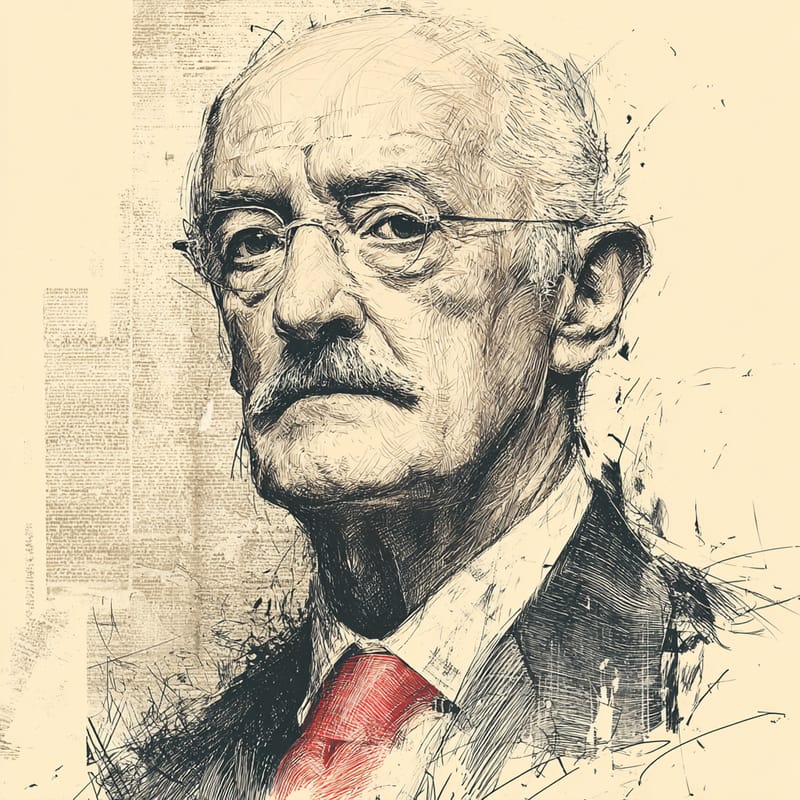
Juan Carlos I
The democratising king
Used the crown to midwife democracy.
Traditional Constitutional MonarchistOne of 729 ideologies · enter the Constitutional Monarchist hall →- Role
- King
- Era
- b. 1938
- Region
- Spain
- Social band
- Traditional
- Placement
- +46 · +68 · −40
§ Where Juan Carlos I stands
3 axesAs a constitutional monarch Juan Carlos held no economic powers, but his reign coincided with Spain's integration into the Western market economy. It spanned the 1977 Moncloa Pacts, which stabilised the economy during the transition, and Spain's entry into the European Economic Community in 1986, and he acted as an unofficial ambassador for Spanish companies abroad, particularly in the Gulf states.
Juan Carlos inherited the powers of Franco's head of state and used that authority, rather than an electoral mandate, to dismantle the dictatorship from above. On the night of 23 February 1981, as commander-in-chief, he ordered the military regions to uphold constitutional order, and the coup collapsed. The 1978 Constitution makes the king's person inviolable and exempt from liability, a protection that shielded his conduct as king from prosecution.
Juan Carlos personified a Catholic, dynastic tradition reconciled with democracy rather than a progressive programme. He swore in 1969 to uphold the principles of Franco's National Movement before helping to dismantle them, and remained a figure of hierarchy, ceremony and military bearing. Spain's social liberalisation, from the 1981 divorce law to the 2005 same-sex marriage law, was the work of elected governments, which he signed as the Constitution required.
How close are you to Juan Carlos I?
Three statements, one per axis. Answer them and we’ll drop you on the compass next to them.
§ The story
HistoricalJuan Carlos I (born 1938) was King of Spain from 1975 until his abdication in 2014. Born in Rome to the exiled Spanish royal family, a grandson of Alfonso XIII, he was sent to Spain in 1948 to be educated under the supervision of the dictator Francisco Franco, who in 1969 named him his successor with the title Prince of Spain, passing over his father, Juan de Borbón. He was proclaimed king on 22 November 1975, two days after Franco's death.
Rather than continue the dictatorship, Juan Carlos appointed the reformer Adolfo Suárez prime minister in 1976, backed the Political Reform Law that led to free elections in 1977 and sanctioned the 1978 Constitution, which made Spain a parliamentary monarchy. His televised order to the army to uphold the Constitution during the coup attempt of 23 February 1981 made him a symbol of democracy. His reputation suffered over a 2012 elephant hunt in Botswana and questions about his finances; he abdicated in 2014, moved to Abu Dhabi in 2020, and Spanish prosecutors closed their inquiries in 2022 without charges.
Notable for
- 01Spain's transition to democracy
- 02Defied the 1981 coup
- 03Restored the constitutional crown
Key works & moments
- 1948Arrives in Spain, aged ten, to be educated under Franco's supervision.
- 1969Franco designates him successor as head of state with the title Prince of Spain.
- 1975Proclaimed king on 22 November, two days after Franco's death.
- 1976Appoints Adolfo Suárez prime minister to steer the transition to democracy.
- 1981Orders the army to uphold the Constitution in a televised address during the 23-F coup attempt.
- 2014Abdicates in favour of his son, who becomes King Felipe VI.
In their own words
“The Crown, symbol of the permanence and unity of the nation, cannot tolerate in any form actions or attitudes of persons who seek to interrupt by force the democratic process that the Constitution, voted for by the Spanish people, determined in its day through referendum.”
§ Minds closest to Juan Carlos I
All minds →


§ Also in the Constitutional Monarchist hall
Enter the hall →§ Common questions
4 answersWhat is Juan Carlos I's political ideology?
Juan Carlos is a constitutional monarchist who used inherited authority to make Spain a parliamentary democracy: on the 99ideologies three-axis compass, a Traditional Constitutional Monarchist. Economically he sits on the market side (+46), having reigned as Spain joined the European Community. On governance he leans clearly toward authority (+68), reflecting a hereditary, inviolable crown that commands the armed forces, and socially he is traditional (−40), a Catholic dynast rather than a reformer of morals.
Is Juan Carlos I left-wing or right-wing?
Neither in party terms, though his instincts are conservative. Raised under Franco's regime and heir to the Bourbon dynasty, he nonetheless backed the reforms under which the Communist Party was legalised in 1977, and from 1982 he worked smoothly with the Socialist government of Felipe González. His role was to stand above parties; his conservatism shows in his defence of monarchy, Catholic tradition and national unity rather than in any economic programme.
Why did Juan Carlos I abdicate?
He announced his abdication on 2 June 2014, saying that a new generation should take the lead, after a period in which the monarchy's popularity had fallen sharply. An elephant-hunting trip to Botswana in 2012, at the height of Spain's economic crisis, prompted a rare public apology, and a fraud case against his son-in-law Iñaki Urdangarin damaged the royal household. His son became King Felipe VI on 19 June 2014. Later inquiries into his own finances were closed in 2022 without charges.
Which minds are closest to Juan Carlos I?
On the 99ideologies three-axis compass, the minds closest to Juan Carlos I are Walter Bagehot (96% alike), Emperor Akihito (96% alike) and Baudouin of Belgium (96% alike). The furthest is Emma Goldman (1% alike).