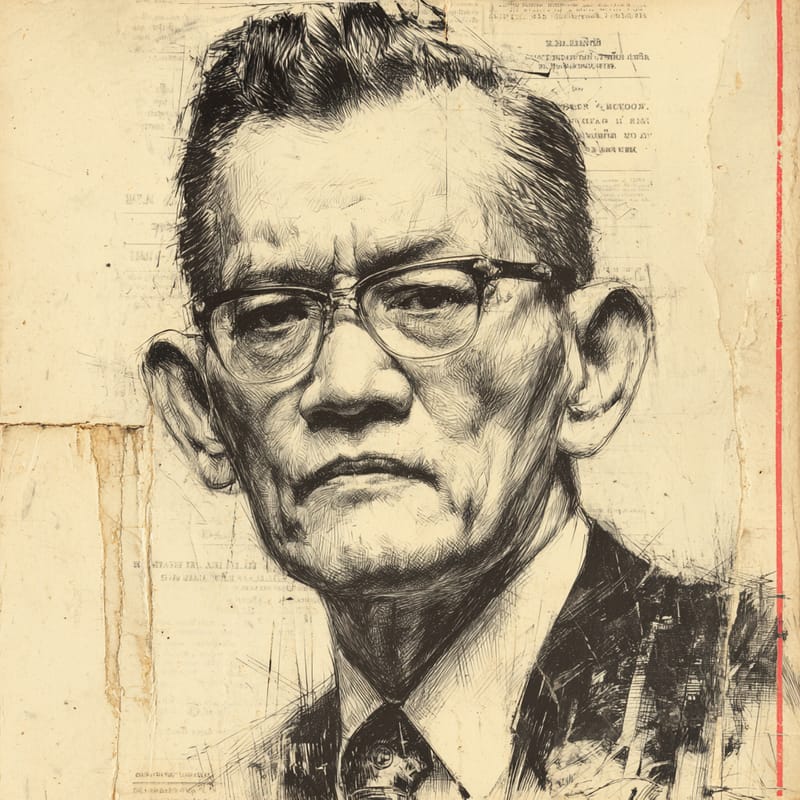
Bhumibol Adulyadej
The revered sovereign
Moral authority above turbulent politics.
Traditional Constitutional MonarchistOne of 729 ideologies · enter the Constitutional Monarchist hall →- Role
- King
- Era
- 1927–2016
- Region
- Thailand
- Social band
- Traditional
- Placement
- +44 · +78 · −60
§ Where Bhumibol Adulyadej stands
3 axesBhumibol reigned over Thailand's transformation into an export-driven market economy, and the Crown Property Bureau made the monarchy a major investor in it. His own economic message was moderation: after the 1997 Asian financial crisis he promoted a sufficiency economy philosophy of self-reliance, prudence and moderate consumption within the market, which later governments wrote into national development plans.
Bhumibol's authority rested less on constitutional powers than on immense prestige, protected by the lèse-majesté law and exercised through the privy council and the army. He endorsed or accepted a series of military governments, from Sarit Thanarat's regime after 1957 to the juntas of 2006 and 2014, and his interventions, as in the televised audience that ended the May 1992 crisis, were decisive because they stood above elected politics.
Bhumibol personified Buddhist kingship and royal tradition. Sarit's government revived royal ceremonies such as the royal ploughing ceremony in 1960 and restored prostration before the king, and Bhumibol presented himself as a righteous Buddhist king whose portrait hung in homes across the country. He was also a jazz saxophonist and composer, but his political role was to embody continuity, hierarchy and national unity.
How close are you to Bhumibol Adulyadej?
Three statements, one per axis. Answer them and we’ll drop you on the compass next to them.
§ The story
HistoricalBhumibol Adulyadej (1927–2016) reigned as King Rama IX of Thailand for seventy years, from 1946 until his death, longer than any other Thai monarch. Born in Cambridge, Massachusetts, while his father studied at Harvard, and educated in Switzerland, he came to the throne at eighteen after his elder brother, King Ananda Mahidol, was found shot dead in the Grand Palace in June 1946. He married Sirikit Kitiyakara in April 1950 and was crowned the following month.
Beginning as a figurehead under military rule, Bhumibol rebuilt the monarchy's prestige through thousands of rural development projects and became the moral centre of Thai politics. In October 1973 he sheltered fleeing student protesters as the military rulers Thanom Kittikachorn and Praphas Charusathien went into exile, and in May 1992 he summoned rival leaders to a televised audience that ended a bloody crackdown. Critics note that he also accepted military coups, including those of 1976, 2006 and 2014, and that the lèse-majesté law shielded him from scrutiny.
Notable for
- 01Longest-reigning Thai monarch
- 02'Sufficiency economy' philosophy
- 03National unifying figure
Key works & moments
- 1946Becomes king at eighteen after his brother, King Ananda Mahidol, is found shot dead.
- 1950Crowned on 5 May, days after marrying Sirikit Kitiyakara.
- 1973Shelters student protesters as the military rulers go into exile after the 14 October uprising.
- 1992Summons rival leaders to a televised audience, ending the Black May crackdown.
- 1997Promotes his sufficiency economy philosophy after the Asian financial crisis.
- 2016Dies on 13 October after a seventy-year reign, the longest in Thai history.
§ Minds closest to Bhumibol Adulyadej
All minds →

§ Also in the Constitutional Monarchist hall
Enter the hall →§ Common questions
4 answersWhat was King Bhumibol Adulyadej's political ideology?
Bhumibol was a royalist conservative who made the monarchy the moral anchor of Thai politics: on the 99ideologies three-axis compass, a Traditional Constitutional Monarchist. Economically he sat on the market side (+44), presiding over rapid capitalist growth while preaching a moderate sufficiency economy. On governance he leaned strongly toward authority (+78), wielding prestige above elected politics and accepting military coups, and socially he was firmly traditional (−60), embodying Buddhist kingship and national unity.
Was King Bhumibol left-wing or right-wing?
His reign aligned the monarchy with the conservative, royalist right. During the Cold War the palace stood with the military and the United States against communist insurgency, and in later decades royalist establishment forces opposed the populist movement of Thaksin Shinawatra, who was ousted in the 2006 coup. Bhumibol presented himself as above politics, and his rural development work had a paternalistic, welfare-minded side, but the order he defended was hierarchical and anti-communist.
How did King Bhumibol end the 1992 Black May crisis?
In May 1992 soldiers fired on crowds in Bangkok protesting against the appointment of the coup leader General Suchinda Kraprayoon as prime minister. On the night of 20 May the king summoned Suchinda and the protest leader Chamlong Srimuang to the palace, where both knelt before him in a televised audience and were told to end the confrontation. The violence stopped, Suchinda resigned within days, and the episode became the most famous demonstration of royal authority in modern Thai politics.
Which minds are closest to Bhumibol Adulyadej?
On the 99ideologies three-axis compass, the minds closest to Bhumibol Adulyadej are Rama VI (Vajiravudh) (97% alike), Otto von Bismarck (97% alike) and King Régis (illustrative) (97% alike). The furthest is Emma Goldman (0% alike).