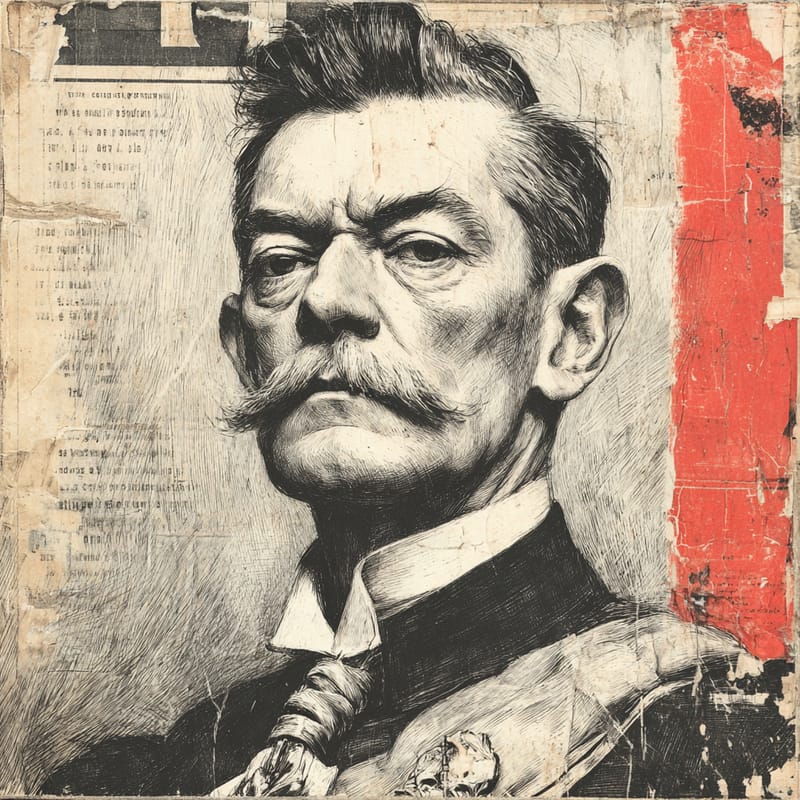
Rama VI (Vajiravudh)
Nation, religion, king
Modernising monarch and nationalist.
Traditional Constitutional MonarchistOne of 729 ideologies · enter the Constitutional Monarchist hall →- Role
- King
- Era
- 1881–1925
- Region
- Siam
- Social band
- Traditional
- Placement
- +46 · +72 · −58
§ Where Rama VI (Vajiravudh) stands
3 axesVajiravudh ruled a market economy driven by rice exports and Chinese and European commerce, and sought to build national economic institutions within it. The Siam Cement Company was founded by royal decree in 1913, a royal savings office opened the same year, and his government began renegotiating the unequal treaties, starting with the United States in 1920, to recover control over tariffs.
Vajiravudh was an absolute monarch who ruled by royal decree and through loyal courtiers. Officers plotting to curb his powers were arrested in the Palace Revolt of 1912, and his Wild Tiger Corps, a paramilitary body under his personal command, rivalled the regular army. His experiment with constitutional forms was confined to Dusit Thani, a miniature model city founded in 1918 where courtiers practised elections and party politics.
Vajiravudh built an official nationalism around throne and Buddhism, summed up in the slogan nation, religion and king, and taught it through the Wild Tiger Corps, the scouts and his own writings. His 1914 pamphlet The Jews of the East, published under a pen name, cast the Chinese minority as disloyal, while the 1913 Surname Act and the new flag of 1917 gave Thai identity a fixed form.
How close are you to Rama VI (Vajiravudh)?
Three statements, one per axis. Answer them and we’ll drop you on the compass next to them.
§ The story
HistoricalVajiravudh (1881–1925) reigned as King Rama VI of Siam from 1910 until his death. A son of King Chulalongkorn, he was sent to Britain at the age of twelve, trained at the Royal Military College, Sandhurst, and studied history and law at Christ Church, Oxford, becoming crown prince in 1895 after the death of his elder half-brother. He succeeded his father in October 1910 as absolute monarch of a kingdom that had kept its independence while Britain and France colonised its neighbours.
Vajiravudh is remembered as the father of Thai nationalism. He promoted the triad of nation, religion and king, founded the Wild Tiger Corps and the Boy Scouts in 1911, required surnames by law in 1913, introduced the tricolour flag in 1917 and took Siam into the First World War on the Allied side, winning a place at the Paris peace conference and in the League of Nations. A playwright and translator of Shakespeare, he was also criticised for a costly court and favouritism, and the officers' plot of 1912 foreshadowed the 1932 revolution against absolute monarchy.
Notable for
- 01Forged Thai nationalism
- 02Modernised education
- 03'Nation, Religion, King' creed
Key works & moments
- 1910Succeeds his father, King Chulalongkorn, as Rama VI on 23 October.
- 1911Founds the Wild Tiger Corps and Siam's Boy Scout movement.
- 1912Officers plotting to limit royal power are arrested in the foiled Palace Revolt.
- 1913Decrees that every Siamese family adopt a surname.
- 1917Takes Siam into the First World War on the Allied side and adopts the tricolour flag.
- 1918Founds Dusit Thani, a miniature city for practising democratic institutions.
§ Minds closest to Rama VI (Vajiravudh)
All minds →

§ Also in the Constitutional Monarchist hall
Enter the hall →§ Common questions
4 answersWhat was King Vajiravudh's political ideology?
Vajiravudh was a royal nationalist who built Thai national identity around the crown and Buddhism: on the 99ideologies three-axis compass, a Traditional Constitutional Monarchist. Economically he sat on the market side (+46), promoting commerce and national institutions in a trading economy. On governance he was strongly authoritarian (+72), ruling as an absolute monarch while toying with constitutional forms, and socially he was firmly traditional (−58), the champion of the creed of nation, religion and king.
Was King Vajiravudh left-wing or right-wing?
Right-wing in the sense of royalist nationalism. Vajiravudh defended absolute monarchy, crushed the 1912 plot by officers who wanted to limit it and made loyalty to king and Buddhism the core of Thai citizenship. Yet he was a modernising conservative rather than a reactionary: he founded Chulalongkorn University in 1917, introduced compulsory primary education in 1921, admired the British institutions he had known at Oxford and experimented with elections in his model city of Dusit Thani.
Who created the Thai motto nation, religion, king?
King Vajiravudh did. Adapting the British formula of God, king and country that he had absorbed in England, he promoted the triad of chat, satsana, phra mahakasat, meaning nation, religion and monarchy, from the early 1910s through his speeches, writings and the Wild Tiger Corps. The three colours of the flag he adopted in 1917 are commonly read as the same trinity: red for the nation, white for religion and blue for the monarchy. The motto remains central to Thai state ideology.
Which minds are closest to Rama VI (Vajiravudh)?
On the 99ideologies three-axis compass, the minds closest to Rama VI (Vajiravudh) are King Régis (illustrative) (98% alike), Otto von Bismarck (98% alike) and Bhumibol Adulyadej (97% alike). The furthest is Emma Goldman (0% alike).