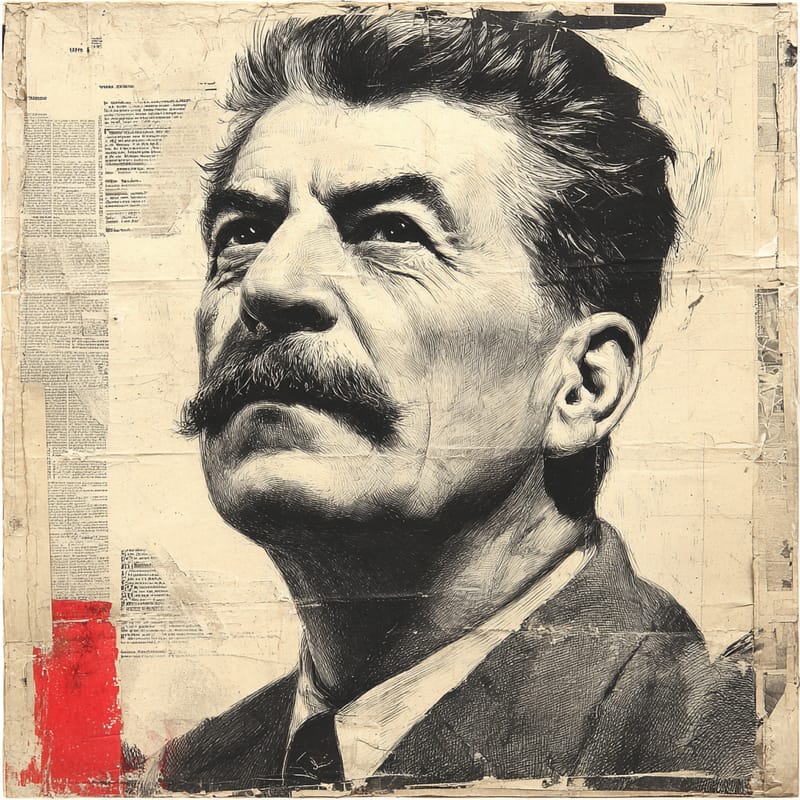
Lazar Kaganovich
Stalin's enforcer
Industrialisation by ruthless command.
Heterodox Stalinist-MarxistOne of 729 ideologies · enter the Stalinist-Marxist hall →- Role
- Politburo official
- Era
- 1893–1991
- Region
- Soviet Union
- Social band
- Heterodox
- Placement
- −94 · +94 · +25
§ Where Lazar Kaganovich stands
3 axesKaganovich embodied the command economy at its most coercive. As Moscow party chief he drove the construction of the first Moscow Metro line, opened in 1935 and named after him until 1955, and as people's commissar of railways from 1935 he enforced freight targets by decree and purge; earlier he had pressed forced collectivisation and grain seizures in Ukraine and the North Caucasus.
Kaganovich belonged to Stalin's inner circle during the Great Terror of 1936–38, co-signing lists that sent thousands to execution and leading purges of railway and party officials. In June 1957 he joined Molotov and Malenkov in the so-called Anti-Party Group's bid to remove Khrushchev, a last stand for Stalinist methods that ended his career.
His social outlook was that of a hard modernising functionary. As Moscow party boss he drove the reconstruction plans that culminated in the 1935 General Plan for the capital, and presided over the demolition of churches and historic buildings, including the Cathedral of Christ the Saviour in 1931, a modernist assault on the old city tempered by the regime's growing social conservatism.
How close are you to Lazar Kaganovich?
Three statements, one per axis. Answer them and we’ll drop you on the compass next to them.
§ The story
HistoricalLazar Moiseyevich Kaganovich (1893–1991) was one of Joseph Stalin's most loyal lieutenants and a full member of the Soviet Politburo from 1930 to 1957. Born into a poor Jewish family near Kiev, he worked as a shoemaker, joined the Bolsheviks in 1911 and rose through the party's organisational apparatus after the revolution. He led the Communist Party of Ukraine in 1925–28, ran the Moscow party organisation in the early 1930s and later headed the railways and heavy industry as a people's commissar.
Kaganovich was a ruthless executor of Stalin's policies. In 1932 he led a commission enforcing grain procurements in the North Caucasus, where whole Cossack villages were blacklisted and deported, and he pressed requisitions in Ukraine during the famine; in 2010 a Kyiv court posthumously named him among the Soviet leaders responsible for genocide in the Holodomor. He co-signed execution lists during the Great Terror and purged railway staff. In 1957 he joined the failed attempt to oust Khrushchev, was removed from the leadership and lived out his life as a pensioner in Moscow, dying in July 1991.
Notable for
- 01Oversaw Soviet industrialisation drives
- 02Built the Moscow Metro
- 03Last surviving Old Bolshevik
Key works & moments
- 1925–28Leads the Communist Party of Ukraine as its first secretary.
- 1930Becomes a full Politburo member and head of the Moscow party organisation.
- 1932Leads a grain-procurement commission to the North Caucasus that blacklists and deports Cossack villages.
- 1935The Moscow Metro opens bearing his name; he becomes people's commissar of railways.
- 1957Joins the Anti-Party Group's failed bid to oust Khrushchev and is removed from the leadership.
- 1991Dies in Moscow in July, months before the Soviet Union's collapse.
§ Minds closest to Lazar Kaganovich
All minds →

§ Also in the Stalinist-Marxist hall
Enter the hall →§ Common questions
4 answersWhat was Lazar Kaganovich's political ideology?
Kaganovich was an orthodox Stalinist: on the 99ideologies three-axis compass, a Heterodox Stalinist-Marxist. Economically he sat at the far left (−94), driving forced collectivisation and state-run industrialisation by command. On governance he was near the authoritarian extreme (+94) as one of the executors of Stalin's purges, and socially he leaned modestly progressive (+25), a modernising functionary who tore down much of old Moscow while serving a regime that grew socially conservative.
Was Lazar Kaganovich left-wing or right-wing?
Left-wing, as a lifelong communist who served a fully state-owned, centrally planned economy and never wavered from Marxism-Leninism. His left-wing credentials were those of the Stalinist command state rather than of democratic socialism: he enforced collectivisation, purges and output targets through terror. Even after his removal in 1957 he remained loyal to Stalin's memory, which made him a symbol of unreformed Stalinism during Khrushchev's thaw and after.
What was Lazar Kaganovich's role in the Holodomor?
He was one of its leading enforcers. As a Politburo member Kaganovich was sent in late 1932 to drive grain procurements in the North Caucasus, including the heavily Ukrainian Kuban region, where villages that missed quotas were blacklisted and their inhabitants deported, and he took part in pressing requisitions in Ukraine itself. The famine of 1932–33 killed millions of Ukrainians. In 2010 the Kyiv Court of Appeal posthumously found him, with Stalin and other Soviet officials, guilty of genocide.
Which minds are closest to Lazar Kaganovich?
On the 99ideologies three-axis compass, the minds closest to Lazar Kaganovich are Napoleon (97% alike), Joseph Stalin (97% alike) and Big Brother (97% alike). The furthest is Hans-Hermann Hoppe (0% alike).