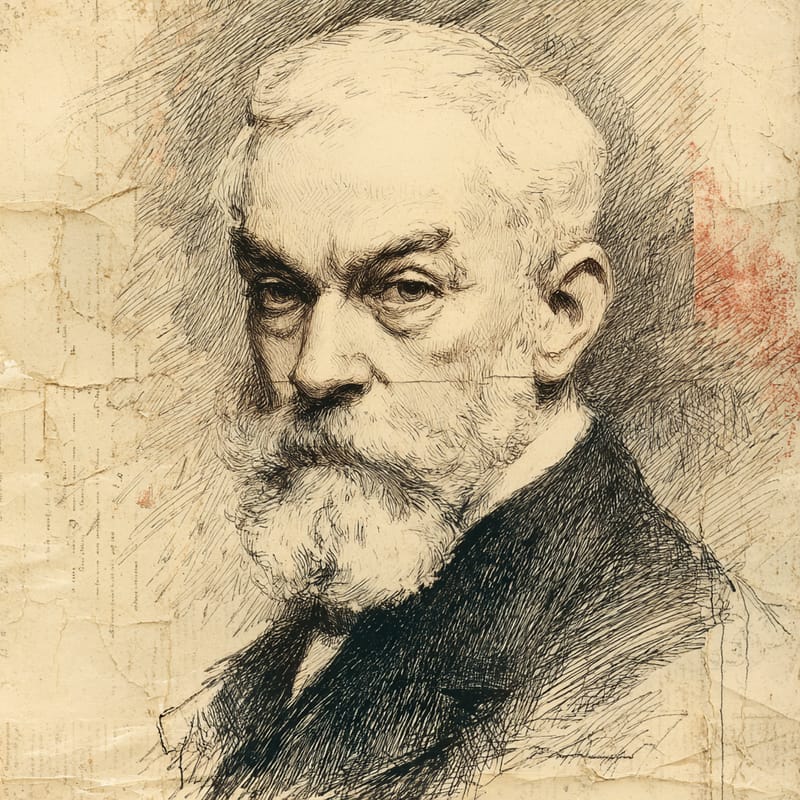
Franz Mehring
The movement's historian
Marxism with a democratic conscience.
Reformist LuxemburgistOne of 729 ideologies · enter the Luxemburgist hall →- Role
- Historian & journalist
- Era
- 1846–1919
- Region
- Germany
- Social band
- Reformist
- Placement
- −88 · −24 · +50
§ Where Franz Mehring stands
3 axesMehring was an orthodox historical materialist who saw common ownership as the necessary outcome of capitalist development. His 1893 essay On Historical Materialism and The Lessing Legend of the same year read German culture and politics through class interests, a method Friedrich Engels praised in an 1893 letter to him that became a classic statement on ideology.
A democratic revolutionary, Mehring opposed both the Prussian monarchy and the Social Democratic leadership's support for the First World War. In 1915 he co-founded the anti-war journal Die Internationale with Luxemburg, which the authorities banned after its first issue, and he joined the Spartacists in calling for power to pass to elected workers' councils.
As a man of letters Mehring sought to bring classical German culture to workers and to strip it of Prussian nationalist myth. The Lessing Legend challenged the image of Frederick the Great as a patron of the Enlightenment, and his literary criticism championed Lessing, Schiller and the democratic traditions of 1848 as part of the working class's inheritance.
How close are you to Franz Mehring?
Three statements, one per axis. Answer them and we’ll drop you on the compass next to them.
§ The story
HistoricalFranz Mehring (1846–1919) was a German journalist, historian and literary critic who became the leading Marxist historian of his generation. Born in Schlawe in Pomerania, he began as a liberal democratic journalist and for years was a sharp critic of the Social Democrats, before converting to Marxism and joining the party in 1891. He wrote lead articles for Karl Kautsky's Die Neue Zeit, edited the Leipziger Volkszeitung and taught at the party school in Berlin, while publishing works that made historical materialism accessible to working-class readers.
Mehring's History of German Social Democracy and his biography Karl Marx: The Story of His Life (1918) gave the movement a sense of its own past, and his edition of the literary remains of Marx, Engels and Lassalle rescued key texts. In his late sixties he sided with Rosa Luxemburg and Karl Liebknecht against the war, co-founding the group that became the Spartacus League, and he was held in custody during the war despite his age. He died in Berlin on 28 January 1919, two weeks after their murders, and is remembered as the scholar of the democratic-revolutionary left.
Notable for
- 01Biography of Karl Marx
- 02Co-founded the Spartacus League
- 03Marxist historian
Key works & moments
- 1891Abandons liberal democracy for Marxism and joins the Social Democratic Party.
- 1893Publishes The Lessing Legend, a Marxist demolition of Prussian cultural myth.
- 1897–98Publishes his History of German Social Democracy.
- 1902Edits the literary remains of Marx, Engels and Lassalle.
- 1915Co-founds the anti-war journal Die Internationale with Rosa Luxemburg; it is banned after one issue.
- 1918Publishes Karl Marx: The Story of His Life, long the standard biography.
§ Minds closest to Franz Mehring
All minds →

§ Also in the Luxemburgist hall
Enter the hall →§ Common questions
4 answersWhat was Franz Mehring's political ideology?
Franz Mehring was a Marxist historian who ended his life as a Spartacist: on the 99ideologies three-axis compass, a Reformist Luxemburgist. Economically he stood on the far left (−88), treating common ownership as the outcome of historical development. On governance he leaned libertarian (−24), opposing the Prussian monarchy and the war and backing workers' councils. Socially he was progressive (+50), a man of letters who sought to open German culture to working people.
Was Franz Mehring left-wing or right-wing?
Left-wing, though he arrived there late. Mehring began as a liberal democrat and critic of socialism, converted to Marxism around 1890 and spent the rest of his life on the party's left, ending as a founder of the anti-war Spartacist group with Luxemburg and Liebknecht. He combined orthodox Marxist economics with a democratic, humanist outlook, which is why he is remembered as a historian of the movement rather than as a party functionary.
Was Franz Mehring always a Marxist?
No. For much of his early career Mehring was a liberal democratic journalist, and in the 1870s he wrote hostile accounts of the Social Democrats that some party leaders long held against him. His growing disgust with Bismarck's Germany and its Anti-Socialist Laws pushed him leftward, and he joined the Social Democratic Party in 1891. He then became one of its most learned Marxists, writing its first major history and a celebrated biography of Marx, and finished as a revolutionary on its far left.
Which minds are closest to Franz Mehring?
On the 99ideologies three-axis compass, the minds closest to Franz Mehring are Paul Levi (98% alike), James Connolly (96% alike) and Karl Liebknecht (96% alike). The furthest is Adam Sutler (0% alike).