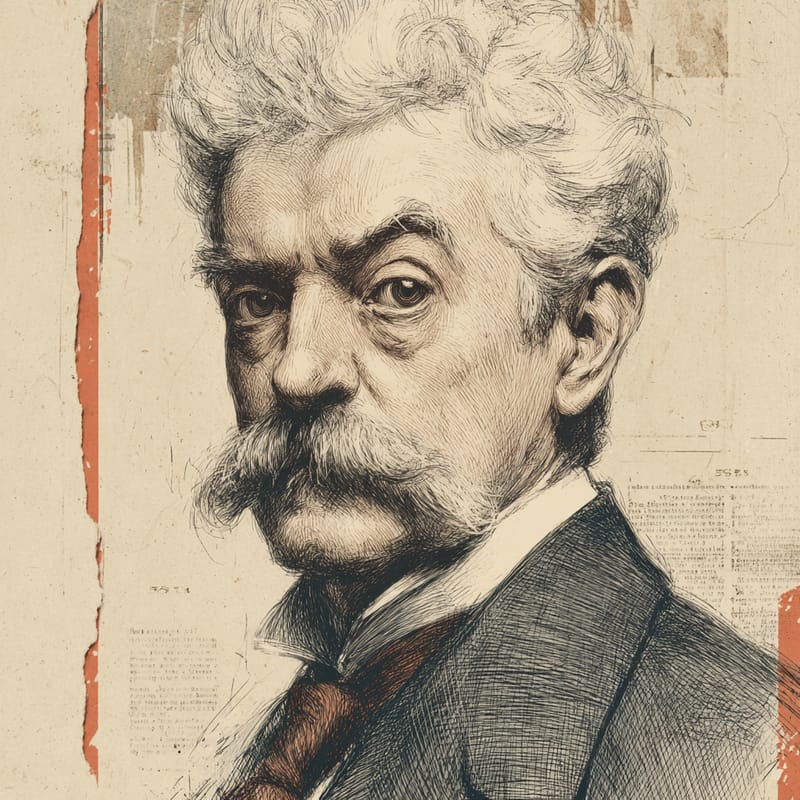
David Lloyd George
The People's Budget
Welfare wrung from the Lords.
Heterodox Labour LiberalOne of 729 ideologies · enter the Labour Liberal hall →- Role
- Prime Minister
- Era
- 1863–1945
- Region
- United Kingdom
- Social band
- Heterodox
- Placement
- −42 · −2 · +20
§ Where David Lloyd George stands
3 axesLloyd George used the tax system to pay for social reform, raising income tax on the rich, introducing a supertax and proposing land-value duties in the 1909 People's Budget to fund old-age pensions. The National Insurance Act 1911 added health and unemployment insurance. He sat left of centre as a radical New Liberal, yet he never sought to socialise industry, preferring to make capitalism pay for social security.
A parliamentary radical, he fought the House of Lords through two general elections in 1910 and secured the Parliament Act 1911, strengthening elected government over hereditary privilege. As wartime premier he concentrated power in a small War Cabinet from 1916 and governed through a personal secretariat, but he remained a constitutional democrat, broadly at the centre on this axis.
Raised in Welsh Nonconformity, he championed the disestablishment of the Church in Wales through the Welsh Church Act 1914 and attacked aristocratic privilege in his Limehouse speech of 1909. His government passed the Representation of the People Act 1918, which gave many women over 30 the vote, though his cautious pre-war handling of women's suffrage keeps him only moderately progressive.
How close are you to David Lloyd George?
Three statements, one per axis. Answer them and we’ll drop you on the compass next to them.
§ The story
HistoricalDavid Lloyd George (1863–1945) was a Liberal politician and prime minister of the United Kingdom from 1916 to 1922, the only Welshman to hold the office. Born in Manchester and raised in the village of Llanystumdwy in north Wales, he qualified as a solicitor and won Caernarvon Boroughs in 1890, holding the seat for 55 years. A fierce critic of the Boer War, he became President of the Board of Trade in 1905 and Chancellor of the Exchequer in 1908, before rising through the wartime ministries of munitions and war to the premiership.
As chancellor, Lloyd George introduced the 1909 People's Budget, whose taxes on high incomes and land provoked the House of Lords into rejecting it and led to the Parliament Act 1911, which curbed the Lords' veto. His National Insurance Act 1911 created contributory health and unemployment insurance. As wartime prime minister he led Britain to victory and helped shape the Treaty of Versailles. His later reputation suffered from the sale of honours, his coalition's dependence on the Conservatives and the bitter split of the Liberal Party, and in 1936 he visited Hitler and praised him.
Notable for
- 01The People's Budget (1909)
- 02National Insurance Act
- 03Wartime prime minister
Key works & moments
- 1890Wins Caernarvon Boroughs at a by-election, beginning 55 years in the Commons.
- 1909Introduces the People's Budget to tax wealth and land and fund social reform.
- 1911Passes the National Insurance Act, founding contributory health and unemployment insurance.
- 1916Replaces Asquith as prime minister and forms a small War Cabinet.
- 1919Negotiates the Treaty of Versailles alongside Georges Clemenceau and Woodrow Wilson.
- 1921Concludes the Anglo-Irish Treaty, leading to the creation of the Irish Free State.
In their own words
“This is a war Budget. It is for raising money to wage implacable warfare against poverty and squalidness.”
§ Minds closest to David Lloyd George
All minds →

§ Also in the Labour Liberal hall
Enter the hall →§ Common questions
4 answersWhat was David Lloyd George's political ideology?
David Lloyd George was a radical New Liberal: on the 99ideologies three-axis compass, a Heterodox Labour Liberal. Economically he sat left of centre (−42), taxing wealth and land to fund pensions and national insurance while leaving industry in private hands. On governance he was at the centre (−2), a parliamentary democrat who nonetheless concentrated power in wartime, and socially he was moderately progressive (+20), an enemy of aristocratic privilege rooted in Welsh Nonconformity.
Was David Lloyd George left-wing or right-wing?
Left of centre, by the standards of his time. Before 1914 he was the Liberal Party's leading radical, attacking landlords and dukes and building the first pillars of the welfare state. But he was never a socialist, and from 1916 to 1922 he led a coalition dominated by Conservatives that confronted waves of post-war strikes. He is best seen as a progressive liberal whose wartime alliances pulled him toward the centre.
Did David Lloyd George found the British welfare state?
He laid its foundations. As chancellor he financed the first state old-age pensions, paid from January 1909, and his National Insurance Act 1911 introduced compulsory health insurance for lower-paid workers and unemployment insurance in selected trades. These schemes were limited, and the insurance schemes were contributory; the comprehensive welfare state came only after the 1942 Beveridge Report and the Attlee government of 1945–51, but historians widely treat his reforms as its starting point.
Which minds are closest to David Lloyd George?
On the 99ideologies three-axis compass, the minds closest to David Lloyd George are Beatrice Webb (94% alike), John Curtin (94% alike) and John Maynard Keynes (93% alike). The furthest is Adam Sutler (21% alike).