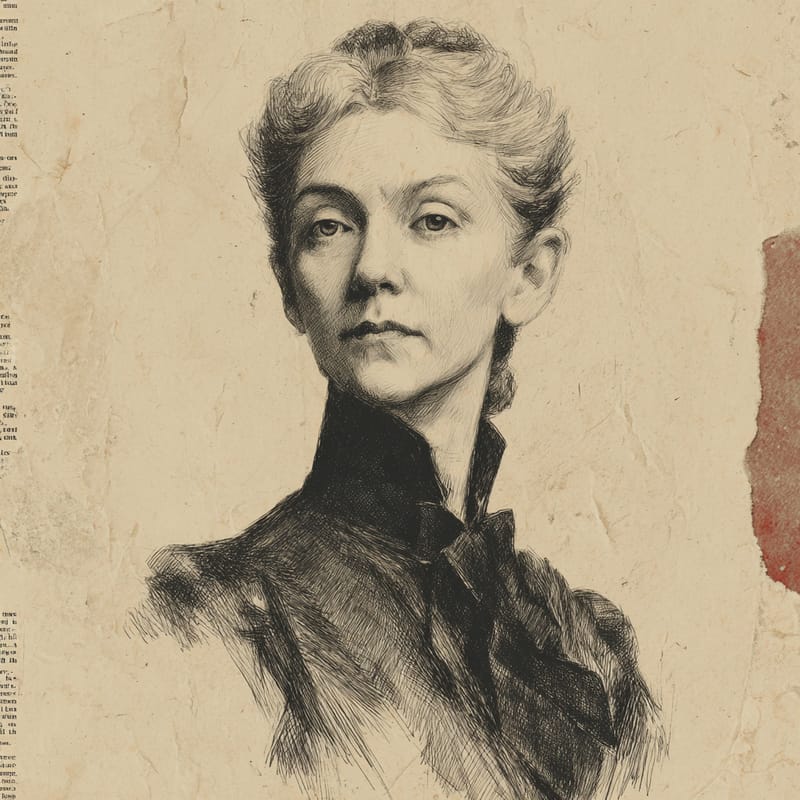
Beatrice Webb
The architect of reform
Evidence, institutions, the welfare idea.
Heterodox LiberalOne of 729 ideologies · enter the Liberal hall →- Role
- Reformer & sociologist
- Era
- 1858–1943
- Region
- United Kingdom
- Social band
- Heterodox
- Placement
- −36 · +6 · +30
§ Where Beatrice Webb stands
3 axesBeatrice Webb favoured gradual collectivism: the Minority Report of 1909 called for a national minimum of wages, health and education, public labour exchanges and the break-up of the Poor Law. True to Fabian gradualism, she pursued these ends through legislation, municipal enterprise and expanding public services rather than revolution, a left-of-centre programme of incremental reform, even if her late enthusiasm for Soviet planning went much further.
Webb believed social problems should be solved by expert administrators guided by rigorous research, working through royal commissions, universities such as the LSE and the Labour Party. That faith in a trained bureaucratic elite was openly elitist and, in her admiration for Soviet planning in the 1930s, uncritical of dictatorship, which tilts her slightly toward the authoritarian side of the centre.
Webb was a progressive reformer whose research exposed sweated labour and urban poverty and who wanted the state to guarantee minimum standards of life for all. Her views on women's rights evolved: she signed a public appeal against women's suffrage in 1889 but publicly reversed that position in 1906. That trajectory places her moderately on the progressive side.
How close are you to Beatrice Webb?
Three statements, one per axis. Answer them and we’ll drop you on the compass next to them.
§ The story
HistoricalBeatrice Webb (1858–1943), born Martha Beatrice Potter, was an English social researcher, economist and reformer. The daughter of a wealthy Gloucestershire industrialist, she learned social investigation working on Charles Booth's survey of London poverty in the 1880s and wrote The Co-operative Movement in Great Britain (1891), in which she coined the term collective bargaining. In 1892 she married the Fabian Sidney Webb, and their partnership became the most influential research team in the history of British social policy.
The Webbs co-founded the London School of Economics in 1895 and the New Statesman in 1913, wrote landmark histories of trade unionism and local government, and helped shape the Labour Party's 1918 constitution. Beatrice's Minority Report to the Royal Commission on the Poor Laws (1909) proposed abolishing the Poor Law and preventing destitution through a national minimum, prefiguring the welfare state. In old age the couple published Soviet Communism: A New Civilisation? (1935), an admiring account of Stalin's Soviet Union that played down famine and repression; a 1937 edition dropped the question mark.
Notable for
- 01Fabian 'Minority Report'
- 02Co-founded the LSE
- 03Coined 'collective bargaining'
Key works & moments
- 1880sWorks as a researcher on Charles Booth's survey of poverty in London.
- 1891The Co-operative Movement in Great Britain coins the term collective bargaining.
- 1895Co-founds the London School of Economics with Sidney Webb and fellow Fabians.
- 1897Publishes Industrial Democracy with Sidney Webb, a classic study of trade unions.
- 1909Writes the Minority Report of the Royal Commission on the Poor Laws, proposing a national minimum.
- 1935Publishes Soviet Communism: A New Civilisation? with Sidney, praising Stalin's Soviet Union.
§ Minds closest to Beatrice Webb
All minds →





§ Also in the Liberal hall
Enter the hall →§ Common questions
4 answersWhat was Beatrice Webb's political ideology?
Beatrice Webb was a Fabian socialist reformer: on the 99ideologies three-axis compass, a Heterodox Liberal. Economically she sat left of centre (−36), pursuing a national minimum and expanded public services through gradual legislation. On governance she leaned slightly authoritarian (+6), trusting expert administrators and, late in life, admiring Soviet planning, and socially she was moderately progressive (+30), exposing poverty and sweated labour while only gradually embracing women's suffrage.
Was Beatrice Webb left-wing or right-wing?
Left-wing. Webb was a founding intellectual of British Fabian socialism, helped shape the Labour Party and wanted the state to guarantee every citizen a minimum standard of life. Her method, however, was gradual, administrative and evidence-based rather than revolutionary, which is why the compass places her in the liberal family. Her uncritical praise of Stalin's Soviet Union in the 1930s showed how far her faith in planning could stretch.
Did Beatrice Webb's Minority Report create the welfare state?
It foreshadowed the welfare state rather than creating it. The 1909 Minority Report, largely written by Beatrice Webb, argued that destitution should be prevented through a national minimum, public labour exchanges, health services and support for the unemployed, rather than punished through the workhouse. Its proposals were not adopted at the time, but they influenced a generation of reformers, including William Beveridge, whose 1942 report laid out the post-war British welfare state.
Which minds are closest to Beatrice Webb?
On the 99ideologies three-axis compass, the minds closest to Beatrice Webb are Franklin D. Roosevelt (97% alike), John Maynard Keynes (96% alike) and John Rawls (95% alike). The furthest is Adam Sutler (22% alike).