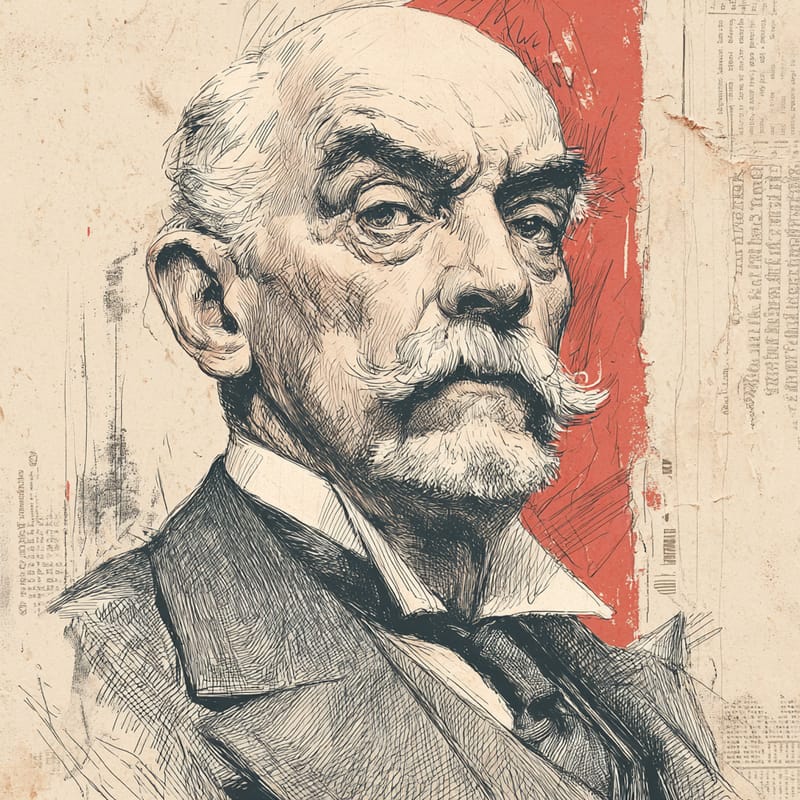
John Maynard Keynes
The general theory
Government can steer the market cycle.
Heterodox LiberalOne of 729 ideologies · enter the Liberal hall →- Role
- Economist
- Era
- 1883–1946
- Region
- United Kingdom
- Social band
- Heterodox
- Placement
- −28 · 0 · +30
§ Where John Maynard Keynes stands
3 axesKeynes rejected laissez-faire, arguing in The End of Laissez-Faire (1926) and The General Theory (1936) that the state must manage aggregate demand, fund public works in slumps and, if necessary, take a large role in investment. But he wanted to save capitalism, not replace it, leaving most production and ownership in private hands, which places him left of centre rather than among socialists.
Keynes was a liberal technocrat who believed a capable, well-informed elite could manage the economy within parliamentary democracy and the rule of law. He opposed both fascist and Soviet planning, and How to Pay for the War (1940) proposed compulsory deferred pay rather than inflation or ever-wider rationing, reflecting a preference for steering incentives over direct control. He sits at the centre on this axis.
A leading member of the Bloomsbury Group, Keynes moved in a circle that rejected Victorian sexual and religious conventions, and he championed the arts, founding the Cambridge Arts Theatre and becoming the first chairman of the Arts Council of Great Britain. His essay Economic Possibilities for our Grandchildren (1930) imagined a future freed from material scarcity. His eugenics involvement tempers the picture, leaving him moderately progressive.
How close are you to John Maynard Keynes?
Three statements, one per axis. Answer them and we’ll drop you on the compass next to them.
§ The story
HistoricalJohn Maynard Keynes (1883–1946) was a British economist, widely regarded as the founder of modern macroeconomics. Born in Cambridge and educated at Eton and King's College, Cambridge, he worked at the India Office and then the Treasury, where he served during the First World War. He resigned from the British delegation to the Paris Peace Conference in 1919 and denounced the reparations imposed on Germany in The Economic Consequences of the Peace. A central figure in the Bloomsbury Group, he returned to the Treasury as an adviser during the Second World War and was made a peer in 1942.
Keynes's The General Theory of Employment, Interest and Money (1936) argued that market economies could remain stuck in mass unemployment because of insufficient demand, and that governments should use public spending and monetary policy to restore it. Its ideas shaped economic policy across the Western world until the stagflation of the 1970s. He led Britain's delegation at the 1944 Bretton Woods conference that created the International Monetary Fund and the World Bank. His record also includes serving as a director of the Eugenics Society from 1937 to 1944, a side of his life later historians have highlighted.
Notable for
- 01'The General Theory'
- 02Bretton Woods architecture
- 03Founded macroeconomics
Key works & moments
- 1919Resigns from the Paris peace delegation and publishes The Economic Consequences of the Peace.
- 1925Attacks Britain's return to the gold standard in The Economic Consequences of Mr Churchill.
- 1926Publishes The End of Laissez-Faire, rejecting the doctrine of the unmanaged market.
- 1936The General Theory of Employment, Interest and Money founds modern macroeconomics.
- 1944Leads Britain's delegation at Bretton Woods, shaping the IMF and the World Bank.
- 1945Negotiates a large American loan to Britain months before his death in 1946.
In their own words
“In the long run we are all dead.”
“The class war will find me on the side of the educated bourgeoisie.”
§ Minds closest to John Maynard Keynes
All minds →

§ Also in the Liberal hall
Enter the hall →§ Common questions
4 answersWhat was John Maynard Keynes's political ideology?
John Maynard Keynes was a reforming liberal: on the 99ideologies three-axis compass, a Heterodox Liberal. Economically he sat left of centre (−28), arguing that governments must manage demand and investment to prevent mass unemployment while leaving ownership largely private. On governance he was at the centre (0), a technocrat who trusted expert management within parliamentary democracy, and socially he was moderately progressive (+30), a Bloomsbury figure who rejected Victorian convention.
Was John Maynard Keynes left-wing or right-wing?
Centre-left, and proudly liberal rather than socialist. Keynes remained a Liberal, declined to join the Labour Party, and wrote in 1925 that in a class war he would be found on the side of the educated bourgeoisie. Yet his economics justified a far larger role for the state than classical liberals accepted, and Labour governments built on his ideas after 1945. He sought a middle way between laissez-faire capitalism and socialist planning.
Was Keynes a socialist?
No. Keynes rejected Marxism and state ownership of industry and remained a Liberal throughout his life. The General Theory did propose that the state take broad responsibility for the overall level of investment, a recommendation sometimes read as socialist, but he explicitly left production and ownership to private enterprise. His aim was to make capitalism work by curing mass unemployment, which he feared would otherwise drive voters toward authoritarian alternatives.
Which minds are closest to John Maynard Keynes?
On the 99ideologies three-axis compass, the minds closest to John Maynard Keynes are Isaiah Berlin (96% alike), Franklin D. Roosevelt (96% alike) and Beatrice Webb (96% alike). The furthest is Adam Sutler (23% alike).