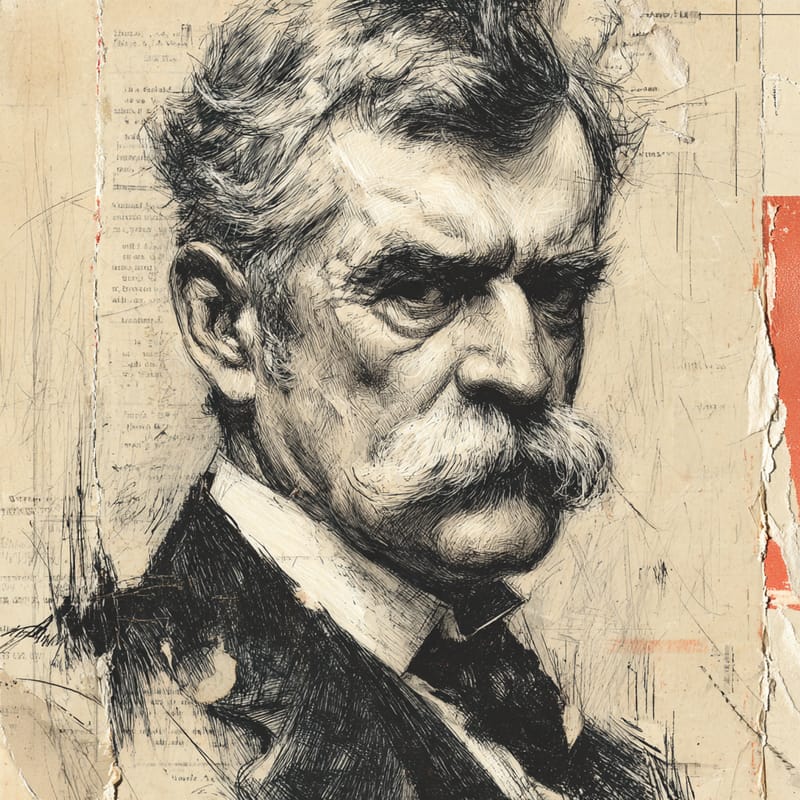
Andrew Fisher
Labor's nation-builder
Pensions, banks and the maternity grant.
Labour LiberalOne of 729 ideologies · enter the Labour Liberal hall →- Role
- Prime Minister
- Era
- 1862–1928
- Region
- Australia
- Social band
- Centre (no modifier)
- Placement
- −46 · 0 · 0
§ Where Andrew Fisher stands
3 axesFisher's governments used the federal state to temper private capitalism: the Commonwealth Bank Act 1911 created a publicly owned bank to compete with private banks, the 1910 land tax targeted large estates, and invalid pensions and the 1912 maternity allowance extended social protection. That places him clearly left of centre, though his Labor Party pursued reform within a market economy rather than socialisation.
Fisher was a democratic institution-builder who strengthened the young Commonwealth through Parliament, taking over the Northern Territory in 1911 and presiding over the naming of the federal capital at Canberra in 1913. He sought wider federal powers through referendums in 1911 and 1913, accepted voters' rejection of them, and stands at the centre of the governance axis.
Fisher shared the mainstream labour values of his generation. His government upheld the White Australia policy, and its Maternity Allowance Act 1912 paid mothers whether or not they were married, a humane break with convention, yet excluded Aboriginal and Asian women. That combination of social protection and racial exclusion leaves him at the centre of the social axis.
How close are you to Andrew Fisher?
Three statements, one per axis. Answer them and we’ll drop you on the compass next to them.
§ The story
HistoricalAndrew Fisher (1862–1928) was prime minister of Australia three times, in 1908–09, 1910–13 and 1914–15. Born in Crosshouse, Ayrshire, he went down the coal mines as a boy and became a union activist before emigrating to Queensland in 1885, where he worked as a miner at Gympie. He entered the Queensland parliament in 1893, won the federal seat of Wide Bay at the first federal election in 1901 and became leader of the federal Labor Party in 1907. After leaving politics in 1915 he served as Australia's high commissioner in London.
Fisher's 1910 victory gave Labor the first majority government in Australia's federal history, widely described as the world's first national labour government with a majority of its own. In three years it created the Commonwealth Bank, introduced invalid pensions and a maternity allowance, imposed a federal land tax on large estates, built up the new Royal Australian Navy and began the transcontinental railway. Fisher pledged Australia's full support for Britain at the outbreak of the First World War, but he resigned in October 1915, worn down by wartime leadership, and was succeeded by Billy Hughes.
Notable for
- 01Founded the Commonwealth Bank
- 02Old-age & invalid pensions
- 03Maternity allowance
Key works & moments
- 1901Wins Wide Bay for Labor at the first federal election.
- 1908Forms his first, short-lived minority Labor government.
- 1910Wins Labor's first federal majority and introduces a land tax and invalid pensions.
- 1911Passes the Commonwealth Bank Act, creating a publicly owned national bank.
- 1912Introduces a maternity allowance of five pounds for the mothers of newborn children.
- 1914Returns to power as war begins, pledging Australia's support to Britain.
In their own words
“to our last man and our last shilling”
§ Minds closest to Andrew Fisher
All minds →


§ Also in the Labour Liberal hall
Enter the hall →§ Common questions
4 answersWhat was Andrew Fisher's political ideology?
Andrew Fisher was a pioneering Labor reformer: on the 99ideologies three-axis compass, a Labour Liberal. Economically he sat left of centre (−46), founding a public bank, taxing large estates and extending pensions within a market economy. On governance he was at the centre (0), a democratic institution-builder who accepted referendum defeats, and socially he was at the centre (0), combining humane welfare measures with the White Australia policy shared by his generation.
Was Andrew Fisher left-wing or right-wing?
Left-wing for his time. A former coal miner and union man, Fisher led the Labor Party to Australia's first federal majority and used it to challenge private banking and landed wealth while expanding social protection. But his Labor was gradualist and parliamentary, more interested in practical nation-building than in socialist theory, and his enthusiastic support for Britain in 1914 showed the patriotic, imperial loyalties that coexisted with his reforming instincts.
Did Andrew Fisher lead the world's first national Labour government?
Not quite: he led the first with a majority. The first national labour government anywhere was Chris Watson's short-lived Australian minority ministry of 1904, and Fisher's own first government of 1908–09 also lacked a majority. His 1910 election victory, however, gave Labor control of both houses of federal parliament, and it is widely regarded as the world's first national labour government to rule with a parliamentary majority in its own right.
Which minds are closest to Andrew Fisher?
On the 99ideologies three-axis compass, the minds closest to Andrew Fisher are John Curtin (98% alike), Ben Chifley (98% alike) and W. L. Mackenzie King (97% alike). The furthest is Adam Sutler (25% alike).