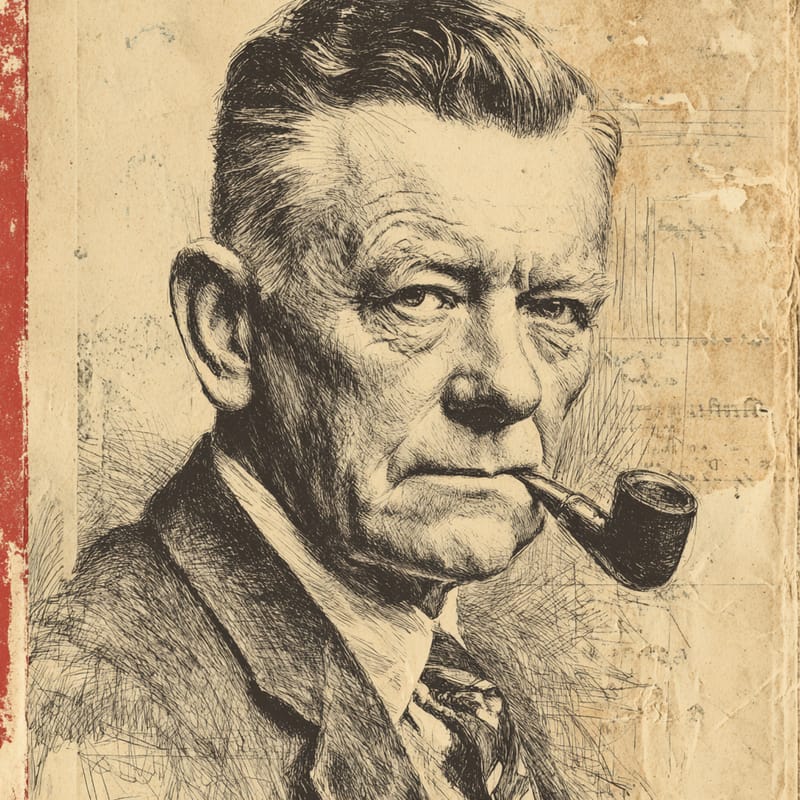
Ben Chifley
The light on the hill
Labor's post-war vision.
Labour LiberalOne of 729 ideologies · enter the Labour Liberal hall →- Role
- Prime Minister
- Era
- 1885–1951
- Region
- Australia
- Social band
- Centre (no modifier)
- Placement
- −50 · +4 · 0
§ Where Ben Chifley stands
3 axesChifley believed public enterprise should serve the community, nationalising Qantas in 1947 and trying to bring the private trading banks under public ownership through the Banking Act 1947. His government also created Trans Australia Airlines and expanded pensions and benefits. That places him further left than most labour leaders of his era, although he left the bulk of the economy in private hands.
Chifley respected the courts and the ballot box, accepting the final rulings against bank nationalisation and his 1949 election defeat. Yet he was prepared to use state power firmly, retaining wartime economic controls and sending troops into the coalfields during the 1949 strike, a mix that leaves him just on the authoritarian side of the centre.
Socially Chifley was a working-class Catholic of conventional habits, but his government opened Australia to large-scale non-British European immigration after 1945, transforming the country's population. It also maintained the White Australia policy and deported some wartime Asian refugees, a combination that leaves him at the centre of the social axis.
How close are you to Ben Chifley?
Three statements, one per axis. Answer them and we’ll drop you on the compass next to them.
§ The story
HistoricalJoseph Benedict Chifley (1885–1951) was prime minister of Australia from 1945 to 1949. Born in Bathurst, New South Wales, he became a locomotive engine driver and union activist, and lost his seniority after taking part in the 1917 general strike. He entered federal parliament for Macquarie in 1928, lost the seat in 1931 and regained it in 1940. As treasurer from 1941 and minister for post-war reconstruction from 1942 in John Curtin's government, he managed the wartime economy, and after Curtin's death and a brief interim under Frank Forde he became prime minister in July 1945.
Chifley's government launched the Snowy Mountains Scheme, a large post-war immigration programme, the Australian National University and a state airline, and expanded the welfare state. His attempt to nationalise the private banks under the Banking Act 1947 was struck down by the High Court and the Privy Council, and it became a powerful weapon for his opponents. During the 1949 coal strike, led by communist union officials, he sent troops to work the open-cut mines. Robert Menzies defeated him in December 1949, and his light on the hill speech remains Labor's most cited statement of purpose.
Notable for
- 01'The light on the hill'
- 02Post-war welfare expansion
- 03Bank-nationalisation fight
Key works & moments
- 1917Joins the New South Wales general strike and loses his seniority as an engine driver.
- 1941Becomes federal treasurer in John Curtin's wartime Labor government.
- 1945Succeeds Curtin as prime minister after a brief interim under Frank Forde.
- 1947Introduces the Banking Act to nationalise Australia's private trading banks.
- 1949Launches the Snowy Mountains Scheme and delivers his light on the hill speech.
- 1949Sends troops into the coalfields during the coal strike, then loses the December election.
In their own words
“We have a great objective – the light on the hill – which we aim to reach by working for the betterment of mankind not only here but anywhere we may give a helping hand.”
§ Minds closest to Ben Chifley
All minds →

§ Also in the Labour Liberal hall
Enter the hall →§ Common questions
4 answersWhat was Ben Chifley's political ideology?
Ben Chifley was a practical Labor democratic socialist: on the 99ideologies three-axis compass, a Labour Liberal. Economically he sat left of centre (−50), favouring public enterprise, a state airline and even the nationalisation of private banks within a mostly private economy. On governance he was near the centre (+4), a parliamentary democrat willing to use state power firmly, and socially he was at the centre (0), conventional in habits but presiding over transformative European immigration.
Was Ben Chifley left-wing or right-wing?
Left-wing. Chifley's attempt to nationalise the private banks was among the most ambitious socialist measures ever attempted by an Australian federal government, and his light on the hill speech framed Labor's purpose as the betterment of humanity rather than mere office. Yet he was firmly anti-communist, using troops against the communist-led 1949 coal strike, and governed through Parliament and the courts, so he belongs to the democratic, reformist left.
Why did Ben Chifley try to nationalise the banks?
He believed private banks had deepened the Great Depression and should not control the nation's credit. Chifley had sat on the royal commission into banking in the 1930s, and in 1947, after the High Court struck down a provision requiring state and local governments to bank with the Commonwealth Bank, he introduced the Banking Act to take over the private trading banks. The High Court and the Privy Council ruled it unconstitutional, and the fight helped Robert Menzies win the 1949 election.
Which minds are closest to Ben Chifley?
On the 99ideologies three-axis compass, the minds closest to Ben Chifley are Andrew Fisher (98% alike), John Curtin (97% alike) and W. L. Mackenzie King (96% alike). The furthest is Adam Sutler (24% alike).