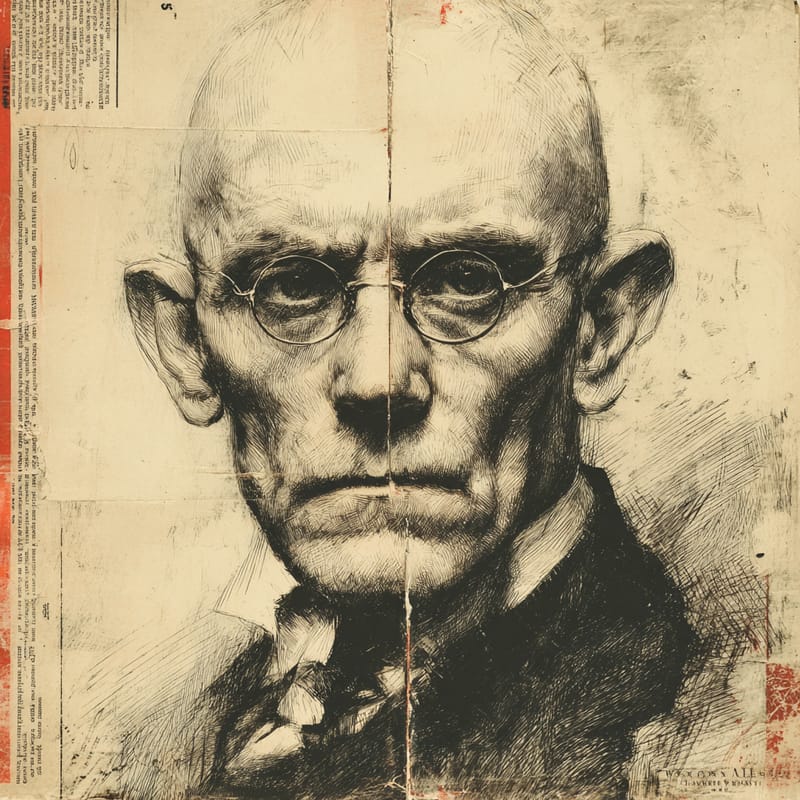
John Curtin
Australia's wartime leader
Labor in the nation's crisis.
Labour LiberalOne of 729 ideologies · enter the Labour Liberal hall →- Role
- Prime Minister
- Era
- 1885–1945
- Region
- Australia
- Social band
- Centre (no modifier)
- Placement
- −46 · +2 · +5
§ Where John Curtin stands
3 axesCurtin's government built the financial base of the Australian welfare state through uniform income taxation in 1942, then used it to introduce widows' pensions in 1942 and unemployment and sickness benefits in 1944. The 1945 White Paper on Full Employment committed government to keeping jobs plentiful. He sat clearly left of centre, but he worked within a market economy rather than seeking wholesale nationalisation.
A committed parliamentary democrat, Curtin governed in wartime through Parliament and the Labor caucus, and his government passed the Statute of Westminster Adoption Act 1942, confirming Australia's legislative independence. Wartime controls over manpower, prices and information expanded state power considerably, but they were tied to the emergency, which keeps him near the centre on this axis.
Curtin reflected the Labor mainstream of his generation rather than any cultural avant-garde. He supported the White Australia policy, which then commanded backing across Australian politics, while his reconstruction plans emphasised education, housing and opportunity for working families. That mix of inherited attitudes and egalitarian ambition leaves him close to the centre on social questions.
How close are you to John Curtin?
Three statements, one per axis. Answer them and we’ll drop you on the compass next to them.
§ The story
HistoricalJohn Joseph Curtin (1885–1945) was prime minister of Australia from October 1941 until his death in July 1945. Born in Creswick, Victoria, to Irish Catholic parents, he left school young, became a socialist activist and trade-union organiser, and in 1917 moved to Perth to edit the Westralian Worker. He was briefly jailed in 1916 during his campaign against wartime conscription. Elected for Fremantle in 1928, he lost the seat in 1931, regained it in 1934 and became Labor leader in 1935, rebuilding a party shattered by the splits of the Depression years.
Curtin led Australia through the most dangerous phase of the Pacific War. After Japan's entry into the war he declared that Australia looked to the United States, clashed with Winston Churchill in 1942 to bring Australian troops home from the Middle East, and worked closely with General Douglas MacArthur. At home his government took over income taxation from the states, expanded pensions and benefits, and began planning post-war reconstruction around full employment. A former anti-conscriptionist, he controversially extended conscripts' service into the South-West Pacific in 1943. He died in office weeks before the war ended.
Notable for
- 01Wartime prime minister
- 02Post-war reconstruction planning
- 03Expanded social services
Key works & moments
- 1916Jailed briefly while campaigning against conscription for overseas military service.
- 1935Elected leader of the federal Labor Party, beginning its recovery from the Depression split.
- 1941Becomes prime minister in October and declares in December that Australia looks to America.
- 1942Insists, over Churchill's objections, on bringing Australian troops home from the Middle East.
- 1943Wins a landslide election and extends conscripts' service into the South-West Pacific.
- 1945His government issues the White Paper on Full Employment; he dies in office on 5 July.
In their own words
“Without any inhibitions of any kind, I make it quite clear that Australia looks to America, free of any pangs as to our traditional links or kinship with the United Kingdom.”
§ Minds closest to John Curtin
All minds →

§ Also in the Labour Liberal hall
Enter the hall →§ Common questions
4 answersWhat was John Curtin's political ideology?
John Curtin was a Labor social democrat: on the 99ideologies three-axis compass, a Labour Liberal. Economically he sat left of centre (−46), building pensions, benefits and a full-employment commitment within a market economy. On governance he was at the centre (+2), a parliamentary democrat who accepted heavy wartime controls, and socially he was close to the centre (+5), reflecting the mainstream Labor values of his era, including support for the White Australia policy.
Was John Curtin left-wing or right-wing?
Left-wing in origin and centre-left in office. As a young man Curtin was a militant socialist journalist and union organiser who campaigned against conscription. As prime minister he governed pragmatically, putting national survival first, cooperating closely with the United States and even extending conscription, while laying the foundations of a welfare state. His mature politics fit the moderate, reformist left rather than the revolutionary socialism of his youth.
Why did John Curtin say Australia looks to America?
Because Britain could no longer defend Australia against Japan. In a newspaper message published on 27 December 1941, weeks after Pearl Harbor, Curtin declared that Australia looked to the United States without pangs about its traditional links with Britain. The statement angered Churchill and some Australians, but it reflected the reality that British forces were overstretched; the fall of Singapore in February 1942 confirmed his fears and began Australia's lasting alliance with the United States.
Which minds are closest to John Curtin?
On the 99ideologies three-axis compass, the minds closest to John Curtin are Andrew Fisher (98% alike), Ben Chifley (97% alike) and W. L. Mackenzie King (97% alike). The furthest is Adam Sutler (24% alike).