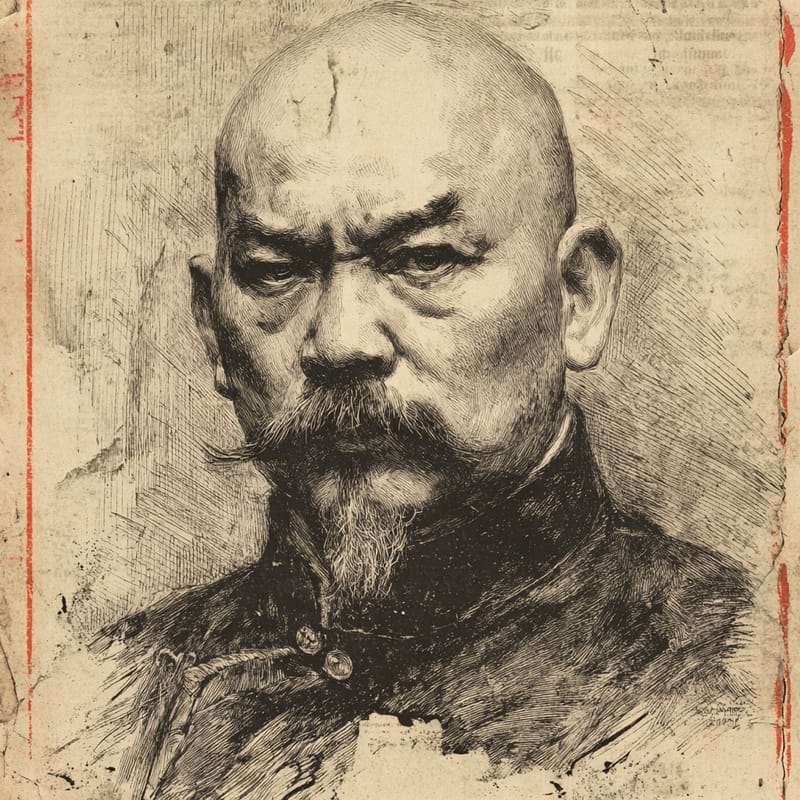
Yuan Shikai
The militarist moderniser
Industry under the strongman.
Traditional State CapitalistOne of 729 ideologies · enter the State Capitalist hall →- Role
- President & self-styled Emperor
- Era
- 1859–1916
- Region
- China
- Social band
- Traditional
- Placement
- +24 · +82 · −48
§ Where Yuan Shikai stands
3 axesYuan promoted capitalist development under official direction. As viceroy of Zhili he backed modern mines and factories and the Beijing–Zhangjiakou railway, built by Chinese engineers and completed in 1909, and as president he financed his government with the 1913 Reorganisation Loan from a foreign banking consortium and standardised the currency with the 1914 silver dollar bearing his portrait. Private enterprise was encouraged within a state-steered framework.
Yuan concentrated power relentlessly. He outlawed the Kuomintang in November 1913, dissolved parliament in early 1914 and imposed a Constitutional Compact that May giving the president near-dictatorial authority, and an amended election law that December granted renewable ten-year terms. His police hunted opponents, and in December 1915 he accepted the throne, turning a military dictatorship into an attempted dynasty until provincial armies forced him back.
Yuan was a conservative who sought legitimacy in imperial and Confucian tradition. He sponsored state rites to Confucius and in December 1914 performed the winter-solstice sacrifice at Beijing's Temple of Heaven in the manner of the emperors. His 1915 restoration, supported by a memorandum from his American adviser Frank Goodnow suggesting that monarchy suited China better than a republic, appealed to the old order rather than the ideals of 1911.
How close are you to Yuan Shikai?
Three statements, one per axis. Answer them and we’ll drop you on the compass next to them.
§ The story
HistoricalYuan Shikai (1859–1916) was a Qing dynasty general and official who became the first president of the Republic of China. From 1895 he trained the Newly Created Army near Tianjin, the core of the Beiyang Army whose officers later dominated northern China, and as viceroy of Zhili from 1901 to 1907 he led the late Qing's New Policies reforms. Dismissed in 1909, he was recalled after the 1911 revolution, negotiated the abdication of the last emperor and in March 1912 succeeded Sun Yat-sen as provisional president.
As president Yuan steadily dismantled the republic he headed. After the 1913 assassination of the Nationalist leader Song Jiaoren, for which he was widely blamed, he crushed the Second Revolution, outlawed the Kuomintang and dissolved parliament. He accepted a modified version of Japan's Twenty-One Demands in 1915 and then proclaimed himself Hongxian Emperor. Provincial revolts forced him to abandon the throne in March 1916, and his death that June opened the warlord era, in which his former officers fought over the country.
Notable for
- 01First President of the Republic of China
- 02State-led modernisation
- 03Brief self-coronation as emperor
Key works & moments
- 1895Begins training the Newly Created Army near Tianjin, nucleus of the Beiyang Army.
- 1901Becomes viceroy of Zhili, leading the Qing court's New Policies reforms.
- 1912Negotiates the Qing emperor's abdication and succeeds Sun Yat-sen as provisional president.
- 1913Crushes the Second Revolution and outlaws the Kuomintang.
- 1915Accepts a modified version of Japan's Twenty-One Demands, then proclaims himself Hongxian Emperor.
- 1916Abandons the throne in March amid provincial revolts and dies in Beijing in June.
§ Minds closest to Yuan Shikai
All minds →


§ Also in the State Capitalist hall
Enter the hall →§ Common questions
4 answersWhat was Yuan Shikai's political ideology?
Yuan was a conservative military moderniser who used the state to build industry while concentrating power in himself: on the 99ideologies three-axis compass, a Traditional State Capitalist. Economically he sat moderately on the market side (+24), encouraging private enterprise under official direction. On governance he was close to the authoritarian extreme (+82), dissolving parliament and finally claiming the throne, and socially he was clearly traditional (−48), reviving Confucian state ritual and monarchy.
Was Yuan Shikai left-wing or right-wing?
Right-wing, in the sense of an authoritarian conservative. Yuan favoured modern armies, railways and banks but had no interest in social revolution or popular sovereignty, and he crushed the republican Nationalists who represented the reforming left of his day. His attempt to restore monarchy and his revival of Confucian rites placed him firmly on the side of order and tradition, though his modernising record distinguishes him from the Qing loyalists who wanted no change at all.
Why did Yuan Shikai make himself emperor?
Yuan appears to have believed that a monarchy would give his rule the permanence and legitimacy the presidency lacked. By 1915 he already held dictatorial power, and supporters such as the Society to Plan for Stability, along with his American adviser Frank Goodnow, argued that China was better suited to a monarchy than a republic. A stage-managed congress of provincial representatives offered him the throne in December 1915, but revolts led by Yunnan province forced him to abandon it within months.
Which minds are closest to Yuan Shikai?
On the 99ideologies three-axis compass, the minds closest to Yuan Shikai are The Party-Corporation (archetype) (93% alike), Albert Speer (92% alike) and Reza Shah Pahlavi (91% alike). The furthest is Emma Goldman (0% alike).