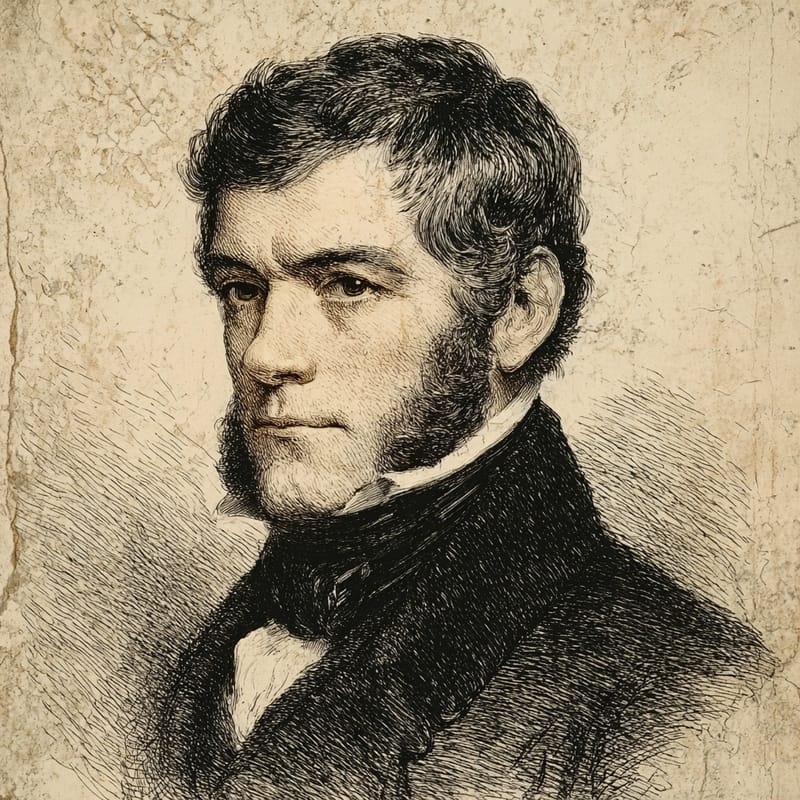
Friedrich List
The national system
Protect, then industrialise.
Rooted State CapitalistOne of 729 ideologies · enter the State Capitalist hall →- Role
- Economist
- Era
- 1789–1846
- Region
- Germany
- Social band
- Rooted
- Placement
- +26 · +64 · −30
§ Where Friedrich List stands
3 axesList accepted private property and competition but rejected laissez-faire as a doctrine for latecomers. In The National System of Political Economy (1841) he argued that a nation's productive powers matter more than its stock of exchangeable wealth, and that temporary tariffs should shelter infant manufactures until they could face British competition, after which free trade among equals would make sense. Agriculture, he held, needed no such protection.
List assigned the state a commanding role in development. His 1833 pamphlet on a Saxon railway system proposed a planned network as the backbone of a united Germany, and he championed the Zollverein of 1834 as a step toward political union. He wanted government to educate industry through tariffs, build infrastructure and pursue national power, including directed German settlement along the Danube.
List was a nationalist who saw the nation, standing between the individual and humanity, as the true unit of economic life. He accused Smith's school of cosmopolitanism, called for German unity and national culture, and urged that German emigrants be steered toward Hungary and the Danube lands rather than lost to America. His outlook was modern in technology but rooted in national community.
How close are you to Friedrich List?
Three statements, one per axis. Answer them and we’ll drop you on the compass next to them.
§ The story
HistoricalGeorg Friedrich List (1789–1846) was a German economist, journalist and railway promoter. A Württemberg civil servant who briefly taught political economy at Tübingen, he co-founded a merchants' association in 1819 to campaign against the tariffs dividing the German states. His reformist politics led to his expulsion from the Württemberg diet and imprisonment, and in 1825 he emigrated to the United States, where he wrote Outlines of American Political Economy (1827), invested in coal and railways and became a citizen.
Returning to Germany as an American consul in the 1830s, List campaigned for a national railway network and for the Zollverein customs union as foundations of German unity. His masterpiece, The National System of Political Economy (1841), attacked Adam Smith's cosmopolitan free trade and argued that young industries need protection until they can compete. Dogged by debt and ill health, he took his own life at Kufstein in 1846. His arguments influenced German protectionism after 1879, economic nationalists in Meiji Japan and, later, the developmental states of East Asia.
Notable for
- 01'The National System of Political Economy'
- 02Theory of productive powers
- 03Inspired developmental states
Key works & moments
- 1819Co-founds the General German Commercial and Industrial Association to fight internal German tariffs.
- 1825Emigrates to the United States after imprisonment in Württemberg for advocating reform.
- 1827Publishes Outlines of American Political Economy, defending protective tariffs.
- 1833Proposes a German railway network centred on Saxony; the Leipzig–Dresden line opens in 1839.
- 1841Publishes The National System of Political Economy.
- 1846Takes his own life at Kufstein in the Austrian Tyrol.
In their own words
“It is a very common clever device that when anyone has attained the summit of greatness, he kicks away the ladder by which he has climbed up, in order to deprive others of the means of climbing up after him.”
“The power of producing wealth is therefore infinitely more important than wealth itself.”
§ Minds closest to Friedrich List
All minds →


§ Also in the State Capitalist hall
Enter the hall →§ Common questions
4 answersWhat was Friedrich List's political ideology?
List was an economic nationalist and the founder of the national school of political economy: on the 99ideologies three-axis compass, a Rooted State Capitalist. Economically he sat moderately on the market side (+26), accepting private enterprise but demanding protective tariffs for infant industries. On governance he leaned strongly toward an active, directing state (+64) that would plan railways and build national power, and socially he was mildly traditional (−30), putting the nation before both the individual and humanity.
Was Friedrich List left-wing or right-wing?
In his own time he was a liberal reformer, jailed for petitioning against Württemberg's bureaucracy, but his economics fit the nationalist right better than the left. He defended private property and industrial capitalism and had no sympathy for socialism; what he rejected was free trade as a universal rule. Protectionists on the right have claimed him ever since, while some development economists on the left admire his case that poorer countries need room to build industry.
Was Friedrich List against free trade?
Not absolutely. List opposed free trade between unequal economies, arguing that Britain preached it only after protection had made its industry dominant. He proposed temporary tariffs on manufactures for nations with the resources to industrialise, such as Germany and the United States, but not on agriculture or raw materials, and expected free trade to follow once nations reached comparable development. His goal was a world of strong industrial nations trading as equals, not permanent autarky.
Which minds are closest to Friedrich List?
On the 99ideologies three-axis compass, the minds closest to Friedrich List are The Party-Corporation (archetype) (96% alike), Reza Shah Pahlavi (95% alike) and Józef Piłsudski (95% alike). The furthest is Emma Goldman (9% alike).