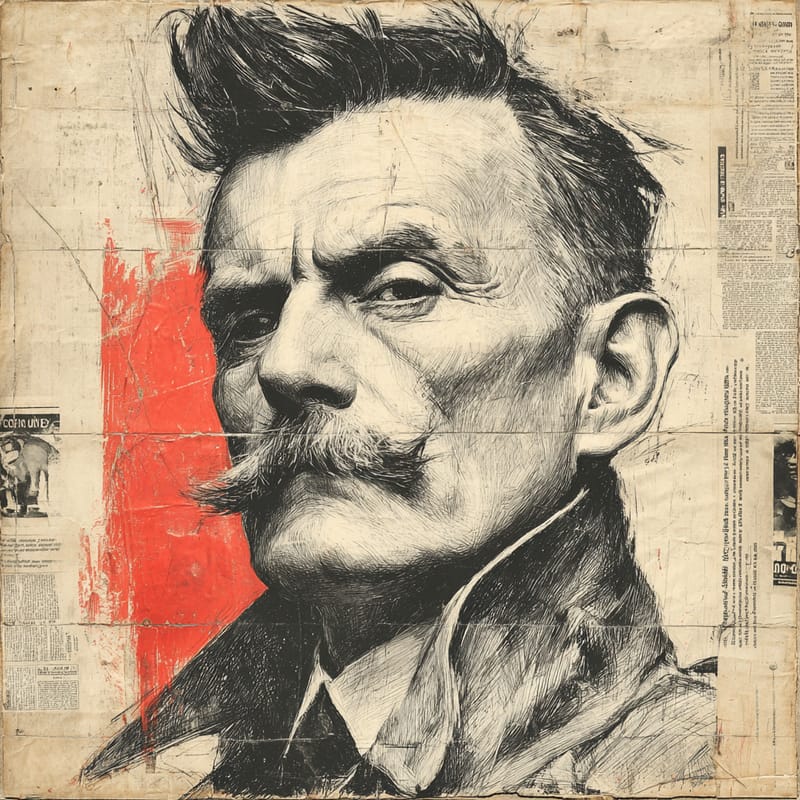
Józef Piłsudski
Sanacja
A market economy under the marshal.
Rooted State CapitalistOne of 729 ideologies · enter the State Capitalist hall →- Role
- Chief of State
- Era
- 1867–1935
- Region
- Poland
- Social band
- Rooted
- Placement
- +18 · +72 · −24
§ Where Józef Piłsudski stands
3 axesPiłsudski began as a socialist but in power left Poland's market economy and private property intact. His governments stabilised the złoty with a 1927 foreign loan and kept it on the gold standard through the Depression, while the state expanded the new port of Gdynia, ran the railways and held tobacco and spirits monopolies. It was state guidance of a capitalist economy, not socialism.
Piłsudski seized power in the May Coup of 1926 and then hollowed out parliament rather than abolishing it. The August 1926 constitutional amendment strengthened the presidency, leaders of the Centre-Left opposition were arrested in 1930 and jailed after the Brest trials, a camp for political detainees opened at Bereza Kartuska in 1934, and the April Constitution of 1935 entrenched a dominant president.
Piłsudski's nationalism was civic and multi-ethnic rather than religious: he hoped for a federation with Lithuania, Belarus and Ukraine, opposed Roman Dmowski's ethnic National Democrats, and many Polish Jews saw him as a protector. Yet his politics rested on military honour and national myth, and his government's 1930 pacification of Ukrainian villages in Eastern Galicia and its 1934 repudiation of the minorities treaty show the limits of that tolerance.
How close are you to Józef Piłsudski?
Three statements, one per axis. Answer them and we’ll drop you on the compass next to them.
§ The story
HistoricalJózef Klemens Piłsudski (1867–1935) was the dominant figure in the rebirth of independent Poland. Born near Vilnius in the Russian partition, he was exiled to Siberia in 1887 for alleged links to a plot against Tsar Alexander III, joined the Polish Socialist Party and led its armed underground, then raised the Polish Legions to fight alongside Austria-Hungary in 1914. When German power collapsed in November 1918 he took charge in Warsaw as Chief of State, an office he held until 1922, and was made Marshal of Poland in 1920.
His defeat of the Red Army at the Battle of Warsaw in August 1920 secured Poland's eastern frontier and halted the Soviet advance westward, making him a national hero. Having stepped back from office in 1923, he returned by force in the May Coup of 1926, in which hundreds died, declined the presidency and ruled until his death through the Sanacja regime, mostly from the war ministry. Opposition leaders were imprisoned after the Brest trials and a detention camp opened at Bereza Kartuska in 1934, so his standing as the father of independence coexists with an authoritarian record.
Notable for
- 01Refounded independent Poland
- 02The 'Sanacja' regime
- 03Defeated the Soviet advance in 1920
Key works & moments
- 1887Exiled to Siberia for five years over alleged links to a plot against Tsar Alexander III.
- 1914Leads the Polish Legions into the First World War alongside Austria-Hungary.
- 1918Returns to Warsaw on 10 November and takes power as Chief of State.
- 1920Directs the counter-offensive that defeats the Red Army at the Battle of Warsaw.
- 1926Overthrows the government in the three-day May Coup and installs the Sanacja regime.
- 1935The April Constitution entrenches presidential power; he dies in Warsaw on 12 May.
§ Minds closest to Józef Piłsudski
All minds →


§ Also in the State Capitalist hall
Enter the hall →§ Common questions
4 answersWhat was Józef Piłsudski's political ideology?
Piłsudski moved from socialism to an authoritarian, nationalist statism known as Sanacja, or moral cleansing: on the 99ideologies three-axis compass, a Rooted State Capitalist. Economically he sat slightly on the market side (+18), leaving private enterprise intact while the state ran monopolies and strategic projects. On governance he was strongly authoritarian (+72) after his 1926 coup, and socially he was mildly traditional (−24), a civic, multi-ethnic nationalist rather than a clerical conservative.
Was Józef Piłsudski left-wing or right-wing?
He began on the left and governed from the right, though he never fitted either camp. As a young man he led the Polish Socialist Party's underground and its armed wing, and socialists backed his 1926 coup. In power he courted landowners and industrialists, broke with the left and jailed its leaders in 1930. Unlike Roman Dmowski's nationalist right, however, he rejected ethnic and religious exclusion, so he is best seen as an authoritarian statist standing above party.
Was Józef Piłsudski a dictator?
In substance, yes, from 1926, though he avoided the trappings. After the May Coup he refused the presidency, held office mostly as minister of military affairs and kept parliament, elections and a constrained opposition press. Real power was nonetheless his: the 1930 elections were held after opposition leaders had been arrested, those leaders were convicted in the Brest trials, and political detainees were held without trial at Bereza Kartuska from 1934. Historians usually describe the Sanacja as authoritarian rather than totalitarian.
Which minds are closest to Józef Piłsudski?
On the 99ideologies three-axis compass, the minds closest to Józef Piłsudski are Friedrich List (95% alike), The Party-Corporation (archetype) (94% alike) and Reza Shah Pahlavi (94% alike). The furthest is Emma Goldman (9% alike).