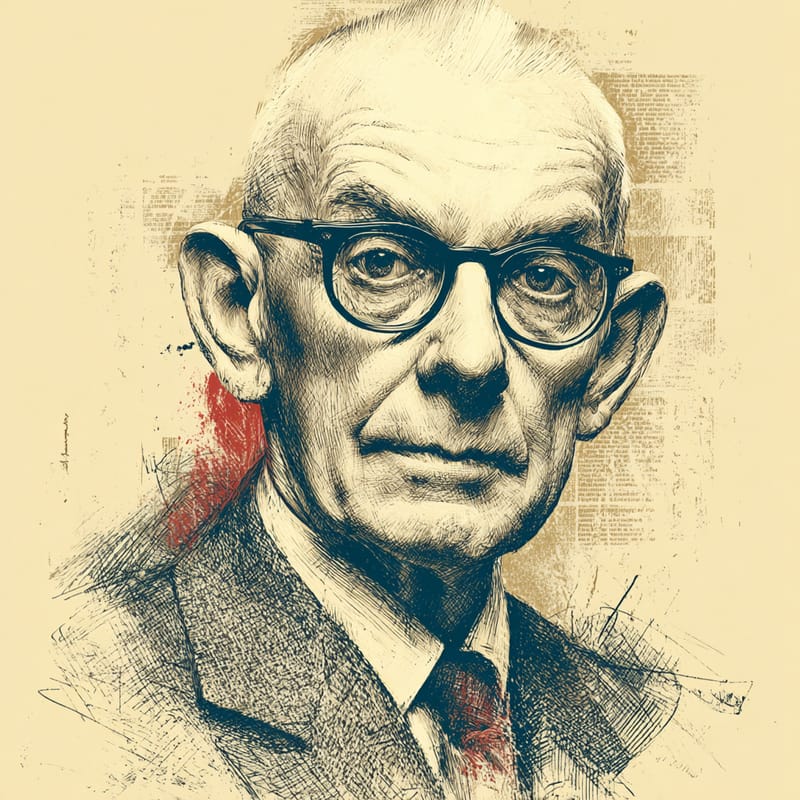
William Vickrey
Pricing the commons
Nobel economics with a Georgist heart.
Reformist GeorgismOne of 729 ideologies · enter the Georgism hall →- Role
- Economist & Nobel laureate
- Era
- 1914–1996
- Region
- Canada / US
- Social band
- Reformist
- Placement
- +24 · −44 · +40
§ Where William Vickrey stands
3 axesVickrey's instinct was to fix public problems with prices: time-of-day fares for New York's subway in 1952, road charges that rise with congestion, and the second-price auction of his 1961 paper 'Counterspeculation, Auctions, and Competitive Sealed Tenders'. He backed land-value taxation as the least distorting source of revenue. But he was also a committed Keynesian who put full employment ahead of balanced budgets, which keeps his market lean moderate.
He preferred mechanisms that let people choose over rules that order them about: a congestion charge rations road space by price rather than by bans or queues, and a well-designed auction draws out honest bids without coercion. A Quaker and conscientious objector in the Second World War, he distrusted force, though his proposals assumed an active public sector setting prices and collecting land rent.
Vickrey was a progressive in the Quaker reforming tradition. His Agenda for Progressive Taxation (1947) sought fairer income taxation, and in a late essay, Fifteen Fatal Fallacies of Financial Fundamentalism, he attacked deficit hawks for tolerating mass unemployment, which he regarded as a needless cruelty. His concern was with equity and waste rather than with cultural battles.
How close are you to William Vickrey?
Three statements, one per axis. Answer them and we’ll drop you on the compass next to them.
§ The story
HistoricalWilliam Spencer Vickrey (1914–1996) was a Canadian-born American economist, born in Victoria, British Columbia, and educated at Yale and Columbia University, where he taught from 1946 for the rest of his career. A Quaker, he served as a conscientious objector during the Second World War. His Agenda for Progressive Taxation (1947) made him an authority on public finance, and he advised on tax reform in occupied Japan as a member of Carl Shoup's 1949 mission.
Vickrey's ideas were often decades ahead of practice. He proposed varying New York subway fares by time of day in 1952 and congestion pricing for Washington's roads in 1959, analysed the sealed-bid second-price auction that bears his name in a 1961 paper, and argued throughout for taxing land values. He shared the 1996 Nobel Memorial Prize with James Mirrlees for work on incentives under asymmetric information, but died three days after the announcement, on his way to a conference.
Notable for
- 01Nobel Memorial Prize, 1996
- 02Pioneered congestion pricing
- 03Land-value public finance
Key works & moments
- 1947Publishes Agenda for Progressive Taxation, based on his Columbia doctoral thesis.
- 1949Joins Carl Shoup's tax mission to occupied Japan.
- 1952Proposes time-of-day fare pricing for the New York City subway.
- 1961Publishes his analysis of sealed-bid auctions, introducing the Vickrey second-price auction.
- 1992Serves as president of the American Economic Association.
- 1996Shares the Nobel Memorial Prize in Economics with James Mirrlees; dies three days later.
§ Minds closest to William Vickrey
All minds →
§ Also in the Georgism hall
Enter the hall →§ Common questions
4 answersWhat was William Vickrey's political ideology?
William Vickrey was a progressive market economist who favoured land-value taxation and pricing over regulation: on the 99ideologies three-axis compass, an adherent of Reformist Georgism. Economically he leaned moderately to the market (+24), relying on prices, auctions and land rents to allocate scarce resources. On governance he was moderately anti-authoritarian (−44), preferring incentives to commands. Socially he was progressive (+40), a Quaker reformer who championed progressive taxation and full employment.
Was William Vickrey left-wing or right-wing?
Neither neatly: progressive in his goals, market-minded in his methods. Vickrey was a Keynesian who wanted full employment, progressive taxation and public investment, and he spent his last years attacking deficit hawks. Yet the tools he championed, congestion charges, auctions and land-value taxes, put prices to work for public ends, which is why free-market economists also claim him. He is best seen as a reformer who used markets for egalitarian purposes.
Was William Vickrey the father of congestion pricing?
Largely, yes. Vickrey is widely credited as the intellectual father of congestion pricing: in 1952 he proposed that New York's subway fares vary with time of day, and in 1959 he urged charging drivers in Washington, D.C. according to traffic conditions, at a time when the technology barely existed. Policymakers took decades to follow. Singapore introduced an area licensing scheme in 1975, London's congestion charge began in 2003, Stockholm's became permanent in 2007, and New York began charging drivers entering lower Manhattan in January 2025.
Which minds are closest to William Vickrey?
On the 99ideologies three-axis compass, the minds closest to William Vickrey are Henry George (98% alike), Silvio Gesell (97% alike) and Fred Foldvary (96% alike). The furthest is Gregor Strasser (18% alike).