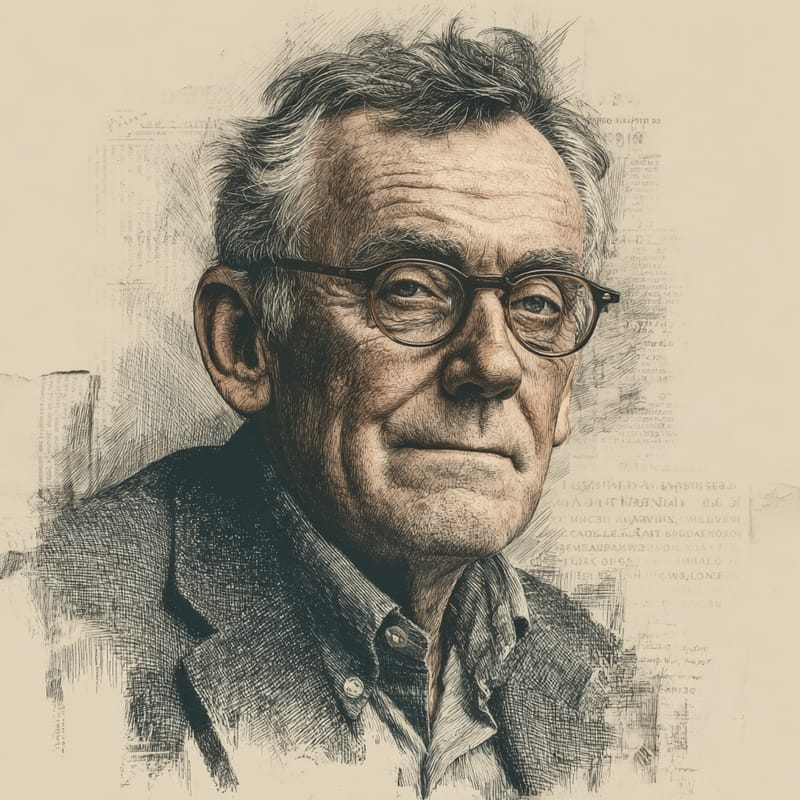
Mason Gaffney
The corruption of economics
Kept Georgist economics alive.
Heterodox GeorgismOne of 729 ideologies · enter the Georgism hall →- Role
- Economist
- Era
- 1923–2020
- Region
- United States
- Social band
- Heterodox
- Placement
- +24 · −46 · +30
§ Where Mason Gaffney stands
3 axesGaffney was a market economist who wanted taxes moved off wages, buildings and trade and onto land rent, which he argued could fund government without discouraging work or investment. In The Corruption of Economics (1994) he blamed neoclassical theory's merging of land into capital for hiding the costs of land speculation, the theme he applied to the 2008 crisis in After the Crash (2009).
His aim was a leaner, less intrusive state: a land-value tax needs no inquiry into anyone's income, spending or business, and land cannot be moved offshore to escape it. In After the Crash (2009) and many essays he argued that untaxed land feeds speculative booms and sprawl that later demand more public spending and regulation, so shifting the tax base would let government do less.
Gaffney was a reform-minded progressive who presented land-value taxation as a way to lower housing costs, spread ownership and curb the inherited advantages of large landholders. He wrote little on cultural questions; his progressivism lay in the claim, central to The Corruption of Economics (1994), that the gains from land belong to the public rather than to a privileged few.
How close are you to Mason Gaffney?
Three statements, one per axis. Answer them and we’ll drop you on the compass next to them.
§ The story
HistoricalMason Gaffney (1923–2020) was an American economist and the most prolific academic champion of Henry George's ideas in the late twentieth century. Born in Tacoma, Washington, he earned his doctorate at the University of California, Berkeley, and taught at several universities in the United States and Canada before joining the University of California, Riverside in 1976. He remained there for the rest of his long career, teaching and writing into his nineties.
Gaffney spent six decades arguing that taxing land values is both the most efficient and the fairest way to raise public revenue, applying the idea to cities, farmland, natural resources and water. His best-known book, The Corruption of Economics (1994), written with Fred Harrison, contends that neoclassical economics was shaped around 1900 partly to neutralise George's challenge to landed wealth, a thesis that remains contested among historians of economic thought.
Notable for
- 01'The Corruption of Economics'
- 02Modern Georgist economics
- 03Land-value-tax scholarship
Key works & moments
- 1976Joins the University of California, Riverside, his academic home for more than four decades.
- 1994Publishes The Corruption of Economics with Fred Harrison.
- 2009Publishes After the Crash: Designing a Depression-Free Economy, linking the 2008 crisis to land booms.
- 2020Dies at 96, having taught and written on land economics into his nineties.
§ Minds closest to Mason Gaffney
All minds →
§ Also in the Georgism hall
Enter the hall →§ Common questions
4 answersWhat was Mason Gaffney's political ideology?
Mason Gaffney was a Georgist economist who spent his career advocating land-value taxation: on the 99ideologies three-axis compass, an adherent of Heterodox Georgism. Economically he leaned to the market (+24), wanting taxes lifted from work, buildings and trade and placed on land rent. On governance he was anti-authoritarian (−46), favouring a simpler, less intrusive tax system. Socially he was moderately progressive (+30), presenting the land tax as a remedy for unaffordable housing and inherited privilege.
Was Mason Gaffney left-wing or right-wing?
Neither in the conventional sense. Gaffney attacked landed wealth, speculation and the economics profession's indulgence of both, themes that appeal to the left, and he wanted the public to capture the rising value of land. But he defended markets, private enterprise and free trade, and opposed heavy taxes on income and capital as burdens on production, positions more familiar on the right. Like most Georgists, he saw his programme as a third way between socialism and laissez-faire.
What is The Corruption of Economics about?
The Corruption of Economics (1994), written by Gaffney with the British writer Fred Harrison, argues that neoclassical economics took shape around 1900 partly as a response to Henry George. Gaffney contends that leading economists such as John Bates Clark, with support from landed and business interests, folded land into the general category of capital, erasing the distinction on which George's single tax depended. The claim of deliberate intent is contested, but the book remains the central Georgist account of why land-value taxation faded from mainstream economics.
Which minds are closest to Mason Gaffney?
On the 99ideologies three-axis compass, the minds closest to Mason Gaffney are Fred Foldvary (97% alike), William Vickrey (96% alike) and Henry George (96% alike). The furthest is Gregor Strasser (20% alike).