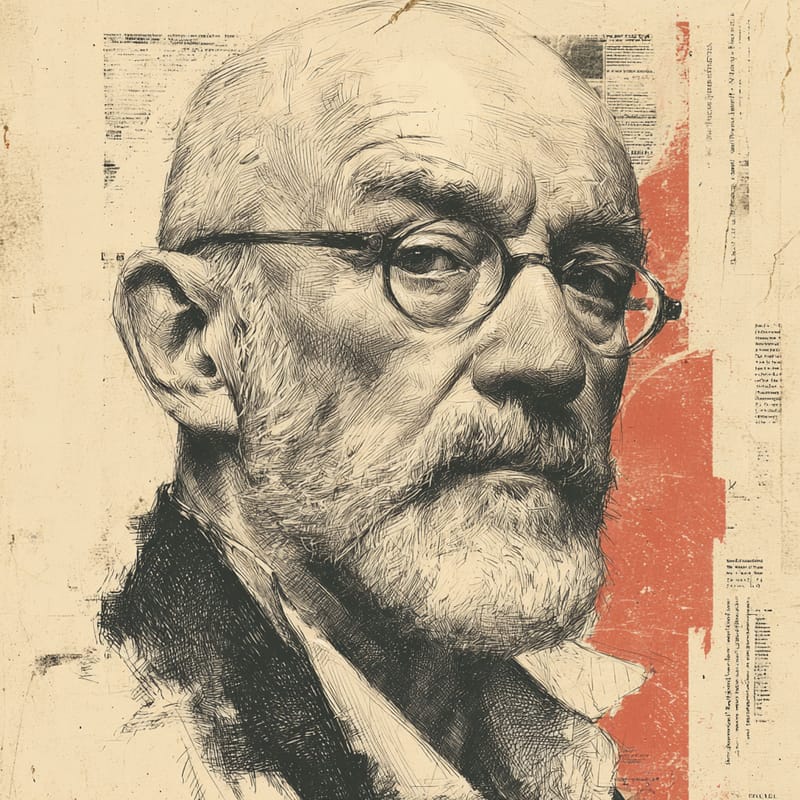
Fred Foldvary
Public goods, private cities
Land rent funds community, voluntarily.
Heterodox GeorgismOne of 729 ideologies · enter the Georgism hall →- Role
- Economist
- Era
- 1946–2021
- Region
- United States
- Social band
- Heterodox
- Placement
- +26 · −52 · +35
§ Where Fred Foldvary stands
3 axesFoldvary was a free-market economist who regarded taxes on wages, sales and capital as an unjust burden on producers. His Georgist twist was that land rent is unearned and should fund common goods, and his 1997 paper 'The Business Cycle: A Georgist-Austrian Synthesis' blamed booms and busts on land speculation fed by credit. That mix of free markets and socialised rent puts him moderately on the market side.
In Public Goods and Private Communities (1994) Foldvary argued that collective services, from security to roads, could be supplied by voluntary, contractual communities that fund them from site rents rather than coercive taxation. He wanted government reduced and decentralised, and his geo-libertarianism treated a levy on land rent as the only fully legitimate public revenue.
Foldvary was a liberal individualist on personal questions, defending free choice in private conduct as part of the universal ethic of freedom he set out in The Soul of Liberty (1980). His progressive streak lay in his view that the earth is a common inheritance, which put him closer to the egalitarian Georgist tradition than to the libertarian right.
How close are you to Fred Foldvary?
Three statements, one per axis. Answer them and we’ll drop you on the compass next to them.
§ The story
HistoricalFred E. Foldvary (1946–2021) was an American economist who spent his career trying to reconcile Henry George's land-value taxation with libertarian free-market thought. He taught economics at universities in California, including Santa Clara University and San Jose State University, and wrote widely for Georgist and libertarian publications, including a long-running online commentary for The Progress Report. His books include The Soul of Liberty (1980) and Public Goods and Private Communities (1994).
Foldvary called his synthesis geo-libertarianism, or geoism: individuals should own what they produce, but the rent of land belongs to everyone and should replace taxes on labour and capital. He argued that private communities, from condominiums to planned towns, already finance shared services from site rents, showing how public goods could be provided by contract. He became known beyond academia for a 1997 paper that used an eighteen-year real-estate cycle to forecast a major downturn around 2008.
Notable for
- 01Geo-libertarian theory
- 02Predicted the 2008 crash
- 03Land-rent public finance
Key works & moments
- 1980Publishes The Soul of Liberty, setting out a universal ethic of freedom.
- 1994Publishes Public Goods and Private Communities, on market provision of collective services.
- 1997Forecasts a major real-estate-driven downturn around 2008 in a Georgist-Austrian business-cycle paper.
- 2007–09The housing crash and Great Recession broadly match his forecast, drawing wider attention to his work.
§ Minds closest to Fred Foldvary
All minds →
§ Also in the Georgism hall
Enter the hall →§ Common questions
4 answersWhat was Fred Foldvary's political ideology?
Fred Foldvary was a geo-libertarian, combining Henry George's land-value tax with free-market libertarianism: on the 99ideologies three-axis compass, an adherent of Heterodox Georgism. Economically he leaned to the market (+26), opposing taxes on labour and capital while treating land rent as common wealth. On governance he was strongly anti-authoritarian (−52), favouring voluntary, contractual communities over coercive government. Socially he was moderately progressive (+35), a liberal individualist on personal conduct.
Was Fred Foldvary left-wing or right-wing?
Mostly on the libertarian side, with a left-leaning view of land. Foldvary defended free markets, private enterprise and minimal government, positions associated with the libertarian right in the United States. But he insisted that the rent of land belongs to everyone and should be shared, a claim that unsettles many free-market conservatives and links him to the reforming tradition of Henry George. He described the result as geo-libertarianism rather than left or right.
Did Fred Foldvary predict the 2008 financial crisis?
Yes, in broad terms. In a 1997 paper in the American Journal of Economics and Sociology, Foldvary combined Henry George's theory of land speculation with Austrian business-cycle theory and argued that real-estate booms and busts follow a cycle of roughly eighteen years. Projecting from the early-1990s slump, he forecast the next major downturn around 2008. The housing crash and the recession that began in late 2007 broadly fitted that forecast, and Georgists cite it as evidence for their land-cycle theory.
Which minds are closest to Fred Foldvary?
On the 99ideologies three-axis compass, the minds closest to Fred Foldvary are Mason Gaffney (97% alike), Henry George (96% alike) and William Vickrey (96% alike). The furthest is Gregor Strasser (17% alike).