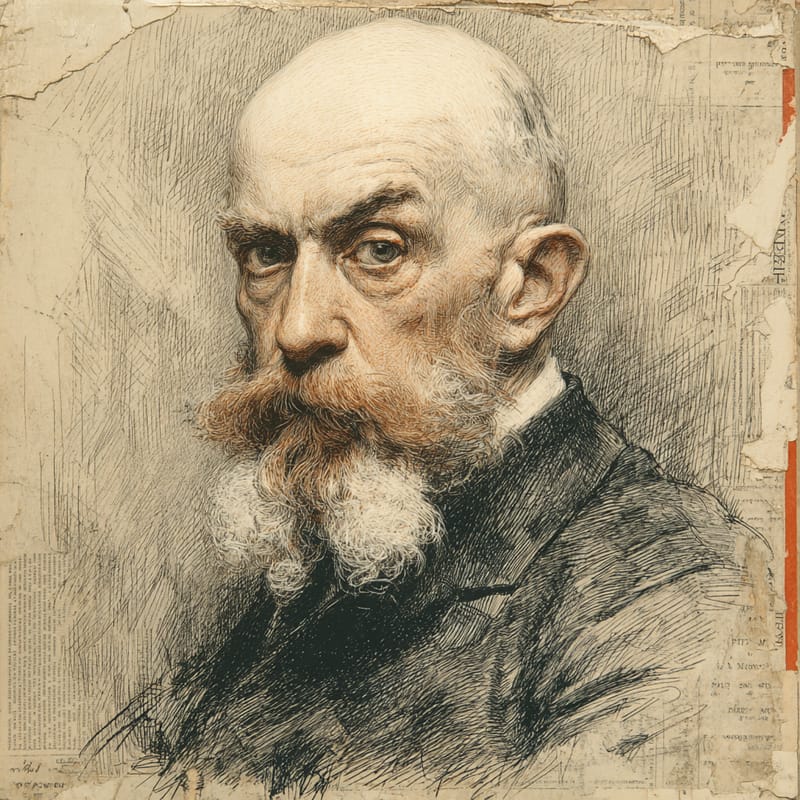
Henry George
Progress and Poverty
Tax land, free everything else.
Reformist GeorgismOne of 729 ideologies · enter the Georgism hall →- Role
- Economist & reformer
- Era
- 1839–1897
- Region
- United States
- Social band
- Reformist
- Placement
- +20 · −48 · +40
§ Where Henry George stands
3 axesGeorge was a free trader who prized competition and enterprise; Protection or Free Trade (1886) attacked tariffs as a tax on the many for the few. His target was land: Progress and Poverty (1879) argued that rising rents swallow the gains of progress and proposed a single tax on land values instead of all others. His support for public ownership of natural monopolies such as railways tempers his market lean.
George wanted to abolish nearly every tax and the officials needed to collect them, arguing that a land-value tax would be simple, impossible to evade and harmless to production. He sought it through elections, running for mayor of New York in 1886 and 1897 at the head of a labour coalition. His state would still be active, running natural monopolies and spending land rent on public goods.
George was a Gilded Age progressive who allied with trade unions and Irish land reformers, and in The Condition of Labor (1891) he answered Pope Leo XIII's encyclical Rerum Novarum by defending common rights in land. His egalitarianism had stark limits, however: his 1869 New York Tribune article on Chinese immigration argued for keeping Chinese workers out of California, a stance that tempers his placement.
How close are you to Henry George?
Three statements, one per axis. Answer them and we’ll drop you on the compass next to them.
§ The story
HistoricalHenry George (1839–1897) was an American journalist, economist and reformer, born in Philadelphia to a modest Episcopalian family. He left school young, went to sea, and in 1858 settled in California, where he worked as a printer and then as a newspaper writer and editor in San Francisco. Watching land speculation enrich a few while wages lagged in a booming state, he set out his answer in Progress and Poverty (1879), which became one of the best-selling books on economics of the nineteenth century.
George argued that land values are created by the community and should be taxed away, allowing all other taxes to be abolished. The idea made him an international celebrity: he lectured across Britain and Ireland in the 1880s, ran for mayor of New York in 1886 as the United Labor Party candidate, finishing second ahead of Theodore Roosevelt, and inspired reformers from Tolstoy to Sun Yat-sen. He died during a second mayoral campaign in 1897. His record also includes hostility to Chinese immigration, set out in an 1869 newspaper article.
Notable for
- 01'Progress and Poverty'
- 02The single-tax movement
- 03Land-value taxation
Key works & moments
- 1871Publishes Our Land and Land Policy, the first sketch of his land-value theory.
- 1879Publishes Progress and Poverty, proposing a single tax on land values.
- 1881–82Lectures in Ireland and Britain in support of Irish land reform.
- 1886Runs for mayor of New York for the United Labor Party, finishing second ahead of Theodore Roosevelt.
- 1891Answers Pope Leo XIII's Rerum Novarum with The Condition of Labor.
- 1897Dies days before the New York mayoral election, in which he was a candidate.
In their own words
“This association of poverty with progress is the great enigma of our times.”
“It is not necessary to confiscate land; it is only necessary to confiscate rent.”
§ Minds closest to Henry George
All minds →
§ Also in the Georgism hall
Enter the hall →§ Common questions
4 answersWhat was Henry George's political ideology?
Henry George was the founder of Georgism, a free-market reform programme built on taxing land: on the 99ideologies three-axis compass, an adherent of Reformist Georgism. Economically he leaned moderately to the market (+20), backing free trade and private enterprise while taxing away land rent. On governance he was anti-authoritarian (−48), wanting to abolish almost every other tax. Socially he was a progressive reformer (+40), allied with labour and Irish land campaigners, though hostile to Chinese immigration.
Was Henry George left-wing or right-wing?
He belongs to neither camp, though his movement sat with the reforming left of its day. George ran for mayor of New York as a labour candidate, attacked landlords and monopolies, and inspired Fabians, progressives and land reformers. Yet he defended free trade, private capital and competition, opposed socialism and parted company with the socialists in his own party in 1887. His single tax is often described as a third way: radical about land, liberal about almost everything else.
What is Henry George's single tax?
It is a tax on the unimproved value of land, meant to replace all other taxes. George argued in Progress and Poverty (1879) that land value is created by the community, through population growth and public investment, rather than by the owner, so taxing it takes nothing anyone earned. Because land cannot move or hide, the tax cannot be evaded or passed on to tenants, and because buildings and labour would go untaxed, it would reward production. Modern economists call the idea land-value taxation.
Which minds are closest to Henry George?
On the 99ideologies three-axis compass, the minds closest to Henry George are William Vickrey (98% alike), Silvio Gesell (98% alike) and The City of Arden (illustrative) (97% alike). The furthest is Gregor Strasser (18% alike).