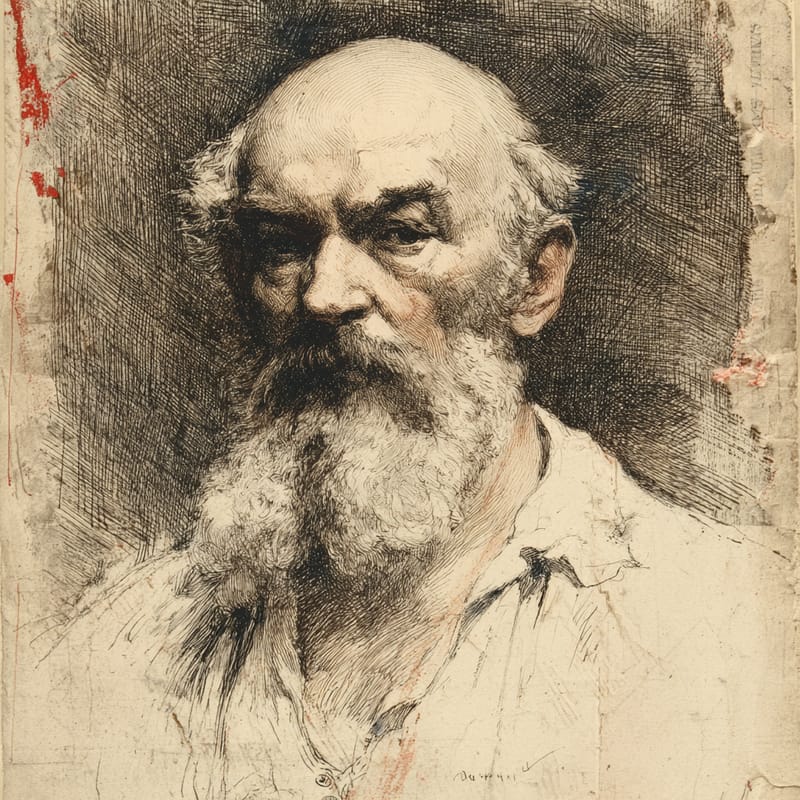
Leo Tolstoy
The land belongs to all
A novelist's Georgist conscience.
Reformist GeorgismOne of 729 ideologies · enter the Georgism hall →- Role
- Novelist & reformer
- Era
- 1828–1910
- Region
- Russia
- Social band
- Reformist
- Placement
- +18 · −56 · +50
§ Where Leo Tolstoy stands
3 axesTolstoy thought private ownership of land a moral wrong, the argument of 'A Great Iniquity', his 1905 letter to The Times urging Russia to adopt Henry George's single tax. He preferred George's remedy to socialism, which he saw as another system of coercion, and in Resurrection (1899) his hero offers his peasants land on Georgist terms. That rejection of collectivism puts him slightly on the market side.
In The Kingdom of God Is Within You (1894) Tolstoy argued that the state rests on organised violence and that Christians should refuse military service, oaths and the courts. He backed the pacifist Doukhobors and protested against executions in 'I Cannot Be Silent' (1908). His anarchism was pacifist rather than revolutionary, and he still urged the Russian government itself to enact George's land reform.
Tolstoy attacked the Orthodox Church's dogma and rituals, recast the Gospels as a purely ethical teaching and was excommunicated in 1901; he gave up meat and hunting, organised famine relief in 1891–92 and campaigned against the death penalty. Yet his moral code was austere, and The Kreutzer Sonata (1889) preached sexual abstinence, which keeps him well short of the progressive pole.
How close are you to Leo Tolstoy?
Three statements, one per axis. Answer them and we’ll drop you on the compass next to them.
§ The story
HistoricalCount Lev Nikolayevich Tolstoy (1828–1910) was a Russian novelist and moral thinker, born into an aristocratic family on the Yasnaya Polyana estate near Tula. After serving as an artillery officer in the Caucasus and at the siege of Sevastopol, recorded in his Sevastopol Sketches, he settled on his estate and wrote War and Peace (1865–69) and Anna Karenina (1875–77), works that made him one of the most celebrated writers in the world.
A spiritual crisis in the late 1870s turned Tolstoy into a radical Christian moralist who rejected the state, the church, private property in land and all violence. His later writings, from The Kingdom of God Is Within You (1894) to Resurrection (1899), were banned or censored in Russia, and the Orthodox Church excommunicated him in 1901. He became an ardent advocate of Henry George's single tax, influenced pacifists including Gandhi, and died in 1910 at Astapovo railway station after fleeing his home at the age of 82.
Notable for
- 01Champion of Henry George
- 02'Resurrection' and land reform
- 03Christian-anarchist ethics
Key works & moments
- 1865–69Serialises and completes War and Peace.
- 1879–82Writes A Confession, recording the crisis that turned him to radical Christian ethics.
- 1894Publishes The Kingdom of God Is Within You, his case for non-resistance against the state.
- 1899Publishes Resurrection, whose earnings help the pacifist Doukhobors emigrate to Canada.
- 1901Excommunicated by the Holy Synod of the Russian Orthodox Church.
- 1905Urges Henry George's single tax on Russia in 'A Great Iniquity'.
§ Minds closest to Leo Tolstoy
All minds →

§ Also in the Georgism hall
Enter the hall →§ Common questions
4 answersWhat was Leo Tolstoy's political ideology?
Leo Tolstoy was a Christian anarchist and convert to Henry George's land reform: on the 99ideologies three-axis compass, an adherent of Reformist Georgism. Economically he sat slightly on the market side (+18), rejecting socialism but condemning private ownership of land and backing a single tax on its value. On governance he was strongly anti-statist (−56), preaching non-resistance and refusal of military service. Socially he was progressive (+50), a critic of the church and the death penalty, if austere in personal morals.
Was Leo Tolstoy left-wing or right-wing?
Closer to the left, though he rejected the left's own programmes. Tolstoy attacked landlords, armies, courts, the church and the tsarist state, sided with peasants and was revered by many radicals. But he condemned revolutionary violence, dismissed socialism as another form of coercion and preferred Henry George's land tax to collective ownership. His politics flowed from Christian ethics rather than class struggle, which is why both liberals and revolutionaries found him an awkward ally.
Was Leo Tolstoy an anarchist?
Yes, in substance: he is regarded as the leading Christian anarchist, though he was wary of the label because it was associated with bombs and assassinations. He agreed with anarchists that the state rests on violence but rejected revolution as a cure, arguing that violence cannot abolish violence. His alternative was individual refusal: no military service, no oaths and no part in courts or government. That doctrine of non-resistance shaped Gandhi, who corresponded with him in 1909–10.
Which minds are closest to Leo Tolstoy?
On the 99ideologies three-axis compass, the minds closest to Leo Tolstoy are The City of Arden (illustrative) (97% alike), Lizzie Magie (97% alike) and Silvio Gesell (96% alike). The furthest is Adam Sutler (13% alike).