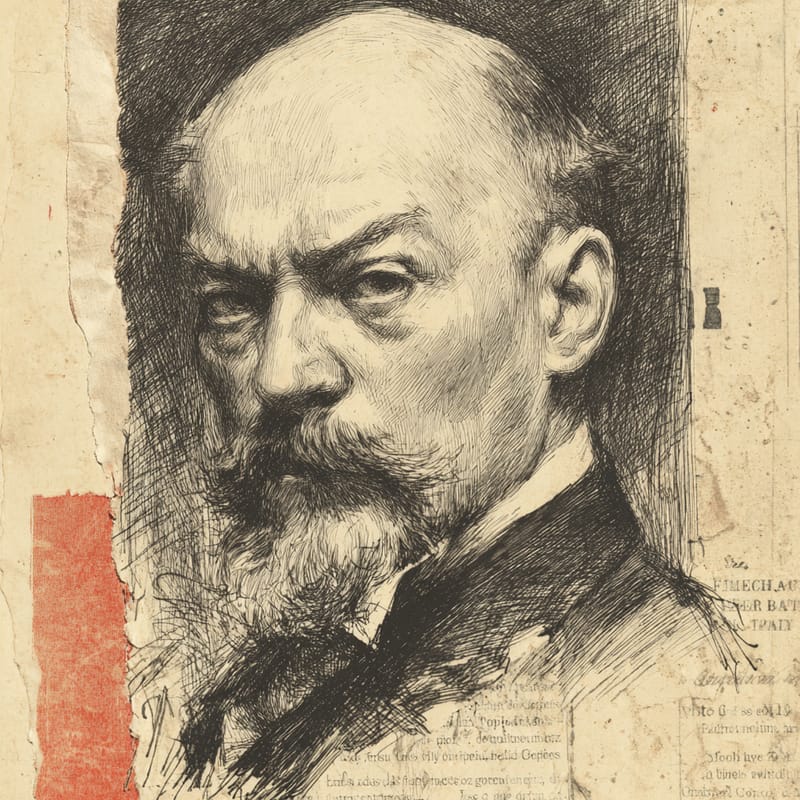
Silvio Gesell
Free-money, free-land
Natural economic order.
Reformist GeorgismOne of 729 ideologies · enter the Georgism hall →- Role
- Economist & merchant
- Era
- 1862–1930
- Region
- Germany / Argentina
- Social band
- Reformist
- Placement
- +22 · −50 · +45
§ Where Silvio Gesell stands
3 axesGesell wanted free competition purged of two privileges: private land rent and interest. The Natural Economic Order (1916) proposed nationalising land with compensation and leasing it by auction, and a free money (Freigeld) that loses a set share of its value each year, so that no one could profit by hoarding it. Markets, private enterprise and trade otherwise stayed, which is why he sits on the market side.
Gesell distrusted state power and believed that once money and land were reformed most of the state could fall away; his late essay Der abgebaute Staat (The Dismantled State, 1927) sketched a society with minimal government. Yet his reforms needed a public currency authority and a land office, and in 1919 he briefly took office in the revolutionary Bavarian Soviet Republic, which keeps him short of anarchism.
Gesell's reformism had a feminist edge: he proposed paying land rents to mothers as an allowance for each child, freeing women from economic dependence on men. He was also an internationalist and free trader who called for an international currency union. His Darwinian talk of competition as natural selection, however, gives his thought a harder edge than most progressive reform.
How close are you to Silvio Gesell?
Three statements, one per axis. Answer them and we’ll drop you on the compass next to them.
§ The story
HistoricalJohann Silvio Gesell (1862–1930) was a German merchant and self-taught economist, born in St. Vith, then in Prussia and now in Belgium. In 1887 he emigrated to Buenos Aires, where he built a successful import business, and the Argentine financial crisis that followed convinced him that the monetary system itself caused depressions. His first pamphlet on currency reform appeared in 1891, and after returning to Europe he farmed in Switzerland while developing his theory of free land and free money.
Gesell's main work, The Natural Economic Order (1916), proposed money that loses value over time, so that holders spend or lend rather than hoard, alongside public ownership of land with rents paid to mothers. In April 1919 he served for about a week as finance minister of the Bavarian Soviet Republic and was later acquitted of treason. His ideas inspired stamp-scrip experiments such as Wörgl in Austria in 1932–33, and Keynes, in The General Theory (1936), predicted that the future would learn more from Gesell than from Marx.
Notable for
- 01'The Natural Economic Order'
- 02Free-money (demurrage) theory
- 03Georgist land reform
Key works & moments
- 1887Emigrates to Buenos Aires and builds an import business.
- 1891Publishes his first pamphlet on currency reform after Argentina's financial crisis.
- 1916Publishes The Natural Economic Order through Free Land and Free Money.
- 1919Serves about a week as finance minister of the Bavarian Soviet Republic; later acquitted of treason.
- 1932–33The Austrian town of Wörgl issues depreciating stamp scrip based on his ideas.
- 1936Keynes's General Theory hails him as an unduly neglected prophet.
§ Minds closest to Silvio Gesell
All minds →
§ Also in the Georgism hall
Enter the hall →§ Common questions
4 answersWhat was Silvio Gesell's political ideology?
Silvio Gesell was a free-market monetary reformer who combined Henry George's land ideas with his own theory of money: on the 99ideologies three-axis compass, an adherent of Reformist Georgism. Economically he leaned moderately to the market (+22), backing free competition while abolishing private land rent and the reward for hoarding money. On governance he was anti-authoritarian (−50), hoping to shrink the state. Socially he was progressive (+45), proposing that land rents support mothers and children.
Was Silvio Gesell left-wing or right-wing?
Neither cleanly. His targets, landlords and interest-earning capital, appealed to the left, and he briefly served in the 1919 Bavarian Soviet government. But he championed private enterprise, competition and free trade and rejected Marxism, and his followers in the Freiwirtschaft, or free economy, movement included liberals and anarchists as well as socialists. On balance he belongs to the market-friendly wing of radical reform, which is why his economic placement sits right of centre.
What is Silvio Gesell's free money?
Free money (Freigeld) is currency designed to lose value steadily, for example by requiring holders to buy a stamp at regular intervals to keep a note valid. Gesell argued that because money, unlike goods, does not rot, its owners can withhold it to extract interest, causing slumps; a carrying cost, or demurrage, would push them to spend or lend. The idea was tried in stamp-scrip experiments, most famously at Wörgl in Austria in 1932–33 until the authorities stopped it, and Irving Fisher promoted it in the United States.
Which minds are closest to Silvio Gesell?
On the 99ideologies three-axis compass, the minds closest to Silvio Gesell are The City of Arden (illustrative) (99% alike), Henry George (98% alike) and William Vickrey (97% alike). The furthest is Gregor Strasser (16% alike).