
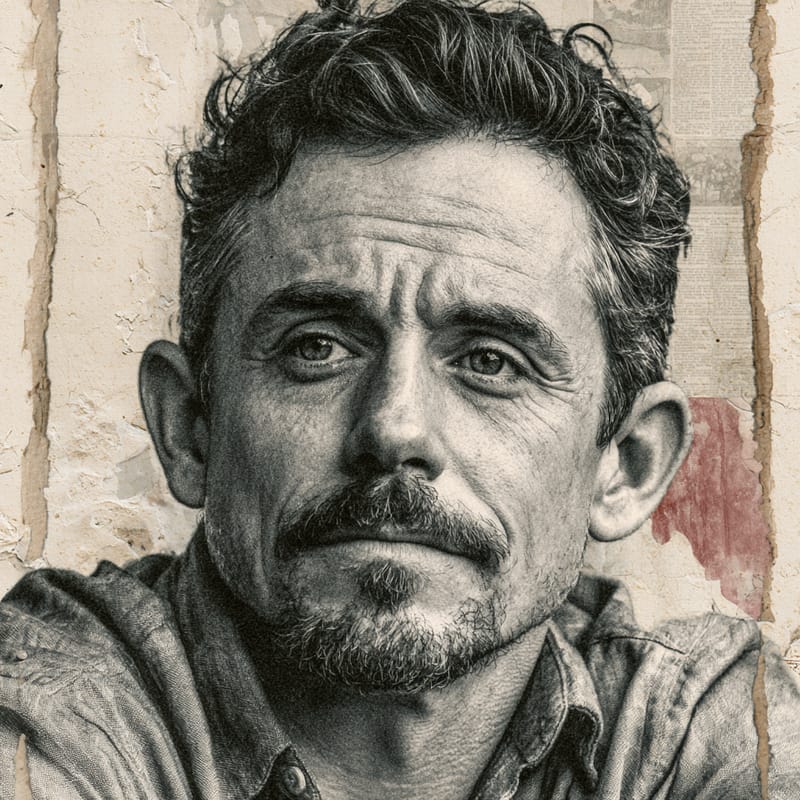
Murray Rothbard
Father of anarcho-capitalism
Abolish the state; privatise everything.
Anarcho-CapitalistOne of 729 ideologies · enter the Anarcho-Capitalist hall →- Role
- Economist & theorist
- Era
- 1926–1995
- Region
- United States
- Social band
- Centre (no modifier)
- Placement
- +98 · −95 · −10
§ Where Murray Rothbard stands
3 axesRothbard stood at the far end of free-market thought, rejecting not only socialism but central banking, antitrust law and every public service. Man, Economy, and State (1962) restated Austrian economics as a deductive system, America's Great Depression (1963) blamed the slump on the Federal Reserve's credit expansion of the 1920s, and he advocated a 100 per cent gold-reserve currency with no central bank.
Rothbard held that the state is an illegitimate institution of organised theft. The Ethics of Liberty (1982) treated taxation as robbery and the state as a criminal organisation writ large, while For a New Liberty (1973) showed how police, courts and defence could be supplied by competing private agencies under a libertarian legal code. He grounded the case in natural rights rather than in expediency.
Socially Rothbard moved from left to right. In the 1960s he co-edited Left and Right (1965–1968), a journal seeking alliance with the anti-war New Left, and he defended civil liberties and the legalisation of victimless crimes. He had long attacked egalitarianism, as in Egalitarianism as a Revolt Against Nature (1974), and from the late 1980s he embraced cultural conservatism and the paleoconservatives, leaving him slightly on the traditional side.
How close are you to Murray Rothbard?
Three statements, one per axis. Answer them and we’ll drop you on the compass next to them.
§ The story
HistoricalMurray Rothbard (1926–1995) was an American economist, historian and political theorist, the principal architect of anarcho-capitalism. Born in the Bronx, he earned his doctorate at Columbia University and from 1949 attended Ludwig von Mises's seminar in New York, becoming a leading figure of the Austrian school. He taught at the Polytechnic Institute of Brooklyn and later the University of Nevada, Las Vegas, and his books included Man, Economy, and State (1962), America's Great Depression (1963), For a New Liberty (1973) and The Ethics of Liberty (1982).
Rothbard fused Austrian economics, natural-rights philosophy and American individualist anarchism into a case for abolishing the state entirely. A restless coalition-builder, he allied with the New Left against the Vietnam War in the 1960s, co-founded the Cato Institute in 1977 and the Mises Institute in 1982, then broke with mainstream libertarians to court paleoconservatives. His 1992 call for a right-wing populism, which praised elements of the former Ku Klux Klan leader David Duke's campaign, and his support for Pat Buchanan remain the most controversial episodes of a career that shaped modern libertarianism.
Notable for
- 01'For a New Liberty'
- 02'Man, Economy, and State'
- 03Founded anarcho-capitalism
Key works & moments
- 1962Publishes Man, Economy, and State, a systematic treatise of Austrian economics.
- 1963Publishes America's Great Depression, blaming the slump on Federal Reserve credit expansion.
- 1965Launches the journal Left and Right, seeking an alliance with the anti-war New Left.
- 1973Publishes For a New Liberty, the manifesto of anarcho-capitalism.
- 1977Co-founds the Cato Institute, with which he later breaks.
- 1982Publishes The Ethics of Liberty and helps found the Ludwig von Mises Institute.
In their own words
“The libertarian creed rests upon one central axiom: that no man or group of men may aggress against the person or property of anyone else.”
§ Minds closest to Murray Rothbard
All minds →



§ Also in the Anarcho-Capitalist hall
Enter the hall →§ Common questions
4 answersWhat was Murray Rothbard's political ideology?
Murray Rothbard was the founder of modern anarcho-capitalism, combining Austrian economics with natural-rights libertarianism: on the 99ideologies three-axis compass, an Anarcho-Capitalist. Economically he stood at the far market end (+98), opposing central banking and every public service. On governance he was almost entirely anti-state (−95), regarding taxation as theft, and socially he sat near the centre (−10), moving from an alliance with the anti-war left in the 1960s to cultural conservatism in his final years.
Was Murray Rothbard left-wing or right-wing?
Right-wing on economics, but his alliances shifted across the spectrum. His defence of pure laissez-faire and hostility to the welfare state place him on the far free-market right. Yet in the 1960s he joined forces with the New Left against the Vietnam War and the military-industrial state, before swinging in the late 1980s to a paleolibertarian alliance with cultural conservatives. Throughout, his fixed point was opposition to the state, which he saw as the enemy whichever side wielded it.
What did Murray Rothbard mean by anarcho-capitalism?
For Rothbard, anarcho-capitalism is a society with no state, in which every good and service, including police, courts and defence, is supplied by voluntary exchange. It rests on the non-aggression axiom, set out in For a New Liberty (1973): no one may initiate force against another person or their property. Rothbard is generally credited with popularising the term, and he distinguished his system from left-wing anarchism by its defence of private property and markets, and from minimal-state liberalism by rejecting taxation entirely.
Which minds are closest to Murray Rothbard?
On the 99ideologies three-axis compass, the minds closest to Murray Rothbard are Walter Block (98% alike), John Hospers (92% alike) and The Night-Watchman State (archetype) (92% alike). The furthest is Pol Pot (0% alike).