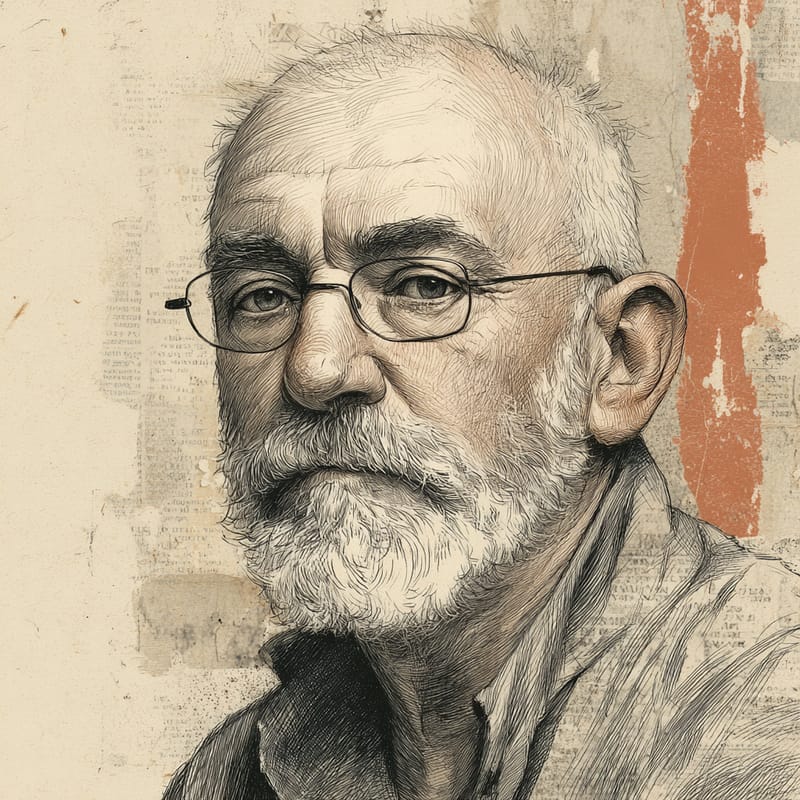
David D. Friedman
Private law works
Even courts can be a market good.
Heterodox Anarcho-CapitalistOne of 729 ideologies · enter the Anarcho-Capitalist hall →- Role
- Economist
- Era
- b. 1945
- Region
- United States
- Social band
- Heterodox
- Placement
- +95 · −90 · +25
§ Where David D. Friedman stands
3 axesFriedman's economics are as market-oriented as any: he would privatise not only industry and welfare but law, police and courts. The Machinery of Freedom (1973) describes rights-enforcement agencies selling protection and arbitration in a competitive market and argues that even goods usually thought public can often be supplied privately. His defence rests on efficiency and incentives rather than on moral absolutes.
Friedman sees no need for a state. His 1979 paper on medieval Iceland, published in the Journal of Legal Studies, presented the Commonwealth's privately prosecuted law as evidence that order can survive without a central enforcer, and Legal Systems Very Different from Ours (2019) surveys other such cases. He treats anarchy as an institutional design problem to be judged by results.
Socially Friedman is a liberal individualist who would leave consensual personal conduct, from drug use to unconventional lifestyles, outside the law's reach. Future Imperfect (2008) explores how technologies from strong encryption to biotechnology could widen individual choice. A longtime medieval re-enactor, he is curious about tradition rather than hostile to it, which keeps his progressive lean mild.
How close are you to David D. Friedman?
Three statements, one per axis. Answer them and we’ll drop you on the compass next to them.
§ The story
LivingDavid D. Friedman (born 1945) is an American economist and legal scholar, the son of the Nobel laureate Milton Friedman. Trained as a physicist at Harvard and the University of Chicago, he moved into economics and later taught law at Santa Clara University. His book The Machinery of Freedom (1973) set out how a society might function with every service, including courts, police and law itself, supplied by competing private firms, and his books Price Theory (1986) and Hidden Order (1996) brought his economic approach to wider audiences.
Friedman's distinctive contribution is a consequentialist case for anarcho-capitalism. Where Murray Rothbard argued from natural rights, Friedman argues that private protection agencies and arbitrators would produce better law at lower cost, and he has tested the claim against history, most famously in a 1979 study of medieval Iceland's privately enforced law. Law's Order (2000) extended his economic analysis of legal rules. Critics doubt that competing agencies would avoid war or collusion, and Friedman himself calls national defence the hard problem for his theory.
Notable for
- 01'The Machinery of Freedom'
- 02Consequentialist anarcho-capitalism
- 03Historical private-law systems
Key works & moments
- 1973Publishes The Machinery of Freedom: Guide to a Radical Capitalism.
- 1979Publishes a study of privately enforced law in medieval Iceland.
- 1986Publishes the textbook Price Theory.
- 1996Publishes Hidden Order: The Economics of Everyday Life.
- 2000Publishes Law's Order, applying economics to legal rules.
- 2019Co-authors Legal Systems Very Different from Ours, surveying unusual legal systems across history.
§ Minds closest to David D. Friedman
All minds →

§ Also in the Anarcho-Capitalist hall
Enter the hall →§ Common questions
4 answersWhat is David D. Friedman's political ideology?
David D. Friedman is an anarcho-capitalist who defends a stateless market society on consequentialist grounds: on the 99ideologies three-axis compass, a Heterodox Anarcho-Capitalist. Economically he sits at the far market end (+95), proposing that even law, police and courts be supplied by competing firms. On governance he is strongly anti-state (−90), drawing on historical cases such as medieval Iceland, and socially he leans mildly progressive (+25), a liberal individualist on personal conduct.
Is David D. Friedman left-wing or right-wing?
Right-wing on economics, libertarian on everything else. Friedman's call to privatise the entire state, including law and defence, places him at the far free-market end of the spectrum, well beyond his father Milton Friedman's limited-government liberalism. But he supports personal freedoms such as drug legalisation that many conservatives oppose, and he argues from costs and benefits rather than from tradition or religion, so he fits the libertarian rather than the conservative right.
How is David Friedman's anarcho-capitalism different from Rothbard's?
They differ in method rather than goal. Murray Rothbard derived anarcho-capitalism from natural rights, holding that any state violates property rights and is therefore unjust. Friedman makes an economic argument instead: competing protection agencies and arbitrators would, he predicts, produce law that is cheaper, more responsive and less prone to abuse than a state monopoly. Because his case rests on consequences, Friedman accepts that it could in principle be refuted by evidence, and he devotes much of his work to historical tests.
Which minds are closest to David D. Friedman?
On the 99ideologies three-axis compass, the minds closest to David D. Friedman are Linda & Morris Tannehill (97% alike), Ragnar Danneskjöld (94% alike) and Lysander Spooner (93% alike). The furthest is Pol Pot (0% alike).