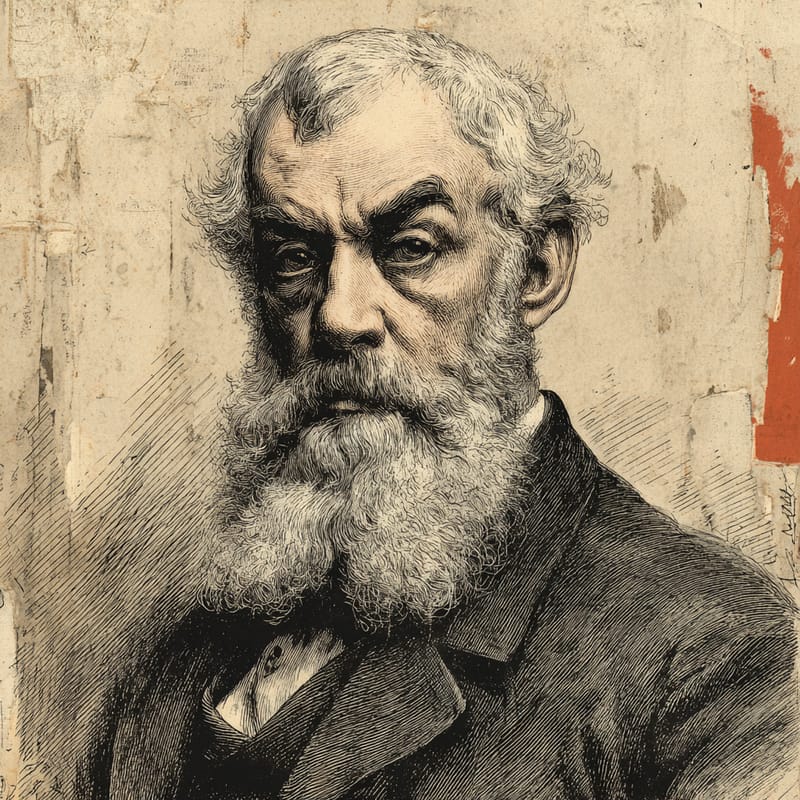
Lysander Spooner
No treason
The constitution holds no authority over anyone.
Reformist Anarcho-CapitalistOne of 729 ideologies · enter the Anarcho-Capitalist hall →- Role
- Abolitionist & theorist
- Era
- 1808–1887
- Region
- United States
- Social band
- Reformist
- Placement
- +88 · −92 · +40
§ Where Lysander Spooner stands
3 axesSpooner championed free competition against every state monopoly. His American Letter Mail Company of 1844 challenged the federal postal monopoly directly, and Poverty: Its Illegal Causes and Legal Cure (1846) blamed laws restricting banking and credit for keeping working people dependent on wages. His ideal was a society of independent proprietors trading freely, a vision later claimed by both free-market and left-wing libertarians.
Spooner denied the state any legitimate authority. No Treason, No. VI: The Constitution of No Authority (1870) argued that a constitution signed by a few men long dead could bind no one living, and that voting and paying taxes under compulsion were not consent. Earlier, An Essay on the Trial by Jury (1852) urged jurors to judge the justice of laws and acquit those charged under unjust ones.
Socially Spooner was a radical by the standards of his age. A militant abolitionist, he went beyond moral persuasion in A Plan for the Abolition of Slavery (1858), urging armed resistance by enslaved people and their allies, and in Vices Are Not Crimes (1875) he argued that drinking and other self-regarding behaviour should never be punished by law. His individualism rested on natural rights, not reform programmes.
How close are you to Lysander Spooner?
Three statements, one per axis. Answer them and we’ll drop you on the compass next to them.
§ The story
HistoricalLysander Spooner (1808–1887) was an American lawyer, abolitionist and political philosopher from Massachusetts. He challenged the state's rules restricting entry to the legal profession, and in 1844 founded the American Letter Mail Company, which undercut the US Post Office's rates until legal action and new federal laws drove it out of business. His treatise The Unconstitutionality of Slavery (1845) argued that the Constitution, properly read, gave no sanction to slavery, and An Essay on the Trial by Jury (1852) defended jurors' right to judge the justice of the law itself.
After the Civil War Spooner turned against the Constitution altogether. In No Treason (1867–1870) he argued that the document bound nobody, since nobody living had consented to it, and that the war had been fought to force the South back into the Union rather than to free the slaves. Vices Are Not Crimes (1875) distinguished self-regarding vices from crimes against others. Little read outside radical circles in his lifetime, he was rediscovered in the twentieth century by anarcho-capitalists, above all Murray Rothbard, and by left-libertarians alike.
Notable for
- 01'No Treason: The Constitution of No Authority'
- 02Ran a private postal company
- 03Radical abolitionism
Key works & moments
- 1844Founds the American Letter Mail Company to compete with the US Post Office.
- 1845Publishes The Unconstitutionality of Slavery, arguing the Constitution gives slavery no legal sanction.
- 1852Publishes An Essay on the Trial by Jury, defending jurors' right to judge the law.
- 1858Circulates A Plan for the Abolition of Slavery, urging resistance by the enslaved and their allies.
- 1867–70Publishes No Treason, culminating in The Constitution of No Authority.
- 1875Vices Are Not Crimes argues that self-harming conduct should never be punished by law.
In their own words
“Vices are those acts by which a man harms himself or his property. Crimes are those acts by which one man harms the person or property of another.”
“But whether the Constitution really be one thing, or another, this much is certain—that it has either authorized such a government as we have had, or has been powerless to prevent it. In either case, it is unfit to exist.”
§ Minds closest to Lysander Spooner
All minds →



§ Also in the Anarcho-Capitalist hall
Enter the hall →§ Common questions
4 answersWhat was Lysander Spooner's political ideology?
Lysander Spooner was an individualist anarchist and natural-rights theorist, often seen as a forerunner of anarcho-capitalism: on the 99ideologies three-axis compass, a Reformist Anarcho-Capitalist. Economically he stood far on the market side (+88), defending free competition even in mail delivery. On governance he was almost wholly anti-state (−92), arguing in No Treason that the Constitution bound no one, and socially he was moderately progressive (+40), a radical abolitionist who opposed laws against victimless vices.
Was Lysander Spooner left-wing or right-wing?
He is claimed by both, which shows how poorly the labels fit him. Anarcho-capitalists on the right celebrate his defence of private enterprise, his competing mail company and his rejection of the state's authority. Left-libertarians point to his wish to free workers from dependence on wages, his support for independent producers and his militant abolitionism. In nineteenth-century terms he was a radical individualist anarchist, writing for Benjamin Tucker's journal Liberty in his final years rather than aligning with any party.
What did Lysander Spooner argue in No Treason?
That the Constitution had no authority over anyone. Spooner argued that a contract binds only those who agree to it, and that the Constitution was agreed to, at most, by a handful of men of the 1780s who were long dead. Voting proves no consent, since voters act in secret and often in self-defence, and taxes are taken by force, as a highwayman takes a purse. A government resting on such grounds, he concluded, has no more legitimacy than a band of robbers.
Which minds are closest to Lysander Spooner?
On the 99ideologies three-axis compass, the minds closest to Lysander Spooner are David D. Friedman (93% alike), The Cryptonomicon Coder (archetype) (93% alike) and Nick Szabo (93% alike). The furthest is Pol Pot (0% alike).