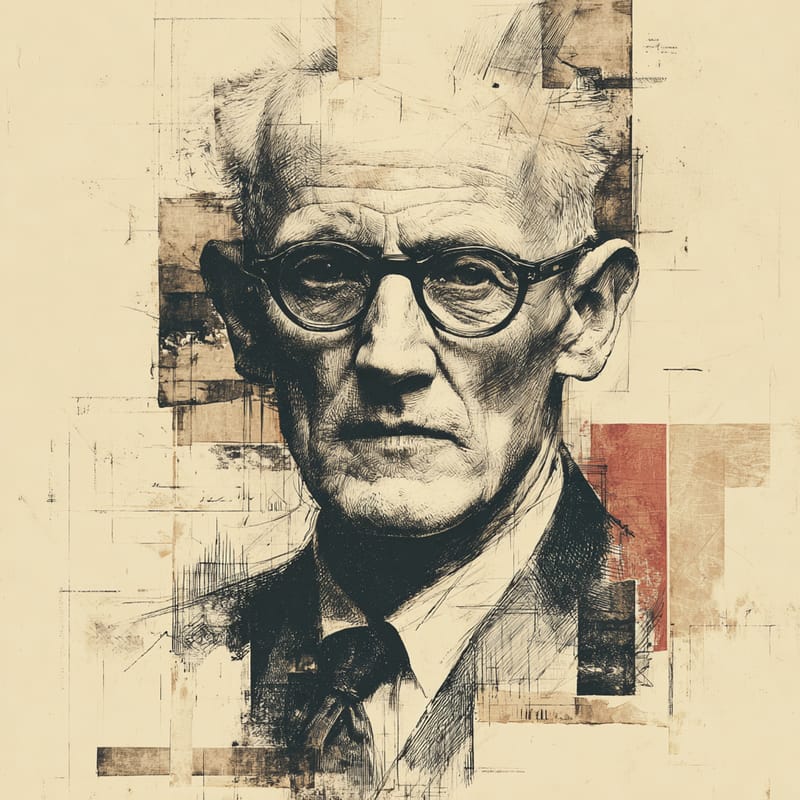
John Hospers
The first Libertarian candidate
Philosophy meets the ballot.
Rooted Minarcho-CapitalistOne of 729 ideologies · enter the Minarcho-Capitalist hall →- Role
- Philosopher & candidate
- Era
- 1918–2011
- Region
- United States
- Social band
- Rooted
- Placement
- +90 · −78 · −14
§ Where John Hospers stands
3 axesHospers defended laissez-faire capitalism on grounds of individual rights. Libertarianism (1971) argued that people are entitled to what they earn through voluntary exchange and that taxing them to fund redistribution takes their property by force, and he carried that programme onto the ballot as the Libertarian Party's first presidential nominee in 1972.
Hospers held that government's only legitimate functions are protecting individuals from force and fraud through police, courts and national defence. Libertarianism (1971) rejected laws that protect people from themselves and laws that compel them to help others, accepting only laws that protect people from one another, and as the Libertarian Party's 1972 nominee he campaigned on that minimal-state platform.
Hospers was a tolerant individualist rather than a cultural radical. Libertarianism (1971) condemned laws against victimless crimes, but it framed liberty around self-reliance, personal responsibility and respect for property rather than any programme of social change, and it treated national defence as a proper duty of government, an outlook rooted in older American individualism rather than the counterculture of his day.
How close are you to John Hospers?
Three statements, one per axis. Answer them and we’ll drop you on the compass next to them.
§ The story
HistoricalJohn Hospers (1918–2011) was an American philosopher and the first presidential candidate of the Libertarian Party. Born in Pella, Iowa, he took his doctorate at Columbia University and became a respected scholar of aesthetics and ethics, author of Meaning and Truth in the Arts (1946) and the widely used textbook An Introduction to Philosophical Analysis (1953). He taught at the University of Minnesota and Brooklyn College before moving to the University of Southern California, where he taught for the rest of his career.
A friend of Ayn Rand in the early 1960s until the two quarrelled, Hospers published Libertarianism: A Political Philosophy for Tomorrow in 1971, one of the first book-length statements of the modern movement. The newly founded Libertarian Party nominated him for president in 1972 with Tonie Nathan as his running mate. On the ballot in only two states, the ticket drew a few thousand votes, but Roger MacBride, a Republican elector from Virginia, cast his electoral vote for it, making Nathan the first woman to receive an electoral vote. Hospers remained a prominent libertarian voice for decades.
Notable for
- 01First Libertarian Party nominee (1972)
- 02'Libertarianism' (1971)
- 03Received an electoral vote
Key works & moments
- 1946Publishes Meaning and Truth in the Arts, establishing his reputation in aesthetics.
- 1953Publishes An Introduction to Philosophical Analysis, a widely used textbook.
- 1971Publishes Libertarianism: A Political Philosophy for Tomorrow.
- 1972Becomes the Libertarian Party's first presidential nominee, with Tonie Nathan as running mate.
- 1972Receives one electoral vote from Roger MacBride, a faithless Republican elector in Virginia.
§ Minds closest to John Hospers
All minds →



§ Also in the Minarcho-Capitalist hall
Enter the hall →The closest minds above are this hall’s whole roster.
§ Common questions
4 answersWhat was John Hospers's political ideology?
John Hospers was a minarchist libertarian who wanted government limited to protecting individuals against force and fraud: on the 99ideologies three-axis compass, a Rooted Minarcho-Capitalist. Economically he sat near the market extreme (+90), defending laissez-faire capitalism and opposing redistribution. On governance he was strongly libertarian (−78), confining the state to police, courts and defence, and socially he leaned mildly traditional (−14), stressing self-reliance and personal responsibility while opposing laws against victimless crimes.
Was John Hospers left-wing or right-wing?
He belonged to the libertarian right. Hospers championed free markets, private property and minimal government, and opposed the welfare state, positions shared with free-market conservatives. But like most libertarians he also rejected state regulation of personal conduct, opposing laws against victimless crimes, which separates libertarianism from social conservatism. His 1972 campaign was one of the first attempts to present that combination as an independent alternative to both major American parties.
Did John Hospers receive an electoral vote?
Yes. In the 1972 presidential election, Hospers and his running mate Tonie Nathan received one electoral vote, cast by Roger MacBride, a Virginia elector pledged to Richard Nixon who chose instead to vote for the Libertarian ticket. The vote made Nathan the first woman in American history to receive an electoral vote. MacBride's gesture made him a hero to the new party, which nominated him for president in 1976.
Which minds are closest to John Hospers?
On the 99ideologies three-axis compass, the minds closest to John Hospers are Tibor Machan (99% alike), The Night-Watchman State (archetype) (97% alike) and Randy Barnett (96% alike). The furthest is Pol Pot (0% alike).